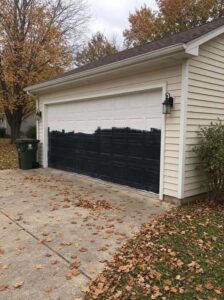
Every morning, my husband and I woke up to find our white garage door covered in fresh black paint. At first, we blamed teenagers. Then we installed cameras, and what we saw changed everything.
For seven nights, someone had been coming to our house after midnight, painting the garage door black, and disappearing before sunrise.
On the eighth night, I finally caught him.
I flung open the front door barefoot, and the cold air struck my face. Beneath the porch light stood a familiar figure, his shoulders hunched against the night, a paint roller dripping black onto the driveway.
My father.
Seventy-three years old, wearing the gray hoodie I had bought him for Christmas, standing two miles from the apartment where he was supposed to be sleeping.
“Dad?” I whispered.
He turned and smiled at me with the same innocent expression he used to wear when I caught him sneaking cookies before dinner.
“Hey, kiddo,” he said. “Go back to bed. I’m almost finished.”
Then he dipped the roller into the paint tray and added, almost casually, “Your mother hates it when this door is white. I have to fix it before she wakes up.”
My knees nearly buckled.
My mother had been dead for nine years.
“Dad, Mom isn’t here,” I said carefully. “She’s been gone a long time.”
His smile disappeared.
For a moment, he stared at me as if I had spoken a language he didn’t understand. Then he looked at the garage door, his expression turning worried.
“Don’t say that,” he whispered. “She’ll hear you.”
My husband, Daniel, appeared behind me and gently took my arm.
“Let’s get him inside,” he murmured.
But my father stepped away from us, gripping the roller as though someone might try to steal it.
“I promised her,” he insisted. “I promised I’d keep it black.”
We eventually persuaded him to come inside. Daniel made coffee while I wrapped a blanket around my father’s trembling shoulders. He sat at our kitchen table, staring at his hands, occasionally glancing toward the window.
I wanted to ask a hundred questions, but I was afraid of the answers.
My father had always been sharp, independent, and stubborn in the way only lifelong carpenters can be. Since my mother’s death, he had lived alone, maintained his little apartment, and refused every suggestion that he needed help.
He had never once mentioned painting our garage door.
And yet, for seven consecutive nights, he had driven across town to do exactly that.
The following morning, I called his doctor. After hearing what had happened, she recommended that he be evaluated as soon as possible. She explained that sudden confusion and memory problems could have several causes, some of which required urgent treatment.
We took him to the hospital that afternoon.
The doctors ran tests, checked his medications, and spoke with him privately. They couldn’t give us every answer immediately, but they warned us not to dismiss his behavior as ordinary forgetfulness.
While my father rested, Daniel and I returned home to inspect the garage.
The paint had begun peeling near the bottom. Beneath the black layers, something caught my attention: a faint outline of a small wooden panel, almost completely concealed by years of paint.
I had never noticed it before.
Daniel fetched a scraper, and together we carefully removed the loose paint. Underneath was a narrow wooden door, its edges swollen with age. It looked like an old access panel that someone had sealed over long ago.
When I was a child, my mother had always forbidden me from playing near that part of the garage.
“Some things are better left alone,” she used to say whenever I asked about it.
I had assumed it was an electrical compartment.
But when Daniel removed the rusted latch, we discovered a small space behind the panel.
Inside lay a yellowed envelope, a faded photograph, and a tiny brass key.
The photograph showed my parents standing in front of our house decades earlier. The garage door was black, just as my father insisted it should be.
On the back, my mother’s handwriting read: For the day you finally remember.
My hands began to shake.
I opened the envelope.
Inside was a letter addressed to my father.
It was dated three months before her death.
The letter explained that my mother had once planned to leave our family home after a terrible argument. Years earlier, my father had secretly sold a piece of land that belonged to both of them, hoping to cover debts he had hidden from her. He had eventually confessed, and although she forgave him, the betrayal left a wound neither of them fully discussed.
They had nearly separated.
Then, one winter evening, my mother asked him to repaint the garage door black. It had been white for years, but black was the color it had been when they first bought the house together.
She told him she wanted to remember the beginning, not the worst thing that had happened between them.
The letter ended with a sentence that made me cry.
If one day you forget everything else, remember that I forgave you. Remember that we chose each other again.
But that wasn’t the only thing in the envelope.
There was another page, written in my father’s handwriting.
It was a list of dates.
Every date corresponded to the anniversary of a difficult moment in their marriage: the day he confessed, the day they reconciled, and the final day they spent together before my mother’s illness became serious.
At the bottom, he had written, Paint it black whenever I forget why she stayed.
I sat on the garage floor and cried.
My father wasn’t simply repainting a door. Somewhere inside his increasingly confused mind, he was trying to preserve the last promise he believed he had made to the woman he loved.
That evening, we visited him at the hospital.
When I showed him the photograph, he stared at it for a long time.
“That’s your mother,” he said softly.
“Yes, Dad.”
“She loved this house.”
“She did.”
He touched the picture with one trembling finger.
“Did I take care of her?”
I swallowed hard.
“You loved her,” I said. “You took care of her in all the ways that mattered.”
Tears gathered in his eyes.
“I keep forgetting things,” he whispered. “Sometimes I wake up and think she’s waiting for me in the kitchen. I know she’s gone, but then I forget again.”
I held his hand and let him cry.
The doctors continued investigating his symptoms, and we began making plans to ensure he wouldn’t have to face them alone. For the first time, my father agreed to accept help.
A week later, when he came home, Daniel and I repainted the garage door with him.
We used black paint.
My father stood beside us, holding the roller with both hands. He couldn’t remember every detail of the letter, and he asked me three times why we were painting the door.
Each time, I told him the same thing.
“Because Mom loved it that way.”
He nodded, satisfied.
When we finished, he stepped back and studied the door beneath the afternoon sunlight.
For a moment, he looked completely like himself.
“Your mother would have liked that,” he said.
Then he turned to me and smiled.
“Come on, kiddo. Let’s go inside. It’s getting cold.”
I followed him into the house, carrying the empty paint tray.
The garage door was black again, but I finally understood that the color had never been the mystery.
It was the promise behind it.
And although I couldn’t stop my father from forgetting pieces of his life, I could help him hold on to the love that had shaped it.
From that night forward, we never let him face the darkness alone.