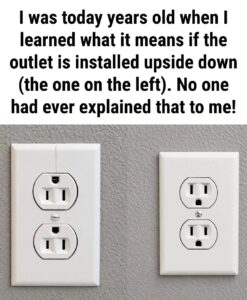
Have you ever walked into a room, glanced at the wall, and noticed an electrical outlet that appears to be installed upside down? Instead of having the ground opening at the bottom, the outlet has it facing upward. At first, you might assume an electrician made a mistake or that someone installed it incorrectly during a renovation.
However, that unusual position may be intentional.
In some homes, electricians install outlets with the ground opening facing upward for practical reasons, including identifying certain electrical configurations or accommodating specific installation requirements. In other cases, the orientation simply reflects the electrician’s preference.
Although the difference may look insignificant, it raises an interesting question: why do some electrical outlets face one direction while others face the opposite way?
The answer involves electrical safety, household lighting, installation practices, and a few common misconceptions about how outlets work.
1. A Visual Signal for a Special Electrical Connection
One commonly cited reason for installing an outlet upside down is to make it visually distinguishable from other outlets.
For example, an electrician might orient an outlet with the ground opening facing upward to indicate that it serves a particular purpose or follows a different wiring arrangement.
This can be useful in buildings where different outlets have different functions. However, it is important to understand that outlet orientation is not a universal code for identifying a particular circuit.
An upside-down outlet does not automatically mean it is connected to a wall switch, supplied by a dedicated circuit, or protected by a specific safety device.
Electrical installations vary, and an outlet’s actual function depends on how it is wired and protected.
Consequently, orientation can provide a clue about the installer’s intentions, but it cannot replace proper testing or inspection.
2. The Connection to Switched Outlets
Another explanation involves switched outlets, which are common in certain older homes.
Before ceiling lights became standard in many living rooms and bedrooms, builders often provided wall switches that controlled lamps plugged into electrical outlets.
This arrangement allowed someone to enter a dark room and turn on a lamp using the wall switch instead of walking across the room to operate it manually.
In some installations, only one half of a duplex outlet is controlled by the switch. The other half remains powered continuously.
For example, the switched half might operate a floor lamp, while the permanently powered half supplies a clock or another household device.
Because electricians sometimes use different outlet orientations to distinguish between particular functions, you may encounter an upside-down outlet in a room with switched lighting.
However, there is an important distinction: an upside-down outlet does not necessarily indicate that it is switched.
The orientation alone cannot establish whether one or both receptacles are controlled by a wall switch. That depends on the actual wiring.
If you want to determine whether an outlet is switched, the safest approach is to use a properly functioning plug-in lamp or another suitable device and operate the relevant wall switches while observing the result.
Do not remove the outlet cover or handle exposed wiring simply to determine its function.
3. Does Electrical Code Require Outlets to Face a Particular Direction?
Many people assume electrical outlets must be installed with the ground opening facing downward.
In the United States, however, the National Electrical Code generally does not require ordinary receptacles to face one particular direction simply because they are installed in a wall.
As a result, both orientations can be found in residential and commercial buildings.
Local electrical codes, building requirements, and the specific circumstances of an installation still matter. Certain locations and specialized installations may have additional requirements, so the rules applicable to one project should not automatically be applied to every other situation.
Electricians may choose an orientation based on their training, local practices, the equipment being installed, or the intended use of the outlet.
That is why two otherwise similar homes can have outlets facing opposite directions without either installation necessarily being incorrect.
The important consideration is whether the receptacle has been installed correctly, securely, and in accordance with the applicable electrical requirements.
4. Can Installing an Outlet Upside Down Improve Safety?
One argument sometimes made in favor of upside-down outlets is that they can reduce certain risks if a plug begins to work its way out of the receptacle.
Consider a grounded plug with three prongs. If the plug becomes partially disconnected, its exposed metal prongs may present a hazard.
With the ground opening facing upward, some people argue that a loose plug or a falling metal object could be more likely to contact the grounding prong first.
The reasoning is that the grounding prong is connected to the equipment grounding system, which is intended to help provide a safe path for fault current under appropriate conditions.
However, this explanation should not be treated as a universal guarantee of safety.
The actual risk depends on the plug design, the receptacle, the object involved, the installation, and the circumstances. An upside-down outlet does not make an electrical installation automatically safer, nor does a correctly installed ground connection eliminate every possible shock or fire hazard.
Proper grounding, suitable electrical protection, secure receptacle installation, and correctly functioning equipment are much more important than orientation alone.
If a plug fits loosely, sparks repeatedly, feels unusually hot, or shows signs of damage, stop using that outlet and have it inspected by a qualified electrician.
5. Why Some Electricians Prefer the Ground Opening at the Top
Electricians sometimes develop preferences based on their training, professional experience, and the types of installations they commonly perform.
For some, positioning the ground opening upward makes it easier to distinguish particular receptacles or maintain a consistent arrangement throughout a building.
Others prefer the traditional orientation, with the ground opening facing downward.
Neither preference should be confused with a universal electrical requirement.
In fact, you might see different orientations in different rooms of the same home, particularly if the property has undergone several renovations over the years.
One electrician may have installed the original outlets, while another may have replaced or added receptacles later.
The result can be a mixture of orientations that looks inconsistent but does not necessarily indicate an electrical problem.
If the installation appears unusual, it is reasonable to ask an electrician why a particular outlet was positioned that way.
6. How to Check Whether Your Outlet Is Controlled by a Wall Switch
If you have noticed an upside-down outlet in your home, you can perform a simple external check to see whether a nearby switch controls it.
Follow these steps:
- Choose a suitable plug-in lamp or another low-risk electrical device that is in good condition.
- Plug the device into the outlet without touching the metal prongs.
- Operate nearby wall switches one at a time, observing whether the device turns on or off.
- If the outlet has two receptacles, test each one separately because they may have different functions.
- If you cannot identify the correct switch, consult the home’s electrical documentation or ask a qualified electrician.
This test can help identify a switched outlet, but it does not establish how the circuit is wired internally or whether the installation meets current requirements.
Never insert tools or other objects into an outlet, remove its cover while it is energized, or attempt to modify the wiring without appropriate qualifications.
If an outlet is damaged, loose, discolored, or producing a burning smell, stop using it and seek professional assistance.
7. What About Outlets in Kitchens, Garages, and Other Locations?
Outlet orientation can also vary according to the installation environment.
In kitchens, garages, workshops, and commercial spaces, receptacles may serve different appliances or specialized equipment. The electrician must consider the applicable electrical requirements, the mounting arrangement, and the intended use.
For example, an outlet installed beneath a countertop may be positioned differently from one mounted on a vertical wall. Receptacles serving particular appliances may also be installed according to equipment instructions or project specifications.
In these cases, the orientation should be evaluated in context rather than judged solely by whether the ground opening faces up or down.
The same principle applies to outlets in older buildings. A different orientation may reflect the original installation practice, a later repair, or the preferences of the electrician who completed the work.
There is no reliable way to identify every outlet’s function simply by looking at its face.
The Real Reason Behind Upside-Down Outlets
An electrical outlet installed with its ground opening facing upward may look unusual, but it is not automatically a mistake.
The orientation may reflect an electrician’s preference, a method of visually distinguishing a particular receptacle, or an installation choice related to the surrounding equipment. In some homes, the outlet may be part of a switched-lighting arrangement, although the direction alone cannot confirm that.
The most important lesson is to separate appearance from function.
If you want to understand why a particular outlet was installed that way, look for practical clues, test it safely using an appropriate device, and consult a qualified electrician if the wiring or installation raises concerns.
The bottom line: Upside-down outlets are not necessarily installed incorrectly, and there is no universal rule requiring every ordinary wall receptacle to face one particular direction. What matters most is correct wiring, proper grounding, suitable protection, and compliance with the electrical requirements that apply to the installation.
The next time you spot an outlet that looks upside down, remember that what appears to be a mistake may simply be a deliberate installation choice—or a detail whose purpose can only be understood by examining the actual wiring.