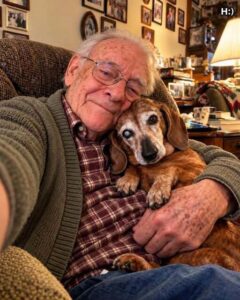
The cashier looked at me as if I had committed a crime.
“Sir, you cannot bring that dog inside, especially if you’re going to carry her around the store.”
I tightened my arms around Daisy, my elderly dachshund. Her little body trembled beneath her soft brown coat, and her cloudy eyes searched for a familiar touch. At fourteen years old, she was almost completely blind, but she still recognized my voice and the sound of my footsteps.
“She can’t see well enough to walk safely through a crowded store,” I explained. “I’ll be quick. She won’t touch anything.”
The cashier shook her head and called the manager.
Within minutes, a tall man wearing a blue apron appeared. He introduced himself as Daniel, the store owner, and listened impatiently as I explained Daisy’s condition.
“I understand she’s old,” he said, “but we have rules. Customers have complained about animals inside.”
“She isn’t bothering anyone,” I replied.
Daniel pointed toward the entrance.
“I’m sorry, sir. You’ll have to leave.”
I felt humiliation burn across my face. Other shoppers watched while I gathered my shopping bag and carried Daisy toward the door.
Outside, I sat on a bench and stroked her ears.
“It’s all right, girl,” I whispered. “We’ll find somewhere else.”
Daisy licked my thumb, completely unaware that we’d just been thrown out of a store.
I had adopted her five months earlier from the county animal shelter. My wife, Helen, had died the previous year after a long battle with cancer, leaving me in a house filled with memories and unbearable silence.
For months, I’d barely spoken to anyone.
Then one afternoon, I visited the shelter to donate Helen’s old blankets. That’s when I saw Daisy curled inside a kennel, her cloudy eyes facing the wall.
The shelter worker explained that her previous owner had died, and nobody wanted to adopt an elderly, blind dog.
I knew what it felt like to be left behind.
So I brought her home.
Since then, Daisy had become my constant companion. She slept beside my bed, followed my voice from room to room, and rested her head on my knee whenever grief overwhelmed me.
That afternoon, however, something unexpected happened.
The store door opened behind me.
“Sir, please wait!”
I turned and saw Daniel hurrying toward us.
His expression had completely changed. The sternness was gone, replaced by shock so profound that he seemed unable to breathe properly.
He stared at Daisy.
Then he crouched in front of her and whispered a name.
“Daisy?”
My little dog lifted her head at the unfamiliar voice.
Daniel’s hands began trembling.
“How long have you had her?” he asked.
“Five months. I adopted her from the county shelter.”
He swallowed hard.
“Her name was Daisy,” he whispered. “She belonged to my sister Margaret, who died last year.”
I stared at him.
“You’re saying this is your sister’s dog?”
He nodded, tears gathering in his eyes.
“Margaret adored her. She took her everywhere. When my sister became ill, she made arrangements for Daisy, but I never knew what happened afterward. I thought she’d been adopted by someone who lived far away.”
Daniel looked at me with an expression I couldn’t understand.
“Would you come inside for a moment? There’s something you need to see.”
I hesitated, remembering how he’d just ordered me out.
He noticed.
“I owe you an apology,” he said. “Please. Let me explain.”
I followed him back inside, carrying Daisy securely against my chest. This time, nobody objected.
Daniel led me into a small office behind the store. He closed the door and reached into a cabinet, pulling out a wooden box decorated with faded flowers.
“My sister left this with me shortly before she died,” he explained. “She told me that if I ever found the person who adopted Daisy, I should give them everything inside.”
My heart began beating faster.
He opened the box.
Inside lay several photographs, a bundle of old letters, and a sealed envelope.
The envelope had my name written across the front.
I recognized the handwriting immediately.
It was Helen’s.
My fingers went numb.
“Where did you get this?” I whispered.
Daniel stared at me.
“You’re Helen’s husband?”
I nodded slowly.
He covered his mouth.
“Oh, my God.”
Then he pulled a photograph from the box and placed it in front of me.
It showed Daisy standing beside my wife in a garden, her front paws resting against Helen’s legs. Helen was smiling broadly, wearing the blue scarf she’d taken with her to every chemotherapy appointment.
I had never seen the photograph before.
“Margaret and Helen became friends at the cancer treatment center,” Daniel explained. “They were both receiving treatment around the same time. My sister told me Helen had a husband she loved very much, but she worried about what would happen to him after she was gone.”
I stared at the picture, struggling to process his words.
Helen had never mentioned Margaret.
Not once.
Daniel pushed the envelope toward me.
“She asked my sister to make sure this reached you when the time was right.”
I carefully broke the seal.
Inside was a letter written in Helen’s familiar, elegant handwriting.
My darling,
If you’re reading this, then somehow Daisy has found her way to you. I hope she’s sitting in your lap as you read these words, because I know how much you need someone to hold.
I met Margaret during treatment. We became friends because we understood something neither of us wanted to admit: loving someone means worrying about what they’ll do when you’re no longer there.
I know you, my love. You’ll tell everyone you’re fine. You’ll keep the house clean, make your coffee every morning, and pretend the silence doesn’t hurt. But I know how deeply you love, and I couldn’t bear the thought of you spending the rest of your life believing that your story ended with mine.
Margaret promised she would help Daisy find you. She knew you would give that little dog a home, and she knew Daisy would give you a reason to get out of bed on the mornings when you didn’t think you could.
Tears blurred the page.
I pressed the letter against my chest.
Helen had known me better than anyone. Even while fighting for her life, she’d been thinking about mine.
But the letter continued.
There’s something else you need to know. I didn’t tell you about Margaret because I wanted to protect you from one more worry while I was ill. She knew something about your past that I only discovered after we became friends.
Before we met, you had a daughter.
I stopped breathing.
My hands began trembling for an entirely different reason.
Twenty-six years earlier, before I married Helen, I’d been engaged to a woman named Susan. We were young, struggling financially, and barely able to take care of ourselves. When Susan told me she was pregnant, I panicked. Our relationship fell apart, and she moved away before I could make things right.
I had tried to find her afterward, but every letter came back unanswered. Eventually, I convinced myself that she’d built a new life and wanted nothing to do with me.
I had never known whether the baby had survived.
Helen’s letter continued.
Margaret knew Susan. They worked together years ago, and she recognized your name when I showed her our wedding photograph. She told me that your daughter was alive.
I pressed a hand over my mouth.
Her name is Emily. She’s an adult now, and she has a family of her own. Margaret tried to reunite you, but Susan asked for time. Before Margaret died, she learned that Emily had begun searching for you.
My love, you have spent so much time believing you lost everyone you ever loved. Please don’t let fear keep you from discovering who’s still out there.
At the bottom of the letter was a telephone number and an address.
Daniel sat quietly while I cried.
For several minutes, I couldn’t speak. Daisy shifted in my arms, then rested her head against my chest.
I felt her warm breath against my shirt.
Helen had given me more than a dog. She had given me a second chance.
Daniel reached across the desk and gently touched my shoulder.
“I’m sorry I sent you out of the store,” he said. “I judged you without knowing anything about you or Daisy.”
I wiped my eyes.
“You couldn’t have known.”
“But I should have listened.”
I nodded.
Then I asked if I could use his telephone.
My fingers shook as I dialed the number from Helen’s letter.
A woman answered after the fourth ring.
“Hello?”
I swallowed.
“Is this Emily?”
“Yes. Who’s calling?”
“My name is David. I think I may be your father.”
Silence followed.
Then I heard a sharp intake of breath.
“Dad?”
One word shattered twenty-six years of uncertainty.
I began to cry again.
We spoke for nearly an hour. Emily told me she’d been searching for me for months. She had a photograph of her mother and an old letter with my name on it, but she hadn’t known where to begin.
She wanted to meet.
And for the first time in years, I had something wonderful to look forward to.
When I finally left the store, Daniel walked us to the entrance and apologized once more. He even offered to help me carry my shopping bags to the car.
I thanked him, then held Daisy close as we stepped into the afternoon sunlight.
That evening, I placed Helen’s letter beside her photograph on the mantel.
Daisy curled up in her usual spot beside me.
I looked down at her cloudy eyes and whispered, “You brought me home, girl. You brought me back to life.”
I had entered that store expecting nothing more than an ordinary afternoon of shopping. Instead, I discovered a friendship my wife had kept secret, a daughter I’d believed I’d lost forever, and a reminder that kindness can reach across years of grief.
Sometimes, the people we lose leave behind gifts we cannot understand until we’re ready to receive them.