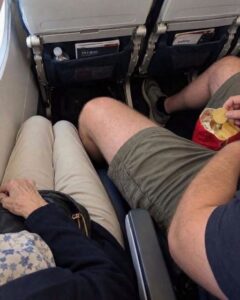
At sixty-one, I boarded the plane carrying excitement and grief in equal measure. I was traveling across the country to meet my first granddaughter, Rose, for the very first time. My daughter had sent me dozens of photographs, and I had already bought a little pink blanket to give the baby. Yet as I settled into my window seat, I couldn’t stop thinking about my late husband, Steven, and how desperately I wished he were sitting beside me.
Steven had dreamed of becoming a grandfather. We had spent years imagining the day our daughter would have a child of her own. Sadly, he died before that dream could become reality. Now, I was making the journey alone, carrying his memory with me.
I placed my handbag beneath the seat in front of me, fastened my seat belt, and looked out the window. I wanted a peaceful flight. I wanted time to think about Steven, read a little, and prepare myself for the wonderful moment when I would finally hold Rose in my arms.
Then the man in the middle seat arrived.
He introduced himself as Josh, placed his backpack overhead, and dropped into his seat with a heavy sigh. He looked to be in his late thirties or early forties, and he was considerably larger than I was.
Within minutes, his knee was pressing against mine.
At first, I assumed he hadn’t noticed. Airplane seats are narrow, and I understood that sharing a row with strangers sometimes required a little patience. I shifted closer to the window to give him more room.
Then his elbow landed on the shared armrest.
I tried to ignore it, but he continued spreading into my space until I could barely sit comfortably.
“Excuse me,” I said politely. “Would you mind giving me a little room?”
Josh glanced at me, chuckled, and pulled his leg away for a few seconds.
“Sorry. I’m a tall guy.”
I nodded and returned my attention to the window.
I didn’t want an argument. I had spent most of my life avoiding confrontation, believing that keeping the peace was usually easier than challenging someone over a small inconvenience.
But this wasn’t a momentary inconvenience.
Within minutes, Josh’s knee was pressing against mine again. His elbow occupied the armrest, and his shoulder leaned toward me whenever he moved.
I shifted my body, crossed my legs, and tried to find a comfortable position. Every adjustment seemed to encourage him to take a little more space.
When the flight attendants began serving drinks, I had to twist awkwardly to reach my cup.
Josh barely noticed.
I looked around the cabin, wondering whether anyone else had noticed what was happening. The passenger across the aisle was reading a magazine. A young woman in the row ahead wore headphones. Everyone seemed absorbed in their own world.
I told myself to endure it.
The flight was scheduled to last nearly four hours. I could manage that, couldn’t I?
As the hours passed, my back began to ache. My shoulder pressed against the window, and my right leg felt cramped from being held in the same position.
Every time I attempted to straighten myself, Josh seemed to reclaim the space.
I considered asking a flight attendant for help, but I felt embarrassed. What if they thought I was being unreasonable? What if Josh became angry and made the rest of the journey even more uncomfortable?
So I remained silent.
At one point, Josh stretched his legs and sighed loudly.
“These seats are ridiculous,” he muttered.
I nearly laughed at the irony. The seats were certainly narrow, but he was the one treating the boundary between us as though it didn’t exist.
I thought about Steven.
He had always been considerate in public. When we traveled together, he made sure I had enough room, offered me the armrest, and asked whether I was comfortable before settling into his own seat.
He used to say that manners were most important when nobody was forcing you to have them.
Remembering those words made me feel both comforted and sad.
Eventually, a flight attendant stopped beside our row to check on the passengers.
She was a woman in her forties with kind eyes and a calm manner.
“Is everything all right here?” she asked.
I looked at her and automatically smiled.
“Yes, thank you. Everything is fine.”
The words came out before I had time to think.
The flight attendant nodded and continued down the aisle.
Josh glanced at me with a satisfied expression before returning to his phone.
I immediately regretted my answer.
Nothing was fine. I was uncomfortable in my own seat, and I had just told the one person who might have helped me that there was no problem.
I closed my eyes and tried to settle my thoughts.
Then, about three hours into the flight, Josh unfastened his seat belt.
“I need to use the restroom,” he announced.
He stood, pulled his bag from the overhead compartment, and stepped into the aisle.
As he walked away, I suddenly realized that I had an opportunity.
For the first time in hours, I could sit upright without someone else’s knee pressing against mine.
I straightened my back, moved my legs into a comfortable position, and took a deep breath.
Then I looked toward the front of the cabin.
The same flight attendant was arranging supplies near the galley.
My heart began beating faster.
I could either remain silent until the plane landed, or I could finally explain what had been happening.
I thought about my daughter waiting at the airport with her newborn. I thought about the long journey ahead of me and how I wanted to arrive feeling excited rather than exhausted.
Most importantly, I thought about how often I had made myself uncomfortable simply because I was afraid of upsetting someone else.
I unfastened my seat belt and stepped into the aisle.
“Excuse me,” I said to the flight attendant. “Could I speak with you privately for a moment?”
She immediately gave me her attention.
“Of course. Is something wrong?”
I explained that the passenger beside me had repeatedly pushed into my seat, despite my asking him to move over. I told her that I had been uncomfortable for most of the flight and had struggled to find a position in which I could sit normally.
She listened without interrupting.
“I’m sorry you’ve had to deal with that,” she said. “Thank you for telling me. Let me see what we can do.”
Her calm response brought tears to my eyes.
I hadn’t realized how much tension I had been carrying until someone finally acknowledged what was happening.
The flight attendant checked the seating arrangements and spoke with another crew member. There were limited options, but they found an available seat elsewhere in the cabin.
“We can move you to a different seat,” she explained. “Would that help?”
“Yes,” I replied immediately. “Thank you.”
She helped me gather my handbag and belongings. I moved to the new seat just as Josh returned from the restroom.
He stopped when he saw my empty space.
“Where did she go?” he asked.
The flight attendant explained that I had been relocated to another seat.
Josh looked irritated.
“Why? I wasn’t doing anything.”
The attendant remained professional.
“She was uncomfortable with the seating arrangement, so we’ve accommodated her elsewhere. Please return to your assigned seat.”
He muttered something under his breath, but the conversation ended there.
I settled into my new seat and fastened my belt.
For the first time in hours, I had enough room to sit comfortably. My shoulders relaxed, and I could finally stretch my legs without worrying about disturbing anyone.
I looked out the window and began to cry quietly.
They weren’t tears of sadness alone. They were tears of relief, frustration, and the strange realization that I had spent so much of my life believing that speaking up was somehow worse than enduring discomfort.
A few minutes later, the flight attendant passed by and asked whether I was comfortable.
“Much better,” I told her.
She smiled.
“You deserve to be comfortable during your flight.”
Those simple words stayed with me.
When the plane finally landed, I collected my belongings and walked through the terminal toward the arrivals area.
My daughter was waiting near the barrier, holding little Rose in her arms.
The moment I saw them, everything else faded away.
My daughter hugged me carefully, and then she placed the baby in my arms.
“Mom, meet your granddaughter.”
I looked down at Rose’s tiny face and felt a wave of love so powerful that I forgot how tired I was.
“Hello, sweetheart,” I whispered. “I’ve been waiting so long to meet you.”
As I held her, I imagined Steven standing beside us, smiling the way he always did when our daughter was little.
I wished he could have been there. I wished he could have held Rose, heard her tiny sounds, and told her the stories he would have repeated a hundred times.
But I knew that the love he had given our family was still present, even in his absence.
Later that evening, after we had settled into my daughter’s home, she asked me about the flight.
I told her what had happened.
She looked horrified.
“Mom, why didn’t you say something sooner?”
I laughed softly.
“Because I didn’t want to make a scene.”
She took my hand.
“You weren’t making a scene. You were asking someone to respect your space.”
Her words echoed what I had slowly begun to understand.
Being polite doesn’t mean allowing someone to disregard your comfort. Avoiding conflict is not always the same as keeping the peace. And asking for help doesn’t make you difficult or unreasonable.
Sometimes, the kindest thing you can do for yourself is speak honestly when something isn’t right.
I still think about that flight occasionally. I don’t know whether Josh ever reconsidered his behavior, and I don’t need to know.
What matters is that I learned something about myself.
For years, I had mistaken silence for strength. I had swallowed discomfort to avoid upsetting other people, even when the situation was unfair.
That day, I finally asked for help.
It didn’t require shouting, arguing, or humiliating anyone. It required only a quiet conversation with someone willing to listen.
And when I arrived at my daughter’s home, I was able to focus on what truly mattered: meeting my granddaughter, celebrating a new generation of our family, and carrying my husband’s memory into a beautiful new chapter of life.
I had boarded that plane feeling the weight of grief.
I stepped off it understanding that I could honor the man I had lost while also learning to stand up for myself.
Sometimes, finding your voice begins with something as simple as asking for a little room to breathe.