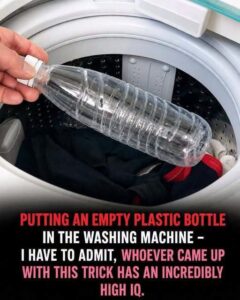
If you have recently seen people putting empty plastic bottles inside their washing machines, you might have wondered whether they have discovered a clever household hack or are simply risking damage to their appliances.
The idea sounds unusual at first. Most people are careful to check their pockets before doing laundry, removing coins, tissues, keys, and anything else that could cause problems during a wash cycle. Yet this viral trick encourages people to place one or two plastic bottles among their clothes.
Supporters claim that the bottles can help laundry move more freely, reduce tangling, and potentially minimize wrinkles. The technique is particularly discussed in connection with bulky items, such as bedsheets, blankets, and large garments that tend to twist around one another during washing.
But does it actually work?
The answer is more complicated than social media videos might suggest.
How the Plastic Bottle Method Is Supposed to Work
The basic idea is that a bottle placed inside the drum moves alongside the laundry as the machine operates. As the drum rotates or the water circulates, the bottle may create additional movement among the fabrics.
People who recommend the trick believe that this movement can help prevent large items from wrapping tightly around each other.
For example, bedsheets sometimes become tangled into a large bundle during a wash cycle. When this happens, other garments can become trapped inside the sheets, making it harder for everything to move independently.
In theory, an additional object moving through the load could help disturb that bundle and encourage the laundry to shift position.
Some people also believe that the bottle’s movement can create more space between garments, allowing water and detergent to circulate more freely.
However, these explanations should be treated as theories rather than established results. Washing machines are designed to move laundry through carefully engineered wash and rinse cycles, and adding an object does not automatically improve that process.
There is no strong scientific evidence establishing that ordinary plastic bottles consistently produce cleaner clothes, prevent wrinkles, or improve washing performance across different machines.
The outcome could depend on several factors, including the machine’s design, the amount of laundry inside the drum, the type of fabric, and how the bottle interacts with the load.
Part 2: Why People Are Particularly Interested in Bulky Laundry
Anyone who regularly washes large bedsheets or duvet covers knows how frustrating it can be to open the washing machine and discover that everything has twisted together.
Bulky laundry presents a challenge because large pieces of fabric can fold, overlap, and become tangled during the wash cycle. The same problem can occur with oversized shirts, lightweight blankets, and other items that easily wrap around one another.
This is why people are drawn to simple solutions that promise to make laundry easier.
Instead of buying a specialized accessory, the plastic bottle trick uses something many households already have. It appears inexpensive, convenient, and easy to try.
The appeal is understandable. People are always looking for ways to save time, reduce wrinkles, and avoid repeating a wash cycle because certain items have not moved properly.
Nevertheless, an inexpensive trick is not necessarily an effective one.
Depending on its shape and the washing machine’s design, a bottle could move harmlessly, interfere with the load, or create additional noise. It might not prevent tangling at all.
The fact that a trick appears to work in one video does not mean it will produce the same result in every household.
Part 3: Can Plastic Bottles Really Reduce Wrinkles?
Wrinkles form for several reasons, including the type of fabric, the way garments are packed into the drum, the spin cycle, and how long wet clothes remain compressed after washing.
When clothes are overloaded into a machine, they have less room to move freely. They may emerge tightly compressed, twisted, or creased.
Some people believe that a plastic bottle can help prevent this by encouraging the fabrics to separate during the cycle.
However, there is no reliable basis for treating the bottle method as a proven wrinkle-reduction technique. Even if a bottle changes the movement of the laundry in a particular load, that does not establish that it will reduce creases.
The fabric itself also matters. Cotton shirts and bedsheets may crease differently from polyester garments, stretchy sportswear, or delicate materials.
A bottle cannot replace appropriate washing settings, sensible load sizes, and proper garment care.
If your main goal is to reduce wrinkles, there are more established methods worth trying first.
Simple Ways to Reduce Laundry Wrinkles
- Avoid overloading the drum. Leave enough room for the clothes to move according to your washing machine’s instructions.
- Separate bulky items when necessary. Washing large sheets or blankets with fewer additional garments may help reduce tangling.
- Choose the correct cycle. Follow the care labels and use a suitable spin speed for the fabric.
- Remove clothes promptly. Leaving wet laundry compressed in the drum can contribute to creasing.
- Shake garments out before drying. A quick shake can help loosen folds and make clothes easier to hang or place in the dryer.
These approaches address common causes of wrinkles without introducing an untested object into the machine.
Part 4: Could Putting a Plastic Bottle in Your Washing Machine Be Dangerous?
This is the most important question to consider before experimenting with the trend.
A lightweight plastic bottle might seem harmless, but washing machines are not designed to accommodate every object that fits inside their drums.
A bottle can become crushed, deform under pressure, or have its cap loosen. Depending on its construction, sharp or damaged edges could potentially catch on fabric. A hard object can also create unusual impacts or noise, particularly during high-speed spinning.
The risks vary according to the bottle, the load, and the appliance. A bottle that causes no obvious problem in one machine might behave differently in another.
There is also a difference between an ordinary drinking-water bottle and a purpose-built laundry accessory. Some commercial laundry products are specifically designed and tested for use in washing machines, while disposable bottles are not.
The safest approach is not to put an ordinary plastic bottle inside your washing machine unless the manufacturer explicitly permits that use.
Check your owner’s manual before trying unfamiliar laundry hacks. If the manufacturer warns against loose objects in the drum, follow that guidance.
Never use a bottle containing liquid, a damaged bottle, or a container with detachable components that could come loose during the cycle. Most importantly, do not assume that a social media demonstration proves a method is safe for your appliance.
Part 5: What About Bottles Used for Other Laundry Tricks?
Not every laundry trend involving a plastic bottle has the same purpose.
Some videos show bottles being used as improvised tools for separating garments, while others demonstrate containers placed near a washing machine or used to organize detergent supplies.
It is important to distinguish between these ideas.
A bottle used to store detergent outside the machine is different from one placed loose inside the drum. Likewise, specialized washing accessories may have a design that makes them suitable for a particular purpose.
If a video claims that a bottle will clean clothes more effectively, remove stains, eliminate odors, or significantly reduce energy consumption, look for credible evidence supporting that specific claim.
A demonstration showing clothes coming out of a machine does not establish that the bottle caused the result. The same outcome might have occurred without it.
For reliable laundry advice, manufacturer instructions and tested product guidance are generally more useful than dramatic before-and-after videos.
Part 6: Better Alternatives for Tangled Sheets and Bulky Clothes
If bedsheets regularly twist into a tight bundle, there are several practical steps you can take without experimenting with loose plastic objects.
First, avoid filling the drum beyond its recommended capacity. Large sheets need sufficient space to move during washing.
Second, consider washing particularly bulky items separately or in smaller loads. Combining a large duvet cover with numerous smaller garments may increase the chance of items becoming wrapped together.
Third, use a cycle appropriate for the fabric and follow the care label. Different machines have different drum movements and settings, so the best option will depend on your appliance.
You can also check whether your washing machine has a dedicated bedding, bulky-items, or reduced-tangling program. Some models offer specialized settings intended to handle larger textiles.
If the problem persists, consult the manufacturer’s troubleshooting advice. Persistent imbalance, unusual banging, or repeated spinning problems may indicate an overloaded drum or another issue that deserves attention.
These simple measures are more dependable starting points than assuming a viral trick will solve every laundry problem.
Final Thoughts: Is the Plastic Bottle Laundry Trick Worth Trying?
The popularity of the empty plastic bottle trick shows how appealing simple household solutions can be. People want cleaner clothes, fewer wrinkles, less tangling, and easier laundry days without spending money on additional products.
Those goals make sense, but an interesting idea is not necessarily a proven technique.
Although a bottle might change how certain items move during a wash cycle, there is insufficient evidence to conclude that ordinary plastic bottles reliably improve cleaning, prevent wrinkles, or protect clothes from tangling.
There are also potential safety and appliance concerns, especially when an object has not been designed for use inside a washing machine.
Before trying the trick, check your appliance’s instructions and consider whether a simpler solution—such as reducing the load size, separating bulky items, or selecting a suitable cycle—would address the problem more reliably.
Sometimes the best household hack is not an unusual new trick. It is understanding how the appliance was designed to work and making a few small adjustments to get the best results.
The bottom line: You do not need to put an empty plastic bottle in your washing machine to achieve good laundry results. When it comes to viral cleaning advice, a little skepticism can save you time, money, and potentially an expensive repair.