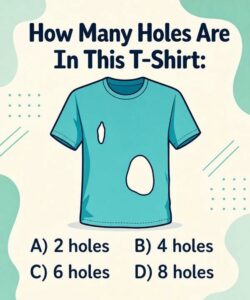
At first glance, counting the holes in a torn T-shirt seems like a simple challenge. You look at the shirt, count the visible tears, and give your answer. Easy, right?
Not quite!
This popular visual puzzle has a clever twist that makes people reconsider their first answers. The trick is to remember that a T-shirt already has openings before it gets damaged. If you count only the torn fabric, you may overlook several important details.
The puzzle’s intended answer is eight holes, but can you figure out how to reach that number before reading the explanation?
Take a moment to imagine a standard short-sleeved T-shirt lying flat in front of you. Look carefully at its neckline, sleeves, bottom edge, and damaged sections. The answer depends on understanding how the puzzle counts each opening.
Why Is This T-Shirt Puzzle So Confusing?
The main reason people struggle with this challenge is that their attention immediately goes to the torn fabric.
When we see damaged clothing, we naturally focus on the unusual parts. Our brains prioritize the visible rips because they appear to be the most important details in the picture.
Meanwhile, the openings that belong to the shirt’s original design are easy to overlook.
Think about it: when was the last time you looked at the neck of a T-shirt and thought, “That’s a hole”?
Most people don’t think that way. They see it as the neckline, just as they see the sleeves and bottom edge as ordinary parts of the garment.
But this puzzle asks you to count openings, not simply tears.
That small difference changes the way you approach the challenge.
Step One: Count the Shirt’s Original Openings
Before examining the damage, begin with the four main openings of a standard T-shirt.
- One neck opening: The opening through which your head passes.
- Two sleeve openings: One at the end of each sleeve, allowing your arms to pass through.
- One bottom opening: The opening at the lower edge of the shirt.
That gives us four openings before we even consider the tears.
Many people forget to include these because they are accustomed to thinking of a hole as damage rather than as a necessary part of an object’s design.
However, under the interpretation used in this puzzle, all four count.
Our running total is now four.
Step Two: Examine the Torn Sections
Now comes the part that makes the puzzle interesting.
The shirt has two damaged sections. If you count only the visible tears, you might assume that there are just two additional holes.
But the intended solution uses a different counting method.
When a tear passes through the fabric, it can create an opening in the front layer and a corresponding opening in the back layer. If the puzzle treats these as separate openings, each tear contributes two.
Therefore:
- First tear: two openings.
- Second tear: two openings.
Together, the damaged sections contribute four additional openings.
Add those four to the shirt’s original four openings, and the calculation becomes:
4 original openings + 4 openings from the tears = 8 holes.
That is how the puzzle reaches its intended answer.
Why Does Counting the Front and Back Matter?
Imagine cutting a small hole through a piece of folded fabric. When you unfold the material, the opening may appear on two different surfaces.
This is why the front and back of a garment can complicate a visual counting puzzle.
However, there is an important detail to remember: the exact number depends on how the damage is shaped and how the puzzle defines a hole. A tear through a single piece of fabric does not automatically mean that every visible edge represents a separate hole.
The intended answer of eight assumes that the two tears each contribute two countable openings.
Without a clear image showing the precise shape and position of the damage, that interpretation cannot be independently confirmed for every version of the puzzle.
The Simple Trick to Solving Similar Puzzles
Whenever you encounter a visual challenge involving holes, openings, or damaged objects, resist the temptation to count only the most obvious details.
Instead, follow three simple steps.
First, identify the object’s original structure. Count the openings or features that existed before any damage occurred.
Second, examine the unusual details. Look at each tear, cut, or opening individually rather than estimating the total at a glance.
Third, check your assumptions. Ask whether the puzzle counts connected openings, separate surfaces, or visible tears. Different definitions can produce different answers.
This approach works for many visual riddles because it forces you to examine the whole object instead of focusing exclusively on the feature that attracts your attention.
Is It True That Only 14% of People Get It Right?
You may see this puzzle accompanied by a claim that only 14% of people solve it correctly.
That figure should be treated cautiously unless it is supported by a reliable study. Without verified research, there is no good reason to assume that exactly 14% of people get the answer right.
Still, the puzzle illustrates an interesting feature of human perception: familiar objects can be surprisingly difficult to analyze when a question encourages us to look at them in an unfamiliar way.
The challenge isn’t necessarily about intelligence. It is about noticing details, interpreting the wording, and understanding the rules being used.
Final Answer: Eight Holes!
Under the puzzle’s intended counting method, the answer is eight:
- Four original openings: the neckline, two sleeves, and bottom.
- Four openings associated with the two tears, counting two per tear.
Total: 4 + 4 = 8 holes.
The real lesson is that sometimes the hardest part of a simple puzzle isn’t doing the arithmetic. It’s recognizing what you should count in the first place.
Next time you see a torn T-shirt, you might never look at it quite the same way again!