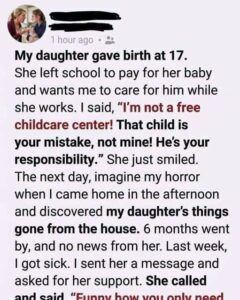
I never imagined that one conversation could change my relationship with my daughter forever.
Her name was Emily, and she was only seventeen when she became a mother. I still remember the afternoon she walked into my kitchen carrying her newborn son, wrapped in a thin blue blanket. Her hair was messy, her eyes were swollen from crying, and her hands trembled as she tried to explain what she needed.
“Mom, I need your help,” she whispered.
I looked up from the dishes.
“What happened?”
She lowered her eyes toward the baby.
“I want to find a job. Maybe finish school later. But I can’t do everything alone right now. Could you please watch him while I get back on my feet?”
I remember the exhaustion in her voice. I remember how tightly she held her baby, as though she was terrified someone might take him away.
And I remember what I said next.
“Emily, I am not a free childcare service. You decided to have a baby, and now you need to take responsibility for your choices.”
The kitchen became silent.
She stared at me as if she had never heard me speak before.
“I’m not asking you to raise him forever,” she said quietly. “I just need some help.”
“I raised you already. I have my own life, and I am not starting over with another baby.”
I believed I was teaching her independence. I thought that if I made things difficult enough, she would learn to stand on her own.
I was so determined to defend my boundaries that I failed to notice my daughter was asking her mother for help.
Emily didn’t shout. She didn’t argue or accuse me of being cruel.
She simply nodded.
“Okay, Mom. I understand.”
She picked up her bag, adjusted the blanket around her son, and walked out of the kitchen.
I watched her leave without following her.
That evening, I told myself I had done the right thing. I reminded myself that raising a child was difficult and that Emily needed to learn responsibility. I convinced myself that helping her too much would only make her dependent on me.
The following morning, I found a folded piece of paper on the kitchen table.
It was a short note.
Mom,
I understand that you have your own life and that you don’t want to raise another child. I’m sorry for asking you to do something you didn’t want to do.
I won’t keep bothering you. You don’t need to worry about visits or phone calls anymore. I’ll figure things out.
I love you.
Emily.
I read it twice.
Then I placed it in a drawer and went to work.
At first, I thought she was being dramatic. I expected her to call within a few days, perhaps after realizing how difficult life with a newborn could be.
But the days passed.
Then the weeks.
I checked my phone more often than I wanted to admit. Whenever it rang, a small part of me hoped it would be Emily.
It never was.
I told myself she was busy. I told myself she was learning to become independent. Whenever someone asked about my daughter, I said she was doing fine.
The truth was that I had no idea how she was doing.
Three months passed before I finally called her.
Her phone rang several times before going to voicemail.
I hung up without leaving a message.
I was afraid she would reject me. I was afraid she would remind me of what I had said. And, most shamefully, I was afraid that apologizing would mean admitting I had been wrong.
So I waited.
Six months after she left, my birthday arrived.
My friends came over for dinner, bringing flowers and a cake. Everyone seemed happy, but I kept glancing toward the front door.
Emily had never forgotten my birthday.
When she was little, she used to make handmade cards covered in glitter and crooked hearts. Even as a teenager, she would find a way to surprise me with something small.
That evening, there was no card.
There was no phone call.
After my guests left, I sat alone at the kitchen table and remembered the note.
For the first time, I wondered whether Emily had not been trying to punish me at all.
Perhaps she had simply believed me.
Perhaps when I told her I wasn’t willing to help, she had accepted that I no longer wanted to be part of her life.
That thought hurt more than I expected.
A year passed.
I heard small pieces of information through relatives. Emily had found a job at a local grocery store. She was renting a modest apartment and trying to complete her education. Her little boy, whom she had named Noah, was growing quickly.
Whenever I heard something about them, I wanted to ask more questions.
But I remained silent.
I told myself that she would reach out when she was ready.
Then, one rainy afternoon, I received a call from my sister, Linda.
“Have you spoken to Emily recently?” she asked.
“No. Why?”
There was a pause.
“She came to see me yesterday. She looked exhausted, but she’s doing her best. Noah is adorable.”
I swallowed.
“Did she say anything about me?”
Linda hesitated.
“She said she misses you.”
My eyes filled with tears.
“Then why doesn’t she call?”
“Because she’s afraid you’ll reject her again.”
Those words landed heavily.
Linda continued gently.
“She didn’t ask me to take care of Noah. She asked whether I knew of anyone who could help her find affordable childcare while she finished her studies. She’s trying to build a stable life for herself and her son.”
I covered my mouth with my hand.
All that time, I had convinced myself Emily wanted too much from me.
But she had been trying to survive.
She hadn’t needed me to solve every problem. She had needed me to listen, to offer guidance, and perhaps to help her find a way forward.
I had confused independence with abandonment.
That evening, I took Emily’s old note from the drawer.
The paper had become soft along the folds.
I read it again, and this time I noticed the words I had ignored before.
I love you.
Even after I had hurt her, she had written that she loved me.
I cried until my eyes burned.
The following morning, I called Linda and asked whether she could pass a message to Emily. I didn’t want to appear at her apartment uninvited or pressure her into forgiving me.
I asked Linda to tell her that I was sorry and that, if Emily wanted to speak with me, I would be ready to listen.
Two days later, my phone rang.
It was Emily.
“Hello, Mom,” she said cautiously.
For a moment, I couldn’t speak.
“Hello, sweetheart.”
Silence settled between us.
Then I took a breath.
“I owe you an apology. When you came to me with Noah, you were frightened and exhausted, and I made you feel like a burden. I was so focused on protecting my time that I didn’t consider how alone you must have felt.”
Her breathing changed.
“I wasn’t asking you to raise him forever,” she whispered.
“I know that now.”
“I just needed my mom.”
Those five words broke something inside me.
“I know, sweetheart. And I’m sorry I wasn’t there for you.”
I didn’t ask her to come home. I didn’t demand visits or insist that she forgive me.
I simply asked whether she would be comfortable meeting me for coffee sometime.
After a long pause, she agreed.
We met the following Saturday at a small café near the park.
When Emily walked in, I barely recognized how much she had changed. She looked older, more serious, and tired in a way that reminded me of myself when I was raising her.
Noah sat in his stroller, watching the world with wide, curious eyes.
I wanted to reach for him immediately, but I waited for Emily to invite me.
She eventually lifted him into my arms.
“He likes people who talk softly,” she explained.
I smiled at him, and he wrapped his tiny fingers around mine.
I felt tears gathering again.
This was my grandson.
I had missed his first smile, his first laugh, and countless ordinary moments that could never be recovered.
But I was grateful for the opportunity to begin again.
Over the following months, Emily and I rebuilt our relationship slowly. I offered help when she wanted it, and we discussed expectations rather than making assumptions. Sometimes I watched Noah while she attended classes, but we agreed on arrangements that respected both her needs and my limits.
I learned that boundaries could be necessary without being cruel. I learned that saying no did not require humiliating someone who was already struggling.
Most importantly, I learned that an apology is not a demand for forgiveness. It is an acknowledgment of the hurt you caused, followed by a willingness to behave differently.
Emily did not forget what happened that afternoon in my kitchen. Trust returned gradually, through small promises kept and honest conversations.
I couldn’t change the day I sent her away.
But I could make different choices afterward.
Today, Noah is old enough to run into my house shouting, “Grandma!” His laughter fills the rooms that once seemed painfully quiet.
Sometimes, when Emily and I sit together after he falls asleep, I think about the woman I was that afternoon.
I still believe parents need boundaries. I still believe young people must learn responsibility. But I no longer believe that teaching independence means refusing compassion.
My daughter needed help, not judgment.
She needed a mother who could listen without turning her fear into a lecture.
And I nearly lost her because I was more concerned with proving a point than protecting our relationship.
If I could speak to the woman I was that day, I would tell her something simple:
You can have boundaries and still be kind. You can say no to a request without saying no to the person. And sometimes, the strongest thing a parent can do is admit that love alone does not make every decision right.
I cannot give Emily back the months we lost.
But I can cherish the time we have now.
And every time my grandson reaches for my hand, I remember that the door I once allowed to close was not beyond repair.
It simply took humility, patience, and the courage to open it again.