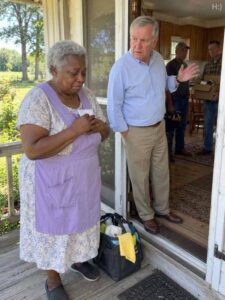
My name is Elnora Ruthanne Whitsett, and I was seventy-two years old when Carlton Lockridge handed me a check for three hundred dollars and told me I was no longer needed.
I had worked for the Lockridge family for twenty-six years. Before me, my mother had served their household for forty-three years. Between the two of us, our family had given nearly seven decades of service to the same home.
But apparently, none of that mattered to Carlton.
His mother, Henrietta Lockridge, had passed away just one week earlier. I had attended her funeral, standing quietly among relatives and neighbors, grieving a woman who had become much more than an employer to me.
For twenty-six years, every Friday morning, I had cleaned her house, prepared her favorite coffee, and shared biscuits with her at the kitchen table.
We talked about everything. Her childhood, my children, our worries, and the little things that made life beautiful.
Henrietta always treated me with kindness.
So when I arrived at the farmhouse after her funeral, I expected Carlton to invite me inside for coffee, just as his mother had always done.
Instead, he remained behind the screen door.
“Elnora, we won’t be needing you anymore,” he said.
I stared at him.
“Is something wrong with the house?”
“No. We’ve decided to handle things differently.”
Then he handed me an envelope.
Inside was a check for $300.
I held it with trembling fingers.
“After twenty-six years, Carlton? Is that really all?”
He looked uncomfortable but quickly straightened his expression.
“That’s what we’ve decided. You can consider it a final payment.”
I wanted to remind him that my mother had worked for his family for forty-three years. I wanted to tell him how many holidays I had sacrificed, how many mornings I had arrived before sunrise, and how often I had stayed late when his mother needed help.
But I couldn’t find the words.
I simply nodded, turned around, and walked toward my little house.
That evening, I sat alone at my kitchen table, staring at the check.
Three hundred dollars.
It wasn’t even enough to cover my monthly expenses.
I had depended on the money from the Lockridge household for years. At seventy-two, finding another regular cleaning job would not be easy.
Yet losing the job wasn’t the only thing hurting me.
I had lost Henrietta, too.
For several days, I barely slept. I kept remembering our Friday conversations and the way she always insisted that I take a few biscuits home.
Then, on the fifth morning after my dismissal, someone knocked on my door.
It was a young woman named Rebecca, Henrietta’s granddaughter.
She looked nervous.
“Miss Elnora, could I come inside? There’s something Grandma wanted me to give you.”
I invited her in and offered her a chair.
Rebecca placed a small wooden box on my table.
“Grandma told me that if anything happened to her, I had to make sure this reached you.”
My heart began beating faster.
I opened the box carefully.
Inside was an old photograph of my mother standing beside Henrietta in the farmhouse garden. Beneath it was a folded envelope with my name written in Henrietta’s familiar handwriting.
I immediately recognized it.
My hands began shaking.
The letter was dated three months before her death.
It read:
“Dear Elnora,
If you are reading this, it means I am no longer sitting across from you at our Friday coffee table. I hope you know how much your friendship has meant to me.
You and your mother gave this family more than years of hard work. You gave us loyalty, kindness, and a friendship that money could never replace.
I have never forgotten the sacrifices your family made for mine.
There is something I want you to know. I have arranged for you to receive something that will help you live comfortably. Please don’t let anyone convince you that you deserve less.
You have earned every bit of happiness coming your way.
With love, Henrietta.”
I couldn’t stop crying.
Rebecca reached across the table and held my hand.
“Grandma talked about you constantly,” she whispered. “She wanted to make sure you were taken care of.”
Then she handed me another envelope.
This one contained a copy of a document prepared by Henrietta’s attorney. It referred to a provision in her estate plan that was intended to benefit me.
I was stunned.
“Does Carlton know about this?” I asked.
Rebecca shook her head.
“I don’t think he knows everything Grandma arranged.”
The following morning, I contacted the attorney whose name appeared on the document.
He asked me to bring the letter and the paperwork to his office.
After reviewing everything, he explained that Henrietta had made arrangements for me through her estate. He would need to verify the documents and review the relevant provisions before discussing the details.
For the first time in days, I felt a little hope.
Two weeks later, I received another phone call.
It was Carlton.
His voice sounded different.
“Elnora, I heard you’ve been talking to my niece and the attorney.”
“Yes,” I replied calmly.
“There’s no reason to make things complicated. My mother was old, and she probably didn’t understand everything she signed.”
I remained silent.
Then he said something that made my stomach tighten.
“I think we should discuss that letter before it becomes a bigger issue.”
I realized he was worried about what his mother had arranged.
I told him that everything would be handled through the attorney.
He ended the call abruptly.
Over the following weeks, the attorney reviewed Henrietta’s estate documents and confirmed that her arrangements were valid. I was informed that I would receive the benefit she had specifically intended for me.
I won’t pretend the money erased the pain of those final days.
It didn’t.
But it gave me something I desperately needed: security and the knowledge that Henrietta had remembered me.
A month later, I returned to the farmhouse for the first time since Carlton dismissed me.
He opened the door and looked surprised.
I wasn’t there to ask for my job back or argue about the three hundred dollars.
I had come to collect the last few belongings I had left in the house.
As I walked through the kitchen, I noticed our old coffee cups sitting on the shelf.
For a moment, I could almost hear Henrietta laughing.
Carlton stood behind me.
“Mother always thought very highly of you,” he said quietly.
I looked at him.
“She showed me that, Carlton. That’s something I’ll never forget.”
Then I picked up my belongings and walked out.
I still miss those Friday mornings. I miss the biscuits, the conversations, and the woman who made me feel like family.
But I no longer measure my worth by the way Carlton treated me.
Twenty-six years of loyalty were never worth just three hundred dollars.
Henrietta understood that.
And in the end, her final act of kindness reminded me that sometimes the people who truly appreciate us are not the ones who have the most power.
They are the ones who remember what we have given, even when everyone else has forgotten.