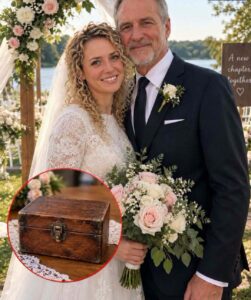
Everyone thought they knew why I married Russell. And honestly, they weren’t entirely wrong.
I was thirty-two, drowning in debt, and terrified that one missed paycheck could ruin my life. Russell was sixty-two, wealthy, widowed, and living in a beautiful house filled with expensive furniture and the financial security I had never experienced.
To outsiders, our relationship seemed simple. A young woman marrying an older man for his fortune.
But nobody knew what happened after the wedding, what Russell whispered to me during quiet evenings, or how deeply he changed my understanding of love.
I met him at a charity dinner where I worked as a server. While carrying champagne through the crowded ballroom, I noticed an elderly gentleman watching me struggle with my uncomfortable shoes.
“Do your feet hurt?” he asked gently.
I was surprised.
Most wealthy guests barely noticed me. Russell was different. He asked my name, thanked me for bringing his drink, and spoke to me as though I mattered.
Three months later, he proposed.
His three adult children were furious, especially his daughter, Marlene.
“She’s after your money, Dad,” she told him.
Russell simply smiled.
“Perhaps you should get to know her before deciding who she is.”
We married despite the criticism.
For the next eight years, I loved him, cared for him, and shared a life I never imagined possible. He never made me feel like an employee or a temporary companion. He treated me as his partner.
But Marlene never accepted me.
Whenever she visited, she made comments about my clothes, my background, and the age difference between Russell and me.
I tried to remain polite.
Russell always defended me.
Then, when he was seventy, his health began deteriorating.
I spent countless nights beside his hospital bed, holding his hand and hoping he would recover.
One evening, he squeezed my fingers.
“Promise me something,” he whispered.
“Anything.”
“When I’m gone, don’t let anyone convince you that you didn’t belong in my life.”
I began crying.
“Please don’t talk like that.”
He smiled weakly.
“There’s something you still don’t know. My lawyer will explain when the time comes.”
I didn’t understand what he meant.
Three weeks later, Russell passed away peacefully.
His funeral was attended by relatives, business associates, and old friends. Marlene barely acknowledged me. During the service, she sat beside her brothers, whispering whenever she thought nobody was watching.
Two days later, Russell’s attorney contacted me.
He asked me to visit his office because Russell had left specific instructions concerning a personal matter.
When I arrived, the lawyer greeted me and placed a small wooden box on his desk.
“This belonged to your husband,” he explained. “He specifically requested that I give it to you after his death.”
I stared at the box.
It was old, beautifully carved, and secured with a small brass clasp.
“What’s inside?” I asked.
“That is something you should discover yourself.”
I opened it carefully.
Inside were dozens of photographs, handwritten letters, and a small velvet pouch.
The first photograph showed Russell standing beside a young woman outside a modest house.
I recognized her immediately.
It was me.
But the photograph had been taken almost ten years before we met.
My hands began trembling.
Beneath it was a letter addressed to Russell.
I unfolded it and started reading.
The letter explained that Russell had quietly supported a charitable organization that helped women struggling with housing, education, and financial difficulties.
The organization had once helped my mother when I was a teenager.
I remembered those difficult years. My mother had received assistance after losing her job, but I had never known who funded the program.
Then I discovered something even more surprising.
Russell had first seen my name in a collection of old photographs and documents connected to the organization. He had recognized my family name when we met at the charity dinner.
But he hadn’t approached me because of my circumstances.
The lawyer interrupted my thoughts.
“There’s more,” he said.
He handed me another envelope.
Inside was a letter written in Russell’s handwriting.
“My dearest wife,
If you’re reading this, I am no longer beside you. I want you to understand something important.
I knew people would question our marriage. Some would say you married me for money. Others would say I married you because I was lonely.
But the truth is that you gave me something I thought I had lost forever: a reason to look forward to tomorrow.
I have watched you grow, become confident, and discover your own strength.
I don’t want you to spend your life proving anything to my children or anyone else.
You deserve happiness without asking permission.
The box contains something that will help you understand why I trusted you with my final wishes.
Love always, Russell.”
I couldn’t stop crying.
The lawyer then explained that Russell had established a separate charitable foundation and included me in its future administration.
He had also made specific arrangements for my financial security through his estate plan.
However, there was one final surprise.
Inside the velvet pouch was a small silver key.
The lawyer explained that it opened a safe deposit box containing additional documents and a recording Russell had made shortly before his death.
I visited the bank the following morning.
Inside the safe deposit box was a flash drive and another handwritten note.
When I watched the recording, Russell appeared on the screen, sitting in his favorite chair.
He looked tired but smiled when the video began.
“If you’re watching this, I hope you’re doing well,” he said.
“I want you to know that marrying you was never about buying companionship. You made the final years of my life beautiful. Don’t let anyone rewrite our story.”
He paused.
Then he mentioned Marlene.
“Please don’t hate my children. They are afraid of losing what they believe belongs to them. But I hope one day they understand that love cannot be measured by inheritance.”
I watched the recording three times.
For the first time since Russell’s death, I felt as though he was speaking directly to me.
When Marlene learned about the foundation and the arrangements, she contacted me immediately.
She accused me of manipulating her father.
I calmly explained that everything had been prepared legally through his attorney.
She threatened to challenge the estate, but the lawyer confirmed that the relevant documents had been properly executed and that any dispute would have to follow the legal process.
I didn’t argue with her.
I didn’t need to.
Russell had left me more than financial security.
He had left me proof that our relationship had been real, despite what everyone believed.
Today, I still keep the wooden box in my bedroom.
Sometimes I open it and look at the photographs.
People once believed I married Russell because I wanted his money.
But they never understood the kindness behind our relationship.
I was thirty-two when I met him, frightened about my future and uncertain about my worth.
He was sixty-two, wealthy, and surrounded by people who wanted something from him.
Somehow, we found something neither of us had expected.
Love.
And when his lawyer handed me that little wooden box, I discovered that the greatest thing Russell had left behind wasn’t his fortune.
It was the truth about the life we shared.