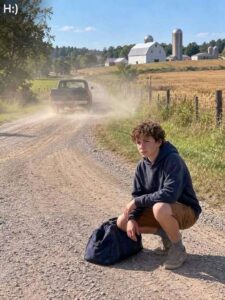
I was thirteen years old when my father decided I was no longer his responsibility.
I still remember that afternoon clearly. The sky was gray, the road was empty, and the only sound was the engine of my father’s old pickup truck. My duffel bag lay in the dirt beside me. I stood there, confused and frightened, watching him grip the steering wheel.
“Maybe walking home will teach you something,” Ray Whitfield said.
Then he drove away.
I watched the truck disappear around a bend, leaving a cloud of dust behind it. For several seconds, I couldn’t move. I honestly believed he would turn around. I thought he was trying to scare me, that perhaps he would come back once he realized how terrified I was.
But he never returned.
My mother had died five years earlier, when I was only eight. After her death, my father changed. He became impatient, angry, and increasingly cruel. Nothing I did seemed good enough. I learned to stay quiet, avoid arguments, and never ask him for anything.
That afternoon, however, something inside me finally broke.
I started walking.
The road stretched through empty fields and patches of woodland. I had no money, no phone, and no idea how far I was from home. My shoes filled with dust, and my shoulders hurt from carrying the bag.
Nearly two hours later, I reached a small gas station.
A woman working behind the counter noticed me standing near the entrance. She immediately understood that something was wrong.
“Sweetheart, are you lost?”
I tried to answer, but my voice cracked. She brought me a bottle of water, sat me down, and allowed me to use the store telephone.
I called my aunt Diane.
When she arrived, she didn’t ask questions. She simply opened her arms and hugged me.
“You’re safe now,” she whispered. “And you’ll never have to beg for a place to belong again.”
Those words stayed with me for the rest of my life.
Aunt Diane took me home and eventually became the parent I needed. She helped me finish school, encouraged me to attend college, and supported me when I decided to start my own heating and air-conditioning business.
It wasn’t easy. There were difficult years, unpaid invoices, broken equipment, and moments when I wondered whether I had made the right decision. But Diane never stopped believing in me.
I built a successful business, purchased my own house, and created a life where nobody could make me feel unwanted.
My father, meanwhile, disappeared from my world.
Eighteen years passed without a single conversation.
I occasionally heard updates through distant relatives. Ray had remarried and had another daughter, Megan. From what I understood, he had built a new family and rarely mentioned me.
I eventually stopped expecting an apology.
Then, one Tuesday morning, an ivory-colored wedding invitation arrived in my mailbox.
It was from Megan.
My younger half-sister was getting married, and apparently, someone had decided I should be invited.
I stared at the envelope for several minutes. I barely knew Megan, and I wasn’t sure whether attending would bring back memories I had spent years trying to forget.
I almost threw the invitation away.
But when I opened the envelope, another one slipped onto the kitchen table.
It was smaller, yellowed with age, and clearly much older than the wedding invitation.
My heart stopped when I recognized the handwriting.
It belonged to my mother.
Across the front were five carefully written words:
“Thomas, please read this first.”
My hands began shaking.
I hadn’t seen my mother’s handwriting in eighteen years. I remembered the birthday cards she used to write, the notes she left in my lunchbox, and the little messages she tucked beneath my pillow when I was sick.
I sat down and carefully opened the envelope.
Inside was a letter written on several sheets of faded paper. The first sentence made my stomach tighten.
“Thomas, if you’re reading this, then something happened that I desperately hoped you would never have to experience.”
I continued reading.
My mother explained that before she became seriously ill, she had discovered troubling things about Ray. He had been hiding financial problems and making decisions that could affect the family’s future. She had also become concerned about the way he treated me whenever she wasn’t around.
She wrote that she had tried to protect me, but she knew she might not be there forever.
Then I reached a paragraph that changed everything.
My mother revealed that she had arranged for Aunt Diane to become my legal guardian if anything happened to her and Ray proved unable to care for me safely. She had also left important documents with Diane, including information about a financial account intended for my education and future.
I read the paragraph twice.
I had always believed Diane had simply stepped in because she felt sorry for me. But my mother had planned for my safety long before that terrible afternoon on the dirt road.
There was more.
The letter explained that Ray had known about the arrangements. He had promised my mother he would respect her wishes, but after her death, he had become increasingly determined to control everything she had left behind.
My mother ended the letter with a sentence that brought tears to my eyes.
“Never believe that you were difficult to love, Thomas. If someone makes you feel unwanted, remember that their failure to love you properly is not proof that you are unworthy of love.”
I put the letter down and covered my face.
For eighteen years, I had carried the memory of that dirt road. Somewhere deep inside, a thirteen-year-old boy had continued wondering what he had done to deserve being abandoned.
Now, for the first time, I understood that my mother had never blamed me.
I immediately called Aunt Diane.
When I told her about the letter, she went quiet.
After a long pause, she said, “I wondered when you would finally find it.”
I asked her what she meant.
She explained that my mother had given her several sealed documents before she passed away. Diane had kept them safe, waiting until I was old enough to understand everything. She also confirmed that the financial arrangements described in the letter were real.
But there was one more thing she had never told me.
Ray had contacted her several times after abandoning me, asking whether she would send me back. Diane refused. She had also kept records of those conversations and the legal paperwork that followed.
Suddenly, the wedding invitation felt different.
I wasn’t sure whether Megan knew anything about our family’s history. I didn’t want to punish her for decisions made by our father. She was my sister, even if we had grown up in completely different worlds.
But I also knew I couldn’t simply walk into that wedding pretending nothing had happened.
I called Megan.
She sounded surprised when she heard my voice. We spoke awkwardly at first, exchanging polite questions about work and family.
Eventually, I asked whether she knew why our father had invited me.
There was a long silence.
Then Megan said, “Dad told me you stopped talking to him because you were angry about Mom’s death. He said you blamed him for everything.”
I closed my eyes.
That was the story he had told her.
I explained what had happened when I was thirteen. I told her about the dirt road, the gas station, and Aunt Diane taking me in.
Megan began crying.
“I didn’t know,” she whispered. “He never told me that.”
I didn’t ask her to choose sides. I simply told her that if she wanted a relationship with me, it would have to be based on honesty.
A few days later, I received another call.
This time, it was Ray.
His voice sounded older, but the confidence was still there.
“So you’ve read the letter,” he said.
I couldn’t believe how casually he spoke.
“Yes,” I answered. “I have.”
He began explaining that the past was complicated, that he had been under pressure, and that I needed to understand how difficult things had been after my mother’s death.
I listened without interrupting.
Then I said something I had waited eighteen years to say.
“I was thirteen, Dad. I was a child. You were supposed to protect me.”
He didn’t respond.
For once, I wasn’t the one searching for an explanation.
I told him I wasn’t ready to forgive him and that I wouldn’t pretend the past had never happened. If he wanted any relationship with me, he would need to take responsibility for what he had done.
Then I ended the call.
I eventually attended Megan’s wedding. I went for her, not for Ray. Aunt Diane sat beside me, and when the ceremony ended, Megan hugged me tightly.
For the first time, I felt that perhaps something good could come from a painful family history.
I still have my mother’s letter.
It sits in a wooden box in my office, beside an old photograph of her holding me as a little boy.
I keep it there because it reminds me of something I spent too many years forgetting.
Being abandoned does not mean you are unlovable.
Sometimes, the people who are supposed to protect us fail. But that doesn’t mean our story ends with their failure.
My father left me on a dirt road when I was thirteen.
Eighteen years later, my mother’s words finally helped me find my way home.