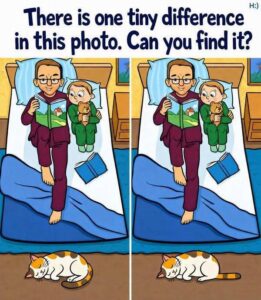
At first glance, these two cozy illustrations look almost exactly the same. They show a peaceful family moment featuring a father wearing glasses, sitting beside his young child while reading a storybook. The child is holding a soft teddy bear, and a relaxed cat is sleeping nearby.
Everything seems perfectly ordinary.
But there is one small difference hidden somewhere in the pictures.
It might be an object that has changed, a tiny detail that has disappeared, or something that looks slightly different from the original illustration.
Think you have sharp eyes?
Take a closer look before reading further. The challenge may sound easy, but finding a single hidden difference can be surprisingly difficult.
1. Start With the Main Characters
The best way to solve a spot-the-difference puzzle is to examine the picture systematically.
Rather than looking at both illustrations as a whole, divide the scene into smaller sections.
Start with the father.
Look carefully at his glasses, facial features, hairstyle, clothing, and the book he is holding.
Are the glasses identical in both pictures? Does the book have the same appearance? Is there a small change in the way his hands are positioned?
Even a tiny adjustment can be the detail you are searching for.
Next, move your attention toward the child.
The teddy bear is another important area to inspect. Look at its ears, arms, facial expression, and position.
Sometimes puzzle creators make changes so subtle that people overlook them even after examining the same area several times.
2. Pay Attention to the Small Details
One of the biggest mistakes people make when solving these puzzles is concentrating only on the largest objects.
The father, child, and teddy bear naturally attract attention because they occupy the center of the illustration.
However, the hidden difference could be something much smaller.
Look for changes involving:
-
The shape of an object.
-
A missing line or decorative detail.
-
A different color or pattern.
-
A slightly altered position.
-
An additional or missing element.
-
A small change in the characters’ appearance.
Try comparing the same objects in both pictures rather than switching randomly between different areas.
This makes it easier to notice details that your eyes might otherwise ignore.
3. Don’t Forget the Sleeping Cat
The sleeping cat might seem like an unimportant background detail, but it deserves special attention.
Look at its ears, paws, tail, and sleeping position.
Does the cat look exactly the same in both illustrations?
Also examine the surface beneath it.
Small changes around animals and background objects are particularly easy to miss because people naturally focus on the main characters.
If you haven’t found the difference yet, this is a good moment to slow down and inspect the surrounding area.
4. Examine the Furniture and Background
Now move your attention away from the family.
Look at the furniture, pillows, floor, and other objects surrounding the characters.
Compare the shapes and positions of individual items.
Sometimes a hidden difference involves something that seems completely unimportant, such as a small decorative feature or an object that appears in only one picture.
A useful technique is to scan the illustrations from left to right.
Start at the top, move through the middle, and finish at the bottom.
This prevents you from repeatedly checking the same areas while overlooking others.
5. Give Yourself a 30-Second Challenge
Want to make the puzzle more exciting?
Set a timer for thirty seconds and challenge yourself to find the difference before the time runs out.
Try these simple rules:
-
Look at both illustrations simultaneously.
-
Examine the main characters first.
-
Compare the teddy bear and sleeping cat.
-
Inspect the furniture and background.
-
Make your final guess before the timer ends.
You can also challenge a friend, family member, or child.
Ask everyone to find the difference without giving hints.
The first person to identify the correct detail wins!
6. Why Are Spot-the-Difference Puzzles So Popular?
These visual challenges are popular because they combine entertainment with careful observation.
They encourage people to slow down, compare details, and pay attention to things they might normally overlook.
For children, they can provide an enjoyable way to practice visual recognition and concentration.
For adults, they offer a relaxing break from everyday responsibilities.
They are also a wonderful activity for families because everyone can participate, regardless of age.
You don’t need special equipment, complicated instructions, or extensive preparation.
All you need is a picture, a little patience, and a willingness to look closely.
7. Still Can’t Find It? Try Looking Again!
If you haven’t spotted the hidden difference, don’t give up.
Take your eyes away from the pictures for a few seconds before looking again.
Sometimes staring at the same illustration for too long makes it harder to recognize small changes.
A short break can help you notice something that was obvious all along.
You can also cover part of each illustration and compare the remaining sections individually.
This technique reduces distractions and makes the search more manageable.
Remember, the goal isn’t simply to finish quickly. The real enjoyment comes from discovering the tiny detail that everyone else might have missed.
The Final Challenge: Did You Find It?
Before moving on, take one last look at the two cozy family illustrations.
Check the father’s glasses, the child’s teddy bear, the sleeping cat, and every little detail in the background.
Have you discovered what changed?
If you found it without any help, congratulations! You have successfully completed the challenge.
If not, don’t feel discouraged. Some differences are deliberately designed to blend into an otherwise familiar scene.
The best part of these puzzles is that even the smallest detail can make the biggest difference. Share the challenge with someone you know and see who has the sharpest eyes!