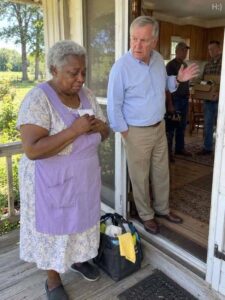
My name is Elnora Ruthanne Whitsett, and I was seventy-two years old when Carlton Lockridge handed me a check for three hundred dollars and told me I was no longer needed.
I had worked for the Lockridge family for twenty-six years.
My mother had worked for them for forty-three years before me. Between the two of us, our family had served the Lockridges for nearly seven decades.
But apparently, none of that mattered to Carlton.
His mother, Henrietta, had passed away three days earlier. I had attended her funeral wearing my best black dress, carrying a small bouquet of white flowers, and trying to hold back tears.
Henrietta had never treated me like an ordinary employee.
She was the woman who remembered my birthday, asked about my grandchildren, and always made sure I took home something from her kitchen.
Every Friday, we shared coffee and biscuits while I cleaned her farmhouse.
We talked about our families, our disappointments, our dreams, and the little things that made life worth living.
Sometimes she would hold my hand and say, “Elnora, I don’t know what I would do without you.”
I always laughed.
“You’re not getting rid of me that easily, Miss Henrietta.”
But now she was gone.
And her son was standing behind the screen door, holding a check.
“We’ve decided we don’t need you anymore,” Carlton said.
I stared at him.
“Excuse me?”
“The house will be handled differently. Here’s your final payment.”
He pushed the check toward me.
Three hundred dollars.
I looked at the amount, then back at his face.
“After twenty-six years?”
He shrugged.
“Mother is gone. Things have changed.”
I wanted to remind him that I had cleaned his mother’s home through illnesses, storms, family celebrations, and countless difficult years.
I wanted to tell him that I had never abandoned her when she needed help.
But I said nothing.
I took the check with trembling fingers and walked back to my little house on the property.
That evening, I sat alone at my kitchen table.
I had seventy-two years behind me, very little savings, and no idea how I would replace the income I had depended on for so long.
I cried for Henrietta.
I cried for myself.
And I wondered whether twenty-six years of loyalty could really be worth only three hundred dollars.
The following morning, something unexpected happened.
At approximately nine o’clock, a dark blue car pulled into the driveway.
A woman stepped out carrying a leather briefcase.
She introduced herself as Margaret Ellis, an attorney from Columbia.
“Are you Elnora Whitsett?” she asked.
I nodded.
“Mrs. Lockridge asked me to find you.”
My heart began racing.
“Henrietta?”
Margaret smiled gently.
“Yes. Before she passed away, she left specific instructions concerning you.”
I invited her inside.
She placed her briefcase on the table and removed a thick envelope.
“Mrs. Lockridge wanted you to receive this personally, but only after her funeral.”
I looked at the envelope.
My name was written across the front in Henrietta’s familiar handwriting.
I recognized the way she formed the letter E.
My eyes immediately filled with tears.
“May I open it?”
“Of course.”
Inside was a handwritten letter and several official documents.
The first sentence made my hands shake.
My dearest Elnora, if you’re reading this, then I have finally gone where you cannot follow me.
I stopped reading.
Margaret gently placed a hand on my shoulder.
I continued.
I know Carlton has probably told you that your services are no longer required. I am sorry, sweetheart. I should have made certain you were protected before I left.
I wiped my eyes.
The letter continued.
You have given this family twenty-six years of your life. Your mother gave us forty-three years before that. I have never forgotten what either of you sacrificed.
But there is something you don’t know about the little house where you live.
I looked up.
Margaret opened one of the documents.
“Mrs. Lockridge made arrangements concerning your home.”
My heart began pounding.
“What arrangements?”
Margaret explained that the small house where I had lived for twenty-six years was part of the Lockridge property.
Henrietta had spent several years working with her attorney to ensure that I would not suddenly lose my home after her death.
According to the documents, she had established a legal arrangement intended to transfer ownership of the cottage to me.
I stared at Margaret.
“She wanted me to own the house?”
“Yes. And she also made financial provisions for you.”
I couldn’t speak.
Margaret showed me another document.
It outlined a separate financial gift that Henrietta had arranged through her estate.
The amount was far more than I had ever imagined.
But before I could understand everything, Margaret asked another question.
“Has Carlton told you anything about the property?”
I shook my head.
“He only gave me three hundred dollars and said he didn’t need me anymore.”
Margaret nodded.
“Then we need to discuss something else.”
She explained that Carlton had recently begun making arrangements to sell portions of the family property.
He had apparently assumed that the cottage and surrounding land would automatically become his after his mother’s death.
However, Henrietta had signed legal documents before she passed away.
Those documents needed to be respected.
And my cottage was included.
I looked toward the window.
For twenty-six years, I had thought of that little house as a place I was allowed to occupy because I worked for the family.
I had never imagined Henrietta wanted it to become mine.
Then Margaret handed me the second letter.
“This one is addressed to Carlton.”
I hesitated.
“Should I read it?”
Margaret explained that she could summarize the relevant provisions, but the letter had been left for her son.
I decided to read only the portion Henrietta had specifically mentioned in her instructions to me.
It began:
Carlton, I know you believe everything on this property belongs to you. But ownership is not the same as entitlement.
My breath caught.
Elnora and her mother gave this family decades of kindness, patience, and hard work. They never asked for anything beyond fair treatment.
If you dismiss her without understanding what I have arranged, you will reveal exactly how little you understood about the people who helped build this family.
I put the letter down.
For the first time since the funeral, I felt that Henrietta was still standing beside me.
Margaret explained that the next step would be to review the estate documents and arrange the necessary property transfers.
I agreed.
But I didn’t want revenge.
I simply wanted to know that the woman I had loved as a friend had not forgotten me.
Two days later, Carlton arrived at my cottage.
He looked angry.
“What is this nonsense about the house?”
I was sitting on the porch with a cup of coffee.
“What do you mean?”
“Margaret says Mother left you the cottage.”
I looked at him calmly.
“That’s what she told me.”
He shook his head.
“That property has belonged to my family for generations.”
I set down my cup.
“Your mother made her decision, Carlton.”
He laughed.
“She was old. She probably didn’t understand what she was signing.”
I felt something tighten inside me.
“Your mother understood more than you think.”
He stepped closer.
“Listen, Elnora. I’ll give you another five hundred dollars. You can find somewhere else to live, and we can forget all this.”
I stared at him.
Twenty-six years of work.
A lifetime of memories.
And now he was trying to buy my silence for another five hundred dollars.
“No, Carlton.”
His face turned red.
“What?”
“I am not selling my home because you’re uncomfortable with your mother’s wishes.”
He stared at me for several seconds.
Then he walked away.
The following weeks were difficult.
Carlton challenged parts of the estate arrangement, claiming his mother had made decisions that were unfair to him.
But Margaret had anticipated the possibility.
Henrietta had worked with independent legal advisers, and the documents were supported by the required records.
The estate review continued.
During that time, I discovered something else.
Henrietta had kept a small notebook for many years.
It contained handwritten entries about the people who had worked on her property.
My mother’s name appeared throughout the older pages.
My name appeared in the later ones.
Beside each entry, Henrietta had written little observations.
Elnora stayed late when I was ill.
Elnora brought soup when the roads were covered in snow.
Elnora remembered my husband’s birthday.
One entry made me cry.
I hope Elnora understands that she is family to me, even if the world insists on calling her an employee.
I held that notebook against my chest.
That was worth more than any check.
Eventually, the estate arrangements were reviewed and the cottage was legally transferred according to Henrietta’s instructions.
The financial gift was also distributed through the estate.
I was finally able to stop worrying about whether I would have a roof over my head.
I repaired the porch, replaced the old kitchen windows, and planted flowers along the fence.
I kept the little wooden table where Henrietta and I used to drink coffee.
Every Friday, I still made two cups.
Sometimes I sat alone and remembered our conversations.
Sometimes I invited my grandchildren over and told them stories about the wonderful woman who had changed my life.
Carlton eventually stopped visiting.
I heard that he had sold some of the remaining family property, but I no longer paid attention to his decisions.
He had his inheritance.
I had my home.
And I had something he could never take away.
One afternoon, Margaret visited again.
She brought a small package that Henrietta had left with her.
Inside was a photograph of the two of us sitting on the farmhouse porch.
On the back, Henrietta had written:
To Elnora, who gave me more than a clean house. Thank you for giving me friendship.
I cried when I read it.
Then I placed the photograph beside the kitchen window.
I had spent most of my life believing that loyalty meant continuing to serve people, even when they didn’t appreciate what I gave.
Henrietta taught me something different.
Real kindness remembers.
Real friendship respects.
And real generosity doesn’t wait until someone is too old or too tired to ask for what they deserve.
I was seventy-two years old when Carlton handed me that three-hundred-dollar check.
I thought he was ending my story.
But he was only closing a chapter that had already reached its conclusion.
The woman who had cleaned the Lockridge farmhouse for twenty-six years finally had a home of her own.
And every Friday morning, when sunlight falls across my little kitchen table, I remember Henrietta’s words.
“You’re not just someone who works for me, Elnora. You’re someone I am grateful to know.”
I never needed Carlton’s approval, his money, or his gratitude. I only needed the truth about what Henrietta had intended. She had remembered twenty-six years of kindness, even when her own son had forgotten what kindness meant.