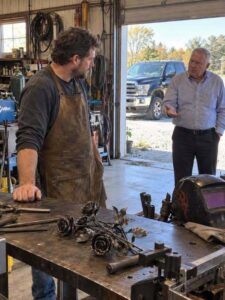
My name is Will Mercer, and I was thirty-one years old when my younger sister told me I wasn’t welcome at her wedding.
I never imagined those words would come from Sydney.
We had grown up together in a small Kentucky town, raised by a father who believed hard work mattered more than money, appearances, or social status. After our mother passed away, it was mostly the three of us. Dad worked long hours, and I helped wherever I could.
When Dad died, I inherited his old workshop, his tools, and the Lincoln welding machine he had owned for more than thirty years. I eventually turned the place into a small welding business outside Georgetown.
My hands were rarely clean. There was almost always grease beneath my fingernails, a small burn on one finger, or a dark stain on my work clothes. But I was proud of what those hands could create.
Sydney had always been different. She was ambitious, fashionable, and determined to build a life far beyond our little hometown. I supported her every step of the way.
So when she announced her engagement to Preston Whitaker, the son of a wealthy construction businessman, I was genuinely happy for her.
Preston’s family owned several successful construction companies. They lived in a beautiful home, attended expensive events, and moved in circles I had never been part of.
Sydney seemed thrilled with her new world.
A few weeks after the engagement, she called me with a special request.
“Will, would you build something for my wedding?”
I immediately said yes.
She wanted a large steel wedding arch decorated with dogwood blossoms. She explained that she wanted something unique, something that would look beautiful during the ceremony.
I spent three weekends working on it.
Using Dad’s old Lincoln welding machine, I shaped the steel, carefully polished the structure, and created 208 handmade dogwood blossoms. Each flower represented a memory from our childhood.
Some reminded me of summers at our grandparents’ farm. Others represented the afternoons Dad spent teaching us how to fix things in his workshop.
I even included a small detail near the bottom of the arch: three tiny flowers connected together, representing Dad, Sydney, and me.
I wanted her wedding to have something of our family in it.
When I finally delivered the arch, Sydney was speechless.
She walked around it, touching the flowers and examining the details.
“Will, this is beautiful!”
Then she hugged me.
I told her I wasn’t charging for the work.
On the invoice, I simply wrote:
“No charge for Sid.”
She laughed, wiped away a tear, and told me she loved me.
For a moment, I believed everything was perfect.
Then, eight days before the wedding, my phone rang.
It was Sydney.
Her voice sounded different.
“Will, there’s something I need to discuss with you.”
I immediately sensed trouble.
She explained that Preston had concerns about the wedding guests. His father’s business partners, wealthy friends, and important clients would be attending.
Apparently, Preston didn’t think I would fit in.
I asked what she meant.
She hesitated before answering.
“He thinks your appearance might embarrass us.”
I looked down at my hands. There was a fresh burn mark near my thumb and a dark stain across my palm from a welding project.
Then she said the words that hurt more than anything else.
“I agree with him, Will. I think it would be better if you didn’t attend.”
For several seconds, I couldn’t speak.
I reminded her that I had built the wedding arch she was planning to stand beneath. I had spent three weekends making something special for her, refusing to accept a single dollar.
She responded that the arch was already delivered and that the wedding was about her future.
I asked whether she was seriously banning her own brother because I worked with my hands.
She sighed.
“Please don’t make this harder than it needs to be.”
Then she ended the call.
I sat alone in my workshop for a long time.
The old Lincoln machine stood beside me, its metal surface covered in years of scratches and memories. I remembered Dad teaching me how to weld safely, reminding me that a person’s character mattered more than the clothes they wore.
I wanted to call Sydney again, but I knew there was nothing I could say that would change her mind.
So I decided not to attend.
The following morning, I received a message from Preston.
He thanked me for building the arch and asked whether I could deliver a few additional decorative pieces before the ceremony.
I didn’t respond.
I wasn’t angry about losing a wedding invitation as much as I was hurt by what it represented. My sister had accepted my love, my time, and my work, but apparently not the person who had given them.
Three days later, something unexpected happened.
A large black SUV pulled into my workshop driveway.
A well-dressed older man stepped out. I recognized him immediately from the engagement photographs.
It was Richard Whitaker, Preston’s father.
He walked around the workshop, examining the equipment and the unfinished projects.
“Are you William Mercer?” he asked.
“Yes, sir.”
He introduced himself and explained that he had come to see the wedding arch.
He had heard about the custom steelwork and wanted to meet the person responsible.
I showed him photographs of the finished piece and explained how I had made each flower by hand.
He studied the photographs carefully.
Then he asked whether I had built everything myself.
I nodded.
He looked toward the old Lincoln welding machine.
“Is that your father’s machine?”
I smiled.
“It is. He taught me everything I know on that machine.”
Richard became quiet.
He walked closer to the machine and examined its worn metal casing.
Then he noticed a small engraved nameplate on the side.
His expression changed.
“Where did your father get this machine?”
I explained that Dad had purchased it decades earlier, after working for a local fabrication company.
Richard stared at the nameplate for several seconds.
Then he asked me to tell him my father’s full name.
When I answered, he slowly sat down on a nearby chair.
“Your father was Arthur Mercer?”
I nodded.
Richard looked genuinely shaken.
He explained that he had known my father many years earlier, long before his construction business became successful.
In fact, my father had once helped him during the most difficult period of his career.
Richard had been a young construction contractor working on a major project. A steel fabrication problem threatened to delay the entire job, potentially costing him his business.
My father had volunteered to help.
He worked through several nights, repairing damaged components and creating a solution that allowed the project to continue.
Richard explained that my father had refused additional payment, saying that helping someone in trouble was more important than making a profit.
I had heard Dad mention helping a struggling contractor years earlier, but I had never known the man’s name.
Richard looked around my workshop.
“Your father helped build the foundation of everything I have today,” he said.
I didn’t know what to say.
He then asked why I wasn’t attending Sydney’s wedding.
I hesitated before explaining the conversation.
I told him that Preston believed my dirty hands and working-class appearance would embarrass the family.
Richard’s expression hardened.
He asked whether Sydney had agreed.
I nodded.
For a moment, neither of us spoke.
Finally, Richard stood up.
“William, I need to make something clear. Those hands of yours are nothing to be ashamed of.”
He looked at the wedding arch photographs again.
“Your father helped me when I had almost nothing. And now you’ve created something beautiful for my family without asking for a penny.”
Before leaving, he asked whether I would consider attending the wedding.
I told him that Sydney had already made her decision.
Richard nodded.
“I understand. But I think there are a few things my son needs to learn before he gets married.”
The following afternoon, Preston called me.
His voice was unusually polite.
He apologized for the way he had treated me and asked whether I would reconsider attending the wedding.
I told him I needed time to think.
Then Sydney called.
She was crying.
Apparently, Richard had spoken privately with both her and Preston. He had explained what my father had done for him and why he considered the Mercer family part of his own history.
But more importantly, he had challenged them to think about what kind of people they were becoming.
Sydney admitted that she had been embarrassed by my profession because she wanted to impress Preston’s wealthy friends.
Hearing her say that hurt, but at least she was finally being honest.
I didn’t immediately forgive her.
I told her that I had never expected her to be ashamed of her new life, but I had hoped she would never become ashamed of where she came from.
Eventually, I agreed to attend the wedding.
I wore my best suit, polished my shoes, and left my work boots at home.
But I didn’t hide my hands.
When I arrived, Richard greeted me personally and introduced me to several guests as the brother who had built the wedding arch.
During the ceremony, Sydney stood beneath the 208 dogwood blossoms I had made.
When she looked toward me, her eyes filled with tears.
After the ceremony, she walked over and hugged me.
“I’m sorry, Will,” she whispered.
I held her for a moment.
I didn’t tell her everything was forgotten. Some wounds take longer than one apology to heal.
But I told her I loved her.
As I looked at the arch, I thought about Dad and the lessons he had left behind.
He had taught me that honest work was never something to be ashamed of.
That day, I finally understood how important that lesson was.
My hands might be stained with grease and marked by years of welding, but they had built something my sister would remember for the rest of her life.
And no amount of money, expensive clothing, or social status could ever make those hands worth less.
Because the true measure of a person isn’t the appearance of their hands.
It’s what they choose to do with them.