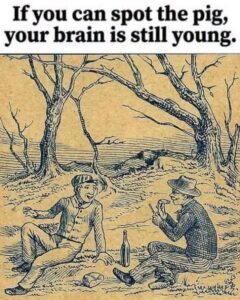
At first glance, this picture looks like an ordinary illustration filled with familiar objects, people, and everyday surroundings. Everything seems perfectly normal until someone challenges you to find the hidden pig.
It sounds easy, doesn’t it?
But there’s a catch.
The pig isn’t sitting in the middle of the picture, waiting to be discovered. It has been cleverly disguised among the surrounding shapes, lines, curves, and empty spaces. Its outline blends into the illustration, making it surprisingly difficult to recognize.
Some people spot it within seconds, while others can stare at the same picture for several minutes without noticing anything unusual.
So, here’s the challenge: Can you find the pig without looking at the answer?
Can You Find the Hidden Pig?
Before reading any further, take a moment to examine the entire illustration.
Don’t concentrate only on the obvious objects. Instead, look carefully at the unusual shapes and patterns.
The pig might not appear as a complete animal at first. You may only notice something resembling an ear, a snout, or part of its body.
Once you recognize one feature, the remaining details may suddenly become obvious.
Try looking at the picture from different angles. Sometimes turning your attention away from the main objects makes it easier to discover something hidden in the background.
Remember, the challenge isn’t about how quickly you can look at the image. It’s about how carefully you observe it.
Why Is the Hidden Pig So Difficult to Find?
Our brains are naturally designed to recognize familiar patterns.
When we look at a picture of a picnic, for example, we immediately identify people, trees, food, blankets, and other familiar objects.
Our brains organize these details into a recognizable scene.
However, this automatic process can also make us overlook unusual shapes.
When something doesn’t immediately match an object we recognize, we often dismiss it as background decoration.
This is one reason hidden-picture puzzles can be surprisingly challenging.
The pig may be formed by combining several ordinary-looking elements that appear completely unrelated when viewed separately.
The secret is to stop looking at the illustration as a simple picture and start examining it as a collection of shapes.
The Secret Is in the Negative Space
One useful technique for solving visual puzzles is paying attention to negative space.
Negative space refers to the empty areas surrounding objects or appearing between different elements in an image.
Most people concentrate on the objects themselves, but hidden pictures sometimes use the spaces around those objects to create recognizable shapes.
For example, the gap between two branches might resemble an animal’s ear. A curved line could form part of its back, while another shape might suggest a nose or mouth.
When these details are combined, an entirely different image can appear.
This is what makes optical illusions and hidden-object challenges so entertaining.
The information was already there. You simply hadn’t interpreted it correctly.
Five Tricks to Help You Find the Pig
If you’re struggling, try these simple techniques:
- Look at the entire picture: Instead of concentrating on individual objects, examine the overall composition.
- Search for unusual curves: Pay attention to shapes that resemble ears, legs, snouts, or rounded bodies.
- Examine empty spaces: The hidden animal might be formed by the background rather than the visible objects.
- Move farther away: Looking at the illustration from a greater distance can sometimes reveal a larger pattern.
- Change your perspective: Try looking at the picture from another angle or briefly turning your attention elsewhere before examining it again.
Don’t rush. Sometimes the most difficult part is convincing yourself that an ordinary-looking detail might actually represent something completely different.
Does Finding the Pig Mean Your Brain Is Younger?
You may have seen online puzzles claiming that people who quickly identify hidden objects have younger or healthier brains.
Although these challenges can be entertaining, finding a hidden pig is not a scientific test of brain age, intelligence, or cognitive health.
Your ability to solve the puzzle may depend on several factors, including attention, visual experience, familiarity with optical illusions, and how the illustration is designed.
Some people naturally notice unusual patterns more quickly than others.
That doesn’t mean someone who takes longer has an older or less capable brain.
The real benefit is that visual puzzles encourage you to slow down, concentrate, and approach familiar information from a different perspective.
Why We Love Hidden Picture Challenges
There is something incredibly satisfying about discovering an object that was hiding in plain sight.
At first, the illustration appears ordinary. You examine it again and again, but nothing seems unusual.
Then suddenly, you notice a small detail.
Within seconds, the hidden animal becomes recognizable, and you wonder how you managed to overlook it.
That moment of discovery is what makes these puzzles so enjoyable.
They are also a wonderful way to spend time with friends and family. Show the picture to someone else, give them a few minutes, and see who discovers the pig first.
You might be surprised by how differently people interpret the same illustration.
Final Challenge: Have You Found It?
Before giving up, take one final look.
Forget about the picnic scene for a moment. Ignore the obvious objects and concentrate on the shapes created by their outlines.
Look for the ears, the rounded body, and the distinctive snout.
Can you finally recognize the hidden pig?
If you find it, congratulations! You’ve successfully solved the visual challenge.
If you haven’t, don’t worry. Sometimes stepping away and returning with fresh eyes is all it takes.
And remember: the real fun isn’t proving that your brain is younger than someone else’s.
It’s discovering something unexpected in a picture you’ve already looked at several times.
Now share the challenge with your friends and family. How many seconds will it take them to find the hidden pig?