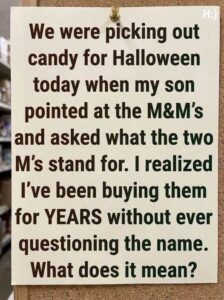
M&M’s are among the most recognizable candies in the world. Their colorful shells, delicious chocolate centers, and familiar little letters have made them a favorite among children and adults for generations. Millions of people enjoy them in movie theaters, at birthday parties, during holidays, and as everyday snacks.
But behind those two famous letters lies a fascinating story involving two businessmen, a clever invention, a family connection, and an idea inspired by soldiers during wartime.
The story began in the early twentieth century, when chocolate was already becoming increasingly popular. However, there was one major problem with traditional chocolate: heat.
Chocolate could easily melt when carried in warm weather, making it difficult for soldiers, travelers, and people working outdoors to enjoy it.
Forrest Mars, an ambitious businessman with a strong interest in the confectionery industry, recognized an opportunity.
During his travels in Europe, he reportedly noticed soldiers eating small chocolate pieces covered in a hard sugary coating. The coating helped protect the chocolate from melting as easily in their hands.
The idea immediately caught his attention.
What if he could create a similar product for American consumers?
A chocolate candy that was small, convenient, easy to transport, and protected by a colorful outer shell could become an enormous commercial success.
However, developing the product would require more than an interesting idea. Mars needed manufacturing resources, business connections, and a reliable supply of chocolate.
That was where Bruce Murrie entered the story.
Bruce was the son of William Murrie, a prominent executive associated with the Hershey Chocolate Company. His family connection provided access to an important part of the American chocolate industry.
Forrest Mars approached him with a business proposal.
Together, they established a partnership and developed the candy that would eventually become known as M&M’s.
The name was surprisingly simple.
The first M represented Mars, while the second represented Murrie.
Thus, the famous name M&M’s was born.
In 1941, the new candies were introduced to the American market.
Their timing was particularly important because the United States was entering a period of enormous military involvement during World War II.
The candies offered practical advantages. Their hard sugar coating helped protect the chocolate center, making them easier to transport and distribute than ordinary chocolate bars.
They were particularly useful for soldiers who needed convenient food supplies while serving overseas.
As military demand increased, production became closely associated with wartime distribution.
Forrest Mars understood that the product had enormous potential beyond the military market.
He wanted ordinary Americans to enjoy the candies too.
After the war, M&M’s became increasingly available to the public, and their popularity continued growing.
One of the most interesting details about the original M&M’s is that they did not look exactly like the candies people recognize today.
Initially, they were produced with brown, red, orange, yellow, green, and violet coatings.
The famous white letter M was introduced in 1950, helping customers identify genuine candies and giving the product an unmistakable appearance.
That small letter became one of the most recognizable features of the brand.
Over time, the company experimented with different colors, packaging styles, and advertising campaigns.
In 1954, another important development took place.
Peanut M&M’s were introduced, offering consumers a different experience by combining chocolate, a hard candy shell, and a peanut center.
The new variety quickly became popular.
Later decades brought additional products, including peanut butter, almond, crispy, and other specialty versions.
Each new variation helped expand the brand’s audience.
But the story of M&M’s was not always completely smooth.
The relationship between Forrest Mars and Bruce Murrie eventually came to an end. Mars ultimately gained greater control of the business, while the product continued developing under the wider Mars confectionery operation.
Today, M&M’s are sold in countries around the world and come in numerous varieties.
The brand has also become famous for its colorful advertising characters.
Red, Yellow, Blue, Green, Orange, and Brown have developed distinct personalities, turning the candies into recognizable characters rather than simply a chocolate product.
Their appearances in television advertisements, promotional campaigns, and special events have helped create a strong connection with consumers.
The brand has also experimented with personalized packaging, seasonal editions, limited flavors, and collaborations.
For example, special colors and packaging frequently appear around Christmas, Halloween, Valentine’s Day, and other celebrations.
One reason M&M’s have remained successful is their ability to combine familiarity with innovation.
People recognize the original candy immediately, but they can also discover new flavors and experiences without losing the product’s original identity.
The famous slogan, “Melts in your mouth, not in your hand,” helped communicate the practical advantage that inspired the original invention.
Of course, the hard coating does not make M&M’s completely immune to heat. Under sufficiently warm conditions, the chocolate inside can still melt.
Nevertheless, the coating makes the candies easier to handle than unprotected chocolate.
Another interesting part of their history involves the changing colors.
For a period beginning in the 1970s, red M&M’s disappeared from American packages because of concerns surrounding a red food dye. The removal was not due to evidence that the candies themselves were dangerous, and red candies eventually returned in 1987 following public interest.
This episode demonstrated just how emotionally connected consumers had become to the product.
People weren’t simply buying chocolate.
They had developed preferences for particular colors and associated memories with the candy.
Today, the original partnership between Forrest Mars and Bruce Murrie remains an important part of confectionery history.
Two businessmen combined their knowledge, resources, and ambitions to create something that would become much larger than either could have imagined.
And the most surprising detail is that the name appearing on billions of colorful candies around the world is simply a combination of their two surnames.
The next time you open a packet of M&M’s, remember that those two little letters represent a business partnership that began with an observation about soldiers eating chocolate during wartime.
An ordinary idea, inspired by an unusual situation, eventually became one of the world’s most recognizable candy brands.
And that is the remarkable story behind M&M’s.