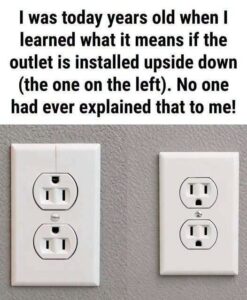
Have you ever walked into a room, looked at the electrical outlets, and noticed that one of them appears to be installed upside down? Instead of having the ground opening at the bottom, the outlet has it facing upward.
At first, you might assume an electrician made a mistake or that someone installed the outlet incorrectly. After all, most wall outlets in homes appear to follow the same familiar orientation.
However, an upside-down electrical outlet is not necessarily a mistake. In many cases, it is an intentional installation choice that can serve a practical purpose.
Electricians sometimes use different outlet orientations to distinguish certain electrical connections, identify switched outlets, or accommodate specific installation preferences.
So why exactly do some outlets look different? Here are the most interesting reasons behind this everyday household mystery.
1. Identifying a Wall-Switched Outlet
One possible reason for installing an outlet upside down is to identify an electrical receptacle controlled by a wall switch.
This arrangement was especially common in older homes that did not have ceiling lights in every room.
Instead of installing an overhead lighting fixture, builders sometimes provided an outlet controlled by a wall switch. Homeowners could plug a table lamp or floor lamp into that outlet and turn the light on or off using the switch near the doorway.
In some installations, only one half of the outlet is controlled by the wall switch, while the other half remains powered continuously.
Electricians may install the outlet with the ground opening facing upward to make the switched receptacle visually distinguishable.
However, this is only one possible convention. An upside-down outlet does not automatically mean that it is controlled by a wall switch.
2. Making Electrical Connections Easier to Recognize
Another reason involves identifying different types of electrical connections.
Homes can contain several kinds of outlets, including switched receptacles, dedicated appliance outlets, and standard general-purpose outlets.
Electricians sometimes use different orientations to make certain outlets easier to recognize during installation, inspection, or future maintenance.
For example, an electrician might choose an unusual orientation for a receptacle that serves a particular function.
This can provide a quick visual reminder without requiring someone to examine the entire electrical circuit.
Still, there is no universal rule requiring electricians to use a particular orientation for a specific function.
3. Preventing Plugs From Falling Out
<AsyncImage query=”electrical wall outlet installed ground pin facing upward upside down receptacle close up” aspectRatio=”16:9″ width=”100%”/>
Another explanation sometimes discussed is safety.
When a plug is inserted into an outlet, its weight and the shape of the surrounding connection can influence how securely it remains in place.
In certain situations, people prefer an orientation that places the grounding connection above the other openings.
The reasoning is that if a partially disconnected plug or metal object were to fall against the exposed prongs, the arrangement might reduce the chance of creating an electrical short.
However, the actual safety benefits depend on the plug, receptacle design, installation, and circumstances. Reversing an outlet is not a substitute for properly designed electrical protection.
4. There Is No Universal Requirement for One Orientation
Many homeowners assume that electrical outlets must always be installed with the ground opening facing downward.
Surprisingly, that isn’t a universal requirement.
In the United States, electrical codes generally do not mandate one specific orientation for standard receptacles.
As a result, electricians may install outlets with the grounding opening facing upward, downward, or horizontally when appropriate.
The final arrangement can depend on local requirements, the type of installation, and professional judgment.
This explains why you might find different outlet orientations even within the same building.
5. Older Homes Often Have Different Electrical Designs
<AsyncImage query=”older American home living room wall outlet lamp plugged into switched receptacle” aspectRatio=”16:9″ width=”100%”/>
The age of a house can help explain why certain outlets look different.
Older homes were often designed around lighting arrangements that are less common in modern construction.
For example, some living rooms and bedrooms relied on switched wall outlets rather than ceiling-mounted lights.
Over time, homeowners renovated their rooms, added ceiling fixtures, or replaced older electrical equipment.
However, some original outlets remained in place.
That means an unusual outlet orientation might be a small reminder of how the house was originally designed.
6. Sometimes, It’s Simply an Electrician’s Preference
Not every unusual outlet has a special purpose.
Sometimes, an electrician simply prefers installing receptacles in a particular orientation.
Two qualified electricians can make different choices while following the applicable electrical requirements.
Homeowners may also request a specific arrangement during renovations.
This is one reason outlet orientation can vary so much between houses, apartments, offices, and commercial buildings.
7. How Can You Tell Whether an Outlet Is Controlled by a Switch?
If you discover an upside-down outlet in your home, you might wonder whether a nearby wall switch controls it.
There is a simple way to investigate.
First, look around the room for a wall switch that doesn’t appear to control an overhead light.
If you find one, it might operate a nearby receptacle.
A properly functioning lamp can help you identify whether the outlet is switched. If you are unsure about the wiring or the outlet’s condition, ask a qualified electrician to check it.
Never remove the outlet cover or touch exposed wiring simply to discover how the circuit works.
8. Should You Turn Your Own Outlets Upside Down?
If you are renovating your home, you might wonder whether you should install your outlets in the same unusual orientation.
There is no single answer for every property.
The best arrangement depends on the electrical design, applicable local regulations, the equipment being used, and the preferences of the homeowner.
If you want switched outlets to be easily identifiable, an electrician can discuss suitable ways to distinguish them.
Safety and correct installation should always come before appearance.
Final Thoughts
The next time you notice an electrical outlet with its grounding opening facing upward, don’t immediately assume someone made a mistake.
It might have been installed that way to identify a switched receptacle, accommodate a particular electrical arrangement, or simply follow the electrician’s preferred installation style.
What appears to be a small detail can sometimes reveal interesting information about how a home was designed.
And the most important thing to remember is that outlet orientation alone doesn’t tell you exactly how the electrical circuit works.
Sometimes, the smallest details around your house have surprisingly practical explanations!