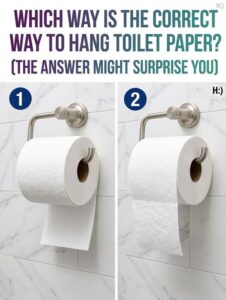
Few household disagreements are as surprisingly persistent as the great toilet paper debate. For decades, couples, roommates, parents, and children have argued over one seemingly insignificant question: should toilet paper hang over the front of the roll or underneath it?
Some people believe the loose end should always face outward, making it easy to grab and tear. Others insist that hanging it underneath looks neater and prevents the paper from unwinding accidentally.
Although the disagreement might seem funny, it has become one of the most recognizable everyday household debates. People have even joked that discovering someone’s toilet paper preference is an important step in determining whether two people are compatible.
But what if the answer has been hiding in an American patent for more than 130 years?
The surprising history of this debate begins in the nineteenth century.
In 1891, American inventor Seth Wheeler received a patent related to perforated toilet paper and its dispensing arrangement. Wheeler was an important figure in the development of commercially produced toilet paper, helping popularize the perforated sheets that people still use today.
His patent included an illustration showing a roll mounted on a holder.
When modern internet users began sharing the historical drawing, something interesting happened.
People noticed that the illustration showed the loose end hanging over the top of the roll.
For supporters of the overhand method, this was the ultimate victory.
They immediately began declaring that the debate was officially settled.
After all, if the inventor’s original illustration showed the paper hanging over the front, surely that was the intended arrangement.
However, the story is slightly more interesting than simply declaring one side correct.
The 1891 patent illustration provides strong historical evidence of how Wheeler depicted his toilet paper arrangement. But a patent drawing is not necessarily a universal instruction for every toilet paper holder ever manufactured.
It demonstrates the configuration shown in that particular invention, rather than proving that every bathroom must follow the same rule.
Still, the drawing offers a fascinating glimpse into the history of an ordinary household object.
To understand why the debate continues, it helps to look at the practical arguments behind both preferences.
Supporters of the overhand method usually have several reasons for their choice.
First, the loose end is easier to see and grab. Instead of reaching behind the roll, users can immediately identify where the next sheet begins.
Second, some people believe the arrangement is more hygienic. When the paper hangs toward the front, there may be less temptation to touch the wall behind the roll while searching for the loose end.
Third, the overhand position can make tearing individual sheets easier, depending on the holder and the direction of the perforations.
It also makes the remaining amount of toilet paper easier to see.
For people who value convenience, these small advantages make the decision obvious.
But supporters of the underhand method have their own arguments.
Some prefer its cleaner appearance, especially in bathrooms where the toilet paper holder is positioned close to a wall.
Others believe hanging the paper underneath makes it less likely that pets will unroll the entire roll.
Cat owners, in particular, sometimes discover that their animals consider toilet paper an entertaining toy.
An underhand arrangement can also reduce accidental unwinding when the loose end brushes against clothing or nearby objects.
For some households, the preference is simply about appearance.
They like the way the roll looks when the loose end is tucked closer to the wall.
And that is perfectly reasonable.
Another interesting part of the debate involves psychology.
Why can such a small decision create surprisingly strong reactions?
One explanation is that household habits often become associated with personal identity.
People grow up watching their parents arrange things in a particular way. Eventually, those small routines become automatic.
When someone else changes them, it can feel strangely irritating.
The disagreement may not actually be about toilet paper.
It may represent a much larger difference in expectations about cleanliness, organization, and personal habits.
This is why the debate frequently appears in conversations about relationships.
A newly married couple might discover that they disagree about dozens of small household routines.
One person squeezes toothpaste from the middle, while the other insists on starting at the bottom.
One folds towels in a particular way, while the other simply places them on a shelf.
And then there is the toilet paper roll.
What makes this particular disagreement especially entertaining is that both sides can make reasonable arguments.
There is no universal bathroom rule requiring everyone to use the same orientation.
The best arrangement may depend on the design of the holder, the location of the toilet, the presence of pets, and individual preferences.
Nevertheless, the historical patent remains an interesting detail.
Seth Wheeler’s 1891 illustration has become a popular piece of evidence in the modern debate because it shows that the overhand arrangement was documented during the early development of perforated toilet paper.
It also reminds us that everyday inventions often have surprisingly long histories.
Toilet paper itself has undergone enormous changes since the nineteenth century.
Early commercial products were very different from the soft, multi-ply rolls commonly found in bathrooms today. Manufacturing improvements gradually made the product more convenient, affordable, and accessible.
The familiar perforated roll became an important part of modern household life.
And with it came a question that continues to divide people.
Interestingly, the argument has also become a recurring topic on social media, where users share photographs of their bathroom arrangements and invite others to choose a side.
Some treat the overhand position as an obvious standard.
Others proudly defend the underhand arrangement.
Occasionally, someone discovers that a family member has secretly changed the roll orientation and treats the situation as a serious household betrayal.
But perhaps the most important lesson is that not every disagreement needs a winner.
The 1891 patent illustration gives overhand supporters a fascinating historical argument. It does not mean that people who prefer the opposite arrangement are doing something wrong.
A comfortable bathroom is more important than winning an argument about a cardboard tube.
So, the next time someone visits your home and quietly changes the direction of your toilet paper, remember that the disagreement has a history stretching back more than a century.
You can mention Seth Wheeler’s famous patent drawing if you want to defend your preference.
Just don’t expect everyone to surrender immediately.
Because after all these years, the great toilet paper debate is still going strong.
And sometimes, the smallest things in everyday life create the biggest arguments.