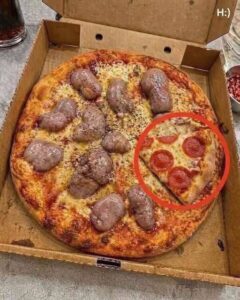
I stared at the photograph on my phone, trying to convince myself that I was imagining things.
The tiny bubbles stretched across the pizza in several uneven rows. At first, they looked like ordinary air pockets caused by melted cheese and heat. But the longer I examined them, the more convinced I became that something about the arrangement was unusual.
I turned the pizza box around and checked the label.
Nothing seemed wrong.
The restaurant’s name was printed clearly, the receipt was attached to the side, and the delivery time matched my order. Everything appeared perfectly ordinary.
Still, I couldn’t shake the feeling that I had noticed something important.
I took another photograph and sent it to my friend Daniel.
“Tell me I’m not going crazy,” I wrote.
He replied almost immediately.
“That’s weird. Did you touch it?”
“No. Why?”
“Don’t eat it yet. Send me a closer picture.”
I leaned over the table and photographed the surface from several angles. The cheese was still warm, and small bubbles continued to rise and collapse in places.
Daniel called me.
“Listen,” he said, “there are several possible explanations. Cheese can blister when exposed to high heat. Some toppings release moisture, and the crust can trap steam. But I want to see the picture.”
I sent it.
There was a long pause.
Then he laughed.
“What?” I asked.
“I think you’ve been watching too many mystery videos.”
I wasn’t amused.
“Then explain the lines.”
He asked me to look more closely at the pizza.
I zoomed in.
The bubbles were concentrated in certain areas, while other sections of the cheese remained relatively smooth. There were also several darker spots where the cheese had browned.
Daniel explained that heat distribution, cheese composition, and moisture could produce uneven patterns. The bubbles might look organized simply because the pizza had been placed in a particular position inside the oven.
It was a reasonable explanation.
But something else bothered me.
The pattern seemed familiar.
I opened my photo gallery and compared the pizza picture with an image I had saved several months earlier. It showed an unusual symbol made from a series of dots and short lines.
My heart began beating faster.
The resemblance was striking, at least at first glance.
I immediately searched for similar patterns online. I found photographs of cheese blisters, cooking experiments, and unusual pizza surfaces. Some people described similar appearances as leopard spotting, a common term used for dark marks on certain styles of pizza crust.
Others explained that mozzarella contains moisture and fat, which can behave differently when exposed to intense oven temperatures.
Suddenly, the mystery seemed much less frightening.
But I still wanted to understand why this particular pizza looked so unusual.
I checked the restaurant’s website and found that they used a high-temperature oven. Their pizzas were cooked quickly, allowing the cheese to bubble and brown before the crust became dry.
That explained a lot.
I also noticed that the pizza contained several different cheeses. Their melting points and moisture levels were not identical, which could have contributed to the strange surface.
I took another look at the box.
Then I noticed something I had overlooked earlier.
The restaurant had printed a small message beneath the ingredients:
“Every pizza is handmade. Natural variations in appearance are normal.”
I laughed at myself.
For nearly an hour, I had treated a perfectly ordinary cooking result like a secret code.
Still, I wasn’t completely satisfied.
I called the restaurant and politely explained what I had noticed. The employee listened and asked whether the pizza smelled unusual, whether the packaging was damaged, and whether the cheese looked discolored.
I answered no to all three questions.
She explained that tiny bubbles were usually caused by the cheese and moisture reacting to high temperatures during baking.
“If anything smells sour, looks moldy, or seems contaminated, please don’t eat it,” she added. “We’ll happily replace an order if something seems wrong.”
I thanked her.
By then, the pizza had cooled considerably.
I inspected it once more. There was no unusual smell, no visible contamination, and nothing suggesting that the food had spoiled. The strange pattern was simply a combination of melted cheese, browned spots, and bubbles.
I finally relaxed.
I put the photograph away, poured myself a glass of water, and sat down to enjoy my dinner.
But the experience taught me something I wouldn’t forget.
Sometimes, the things that look frightening are simply unfamiliar. A strange mark, an unusual texture, or an unexpected pattern can send our imaginations racing toward the worst possible explanation.
The internet makes that even easier.
One photograph can lead to dozens of theories, and before long, an ordinary dinner becomes an investigation.
That night, I learned that tiny bubbles on pizza are generally nothing mysterious. They are often a natural result of heat, moisture, and the way cheese melts.
And perhaps the biggest surprise wasn’t what I discovered on the pizza.
It was how quickly my imagination had turned an ordinary meal into a mystery.
The lesson? A strange-looking pizza isn’t automatically a spoiled pizza. But when food has an unusual odor, visible mold, damaged packaging, or other warning signs, don’t take chances. Contact the restaurant and choose safety over curiosity.