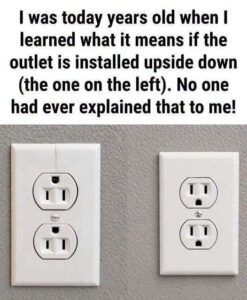
Have you ever walked into a home, looked at a wall outlet, and noticed something that seemed a little unusual? Instead of seeing the familiar ground opening at the bottom, you find it facing upward. At first glance, it might look like an installation mistake, but there may be a practical reason behind this unexpected arrangement.
Although most people rarely pay attention to the direction of their electrical outlets, their orientation can sometimes reveal interesting details about how a home’s electrical system was designed. In certain installations, an upside-down outlet is intentional and may help distinguish it from other outlets in the same room.
One explanation commonly associated with this arrangement involves switched electrical outlets. These were particularly useful in homes where lamps provided much of the indoor lighting and controlling them conveniently was an important part of everyday life.
However, switched outlets are not the only possible explanation. Understanding why electricians sometimes install receptacles with the ground opening facing upward requires looking at both household lighting habits and electrical installation practices.
How Switched Outlets Work
Before built-in ceiling lights became common in many living rooms and bedrooms, portable lamps played an important role in illuminating indoor spaces.
Families often placed lamps on tables, beside sofas, or in bedroom corners. While these lights provided flexibility, switching them on and off individually could become inconvenient.
Imagine entering a living room after dark. You might have to walk across the room to reach a table lamp before getting enough light to see comfortably. Leaving the room could involve repeating the same process.
A switched outlet offered a simple solution.
An electrician could connect a wall receptacle to a nearby wall switch, allowing someone to control a plugged-in lamp without touching the lamp itself.
For example, a switch positioned near the entrance could control a living room lamp. When someone entered, flipping the switch would turn the lamp on. When leaving, the same switch could turn it off.
This arrangement made everyday lighting more convenient and eliminated the need to walk around a dark room searching for individual lamp switches.
Why Some Outlets Have the Ground Opening Facing Up
The most interesting part of this arrangement is the way some electricians choose to position the receptacle.
In certain homes, an outlet may be installed with its grounding opening facing upward rather than downward. One possible reason is to make it visually different from the other outlets in the room.
For example, imagine a wall containing several standard receptacles. Most have their grounding openings facing downward, but one is installed in the opposite direction.
That unusual orientation might have been deliberately chosen to identify an outlet with a particular function, such as a receptacle controlled by a wall switch.
This could make it easier for electricians, homeowners, or future maintenance workers to recognize that the outlet is different.
However, there is an important detail to remember: an upside-down outlet does not automatically mean it is connected to a wall switch.
Electrical installation practices vary, and electricians may choose different orientations for several reasons. Some installations simply reflect personal preference, local conventions, or other practical considerations.
The Difference Between Switched and Always-Powered Outlets
Another interesting feature of some household electrical systems is that a single duplex receptacle can provide two different types of power.
A standard duplex outlet has two places where electrical devices can be plugged in. Depending on how it is wired, one half may be controlled by a wall switch while the other remains continuously powered.
This arrangement can be especially convenient in living rooms and bedrooms.
For example, someone might connect a table lamp to the switched half of the outlet. A nearby wall switch could then control the lamp without affecting the other receptacle.
The second half could remain available for a device that needs uninterrupted power, such as a suitable charger or electronic clock.
This provides flexibility without requiring two completely separate outlet locations.
It is important to understand that the actual wiring determines whether a receptacle is switched or continuously powered. Its physical orientation alone cannot confirm its electrical function.
Another Possible Reason: Safety and Mechanical Considerations
There are also discussions about installing outlets with the ground opening facing upward for safety-related reasons.
One argument involves what might happen if a partially inserted plug or another conductive object accidentally contacts the exposed metal prongs of a plug.
Some people prefer an orientation in which the grounding contact is positioned above the other openings, reasoning that a falling metal object might contact the grounding portion first.
However, this is not a universally accepted safety rule, and the actual risk depends on the receptacle design, plug construction, installation, and circumstances.
Electrical safety standards and installation requirements vary by country and region. In many places, there is no universal requirement that ordinary wall outlets must have their grounding openings facing either upward or downward.
Proper grounding, suitable protective devices, correct wiring, and secure installation are far more important than orientation alone.
Why Electricians Sometimes Choose Different Orientations
Not every unusual outlet installation has a hidden explanation.
Electricians may install receptacles in different directions depending on the surrounding equipment, available space, and the design of the electrical system.
In some locations, the orientation may make it easier to accommodate certain plugs, cords, or connected equipment.
Commercial buildings, workshops, and other specialized spaces may also use different outlet arrangements to help distinguish particular circuits or types of electrical connections.
In addition, older houses may contain installations that reflect practices used decades ago. An outlet that looks unusual today might simply have been installed according to the preferences or conventions of the electrician who worked on the property.
This is one reason why it is difficult to identify the original purpose of an upside-down receptacle just by looking at it.
How Can You Tell What Your Outlet Actually Does?
If you notice an outlet installed with its ground opening facing upward, there are a few safe ways to learn more about it.
First, check whether a nearby wall switch appears to control a lamp or another device connected to that receptacle.
Second, look for labels or markings that might identify a switched receptacle or a dedicated electrical circuit.
You can also consult the home’s electrical documentation, if available.
If the outlet’s function remains unclear, a qualified electrician can inspect the wiring and determine whether it is switched, continuously powered, or connected to another type of circuit.
Avoid removing the outlet cover, opening the receptacle, or touching internal wiring to investigate it yourself. Electrical circuits can remain dangerous even when a nearby wall switch is turned off.
A Small Detail That Reveals More About a Home
Something as ordinary as the direction of a wall outlet can reveal interesting details about how a home was designed and how people used electrical appliances.
What initially appears to be an installation mistake may actually reflect a deliberate choice made to improve convenience, identify a particular receptacle, or accommodate the surrounding electrical equipment.
Switched outlets are one possible explanation, especially in homes where wall switches were used to control lamps instead of built-in lighting.
Nevertheless, the orientation is not a reliable indicator of how an outlet is wired, and there is no single explanation that applies to every installation.
The next time you notice an electrical outlet with its grounding opening facing upward, take a closer look. It might simply be an electrician’s preferred arrangement, or it could be a small clue about the home’s original electrical design.
Have you ever noticed an upside-down electrical outlet in your home? Did you assume it was installed incorrectly, or did you know there could be a practical reason behind it?