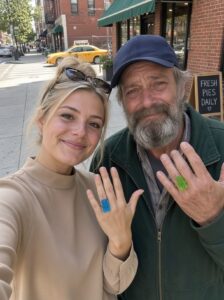
For three years, I bought coffee for a quiet homeless man who sat outside the subway station. His name was Douglas, and he rarely spoke more than a few words. Every morning, I handed him a warm cup before heading to work. Sometimes he thanked me. Other times, he simply smiled and lowered his eyes.
I never imagined that this stranger would eventually change my understanding of family, forgiveness, and the meaning of love.
When Douglas became seriously ill, I learned that he had nowhere to go and nobody who could legally make decisions on his behalf. He had spent years moving between shelters and temporary jobs, living a life that seemed almost completely disconnected from the world around him.
I felt sorry for him.
One afternoon, while we were talking, he made an unusual request.
He asked whether I would consider marrying him.
I laughed at first, thinking he was joking. But his expression remained serious.
He explained that he had a small life insurance policy and wanted to leave something behind rather than disappear without anyone knowing he had existed.
I was confused by the request, but after several conversations, I agreed to help him arrange his affairs. We eventually completed the legal process, although I never imagined the decision would lead to anything more than helping an elderly man find a little dignity.
Douglas died several months later.
I attended the funeral alone.
There were no relatives waiting outside the chapel, no friends sharing childhood memories, and no family members asking for photographs. Just a small gathering and a man whose life seemed to have passed almost unnoticed.
Afterward, a lawyer contacted me about an envelope Douglas had left behind.
Inside was a collection of handwritten pages.
I opened the first one and immediately recognized the handwriting.
My father’s handwriting.
The same cramped letters, the same unusual loops, and the same habit of writing certain words in a particular way.
I stopped breathing.
Douglas wasn’t a stranger.
He was Douglas Ward Kessler, my father.
The man who had disappeared from our apartment in Pittsburgh when I was six years old.
My mother had told me he was dead by the time I was nine. I grew up believing that he had died somewhere far away, leaving behind nothing but a few childhood memories.
But he had been alive all those years.
And he had been sitting outside my subway station.
I sat down and began reading.
The pages explained that my father had struggled with alcoholism during the late 1990s. His addiction gradually destroyed his marriage, his relationships, and his ability to maintain a stable home.
He wrote that leaving had been the worst decision of his life, but he had convinced himself that disappearing was better than allowing me to grow up watching him destroy himself.
He never expected forgiveness.
He simply wanted me to have a childhood without his mistakes becoming my responsibility.
Then came the sentence that broke my heart.
He wrote that he had recognized me during the first week I started buying coffee from him.
He recognized my face, my voice, and even the way I held my cup.
He knew I liked my coffee prepared exactly the way he did.
For three years, he watched his daughter walk toward him every morning without knowing who he was.
And every time I handed him that coffee, he experienced a small moment of happiness that he believed he didn’t deserve.
He wrote that he wanted to tell me the truth countless times.
But fear always stopped him.
He was afraid I would recognize the disappointment in his face. He was afraid I would ask why he had never returned. Most of all, he was afraid that telling me would destroy the only relationship he had managed to build with me in decades.
Then I reached the explanation for his unusual marriage proposal.
It wasn’t about romance or companionship.
For nineteen years, my father had continued paying premiums on a modest life insurance policy, even while living in shelters and surviving on temporary work.
The policy had no named beneficiary.
He had apparently believed that without a legally recognized family member, the money might never reach anyone he wanted to help.
He hoped that marriage would allow the policy to be claimed and that I would eventually receive something from him.
The amount was $61,000.
I couldn’t stop crying.
My father had spent years living with very little, yet somehow continued paying for a policy that might give his daughter something after he was gone.
I felt angry, heartbroken, confused, and strangely grateful all at once.
Why hadn’t he told me?
Why had he allowed me to believe he was dead?
And how could I possibly forgive someone who had spent three years sitting a few feet away from me without revealing his identity?
For months, I couldn’t bring myself to touch the money.
It sat in my account, representing everything I couldn’t understand about my father.
Eventually, I decided that keeping it untouched would not bring him back or answer all my questions.
I remembered something he had written near the end of his letter.
He said he had spent most of his life being invisible, and that the hardest part wasn’t the cold or hunger. It was realizing that entire days could pass without anyone saying his name.
That sentence stayed with me.
Last November, I used the money to open a small community space near the subway station.
It wasn’t a large business or an elaborate charity. It was simply a warm room where people could sit during the winter, drink coffee, read, talk, or rest without being expected to purchase anything.
I called it Douglas’s Place.
At first, only a handful of people came.
Then word spread.
Soon, the room began filling with people who needed somewhere warm and welcoming. Some were homeless. Others were elderly people living alone, struggling workers, or individuals who simply needed someone to talk to.
Today, there are 42 regular visitors.
I know every one of their names.
I learned their favorite drinks, remembered their stories, and discovered that many of them had spent years feeling invisible.
Sometimes I think about my father sitting outside that subway station, waiting for the morning coffee I brought him.
I wonder what he felt when he saw me approaching.
I wonder how many times he almost said my name.
I still keep his old cardboard sign behind the counter. I don’t display his letter because some memories are too personal to turn into decorations.
But the sign reminds me of the man he was before I knew the truth.
For a long time, I believed my father had given me $61,000.
It took almost a year to understand what he had actually left behind.
He had given me a reason to notice people everyone else overlooked.
He had taught me that family is complicated, that forgiveness does not erase pain, and that sometimes love appears in ways we don’t recognize until it is too late.
I never got the chance to ask him why he stayed silent for so long.
But every morning, when someone walks through the door and I greet them by name, I feel that perhaps something good has grown from the years we lost.
My father spent his final years hoping to belong to someone.
And without realizing it, he gave me a place where dozens of people could finally feel that they belonged, too.