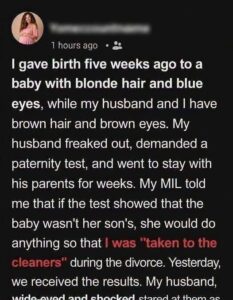
The first time my husband Daniel held our newborn son, I expected tears of happiness, a smile, and perhaps a few emotional words about becoming a father.
Instead, he stared at the baby’s face for several seconds before quietly saying something I would never forget.
“He doesn’t look like me.”
At first, I thought exhaustion was affecting his judgment. We had spent hours at the hospital, and neither of us had slept properly. I smiled and told him that newborns changed quickly and that our son would eventually develop his own features.
But Daniel didn’t smile.
He continued examining the baby’s face, looking from his eyes to his nose and then toward his hair.
Something about his expression made me uncomfortable.
I tried to ignore it, hoping it was simply an awkward moment during an overwhelming experience.
I was wrong.
Over the following days, his questions became increasingly suspicious.
He wanted to know whether I had been seeing anyone before our wedding. He asked whether I had ever hidden messages from him and whether I was absolutely certain about the baby’s conception date.
Every question felt like another accusation.
I reminded him that I had never been unfaithful.
We had been married for six years, and I had trusted him completely. I had imagined raising children together, celebrating birthdays, and watching our family grow.
Now, instead of enjoying those first precious days with our son, I was defending myself against accusations I had never imagined hearing.
One evening, while I rocked our sleeping baby in the nursery, Daniel entered the room.
He stood near the doorway with his arms folded.
“We need to settle something,” he said.
I looked up.
“What is it?”
“I want a DNA test.”
For several seconds, I couldn’t respond.
He explained that he wanted absolute certainty that the baby was biologically his.
I felt tears gathering in my eyes.
“You really think I cheated on you?”
He avoided looking directly at me.
“I just want the truth.”
I looked down at our sleeping son.
There was something deeply painful about having to prove my honesty at a moment when I should have been celebrating becoming a mother.
But I agreed to the test.
Not because I had anything to hide, but because I refused to spend the rest of my life trying to convince someone who had already decided to doubt me.
That same evening, I made another decision.
I contacted a divorce attorney.
I had no intention of raising my child in a home where his mother was constantly treated like a suspect.
Daniel was shocked when I told him.
“You’re divorcing me over a test?”
“No,” I replied. “I’m divorcing you because you accused me of betraying you when I gave you no reason to doubt me.”
He insisted that he still loved me.
But love without trust had suddenly become something I could no longer recognize.
A few weeks later, the DNA results arrived.
Daniel opened the envelope at the kitchen table while I stood nearby holding our son.
He read the first page.
Then he read it again.
His hands began trembling.
The report confirmed what I had known all along.
He was our son’s biological father.
I expected relief.
I thought he might apologize immediately, perhaps cry, or finally understand how deeply his accusations had hurt me.
Instead, he became unusually quiet.
He placed the report on the table and stared at it.
“I’m sorry,” he whispered.
I didn’t answer.
For a moment, I thought the matter was finally over.
But it wasn’t.
Several years passed.
Our divorce proceedings were completed, and Daniel eventually became involved in our son’s upbringing through an agreed parenting arrangement.
His relationship with our boy was sometimes affectionate and sometimes distant.
I concentrated on creating a stable home.
Our son, whom we named Oliver, grew into a curious, energetic little boy who loved drawing, asking questions, and taking things apart to discover how they worked.
He had inherited Daniel’s interest in mechanical objects, but he also had my habit of asking endless questions.
As the years passed, Daniel and I learned to communicate more peacefully.
We were no longer a married couple, but we were still parents.
Then, when Oliver was seven, something unexpected happened.
He began experiencing a medical issue that required additional investigation.
His doctor recommended further testing and suggested that understanding our family medical history might help specialists decide which examinations were appropriate.
I contacted Daniel and explained the situation.
He agreed to participate in the process.
During one appointment, the specialist asked whether we had any known inherited conditions in either family.
I provided everything I knew.
Daniel also shared information about his relatives.
But one detail caught the specialist’s attention.
There was a discrepancy between a medical finding and the family history we had supplied.
The doctor explained that this did not necessarily indicate anything unusual, but additional testing could help clarify the situation.
Daniel and I agreed.
We arranged the necessary tests and waited for the results.
A few weeks later, the specialist requested that we attend another appointment.
I remember sitting beside Daniel in the consultation room.
Oliver was at school, and neither of us knew exactly what the doctor intended to discuss.
The specialist placed several documents on the desk.
“Before we go through these results,” she said, “I want to explain that genetic testing can sometimes reveal unexpected information about biological relationships.”
Daniel immediately looked uncomfortable.
I felt a familiar sense of dread.
The doctor continued carefully.
The new results raised questions that could not be answered by looking at medical history alone.
She recommended a more comprehensive relationship test, explaining that the original paternity test had answered a specific question about Daniel and Oliver, while the newer investigation involved a different set of genetic markers and family relationships.
Daniel stared at her.
“What are you saying?”
She explained that we should avoid drawing conclusions until the additional testing was completed.
We left the appointment in silence.
For the first time in years, I remembered the day Daniel had opened the original DNA report.
I remembered his trembling hands and the strange expression on his face.
I wondered whether there was something he had never told me.
The additional test took several weeks.
During that time, Daniel became increasingly anxious.
He called me repeatedly, asking whether I had spoken to the specialist.
I told him we needed to wait for the official results.
When the report finally arrived, we arranged to review it together with the genetic counselor.
The counselor explained the findings slowly.
The original paternity test had correctly established that Daniel was Oliver’s biological father.
There was no question about that.
However, the broader genetic investigation had revealed something unexpected about Daniel’s own biological family.
One of the people Daniel had always believed was his biological parent was not genetically related to him in the way he had assumed.
The counselor explained that the results suggested a previously undisclosed family relationship involving his biological father.
Daniel looked completely stunned.
“What does that mean?”
The counselor emphasized that the results needed to be interpreted alongside family records and, where appropriate, additional testing.
But the central discovery was clear.
Daniel’s own understanding of his biological origins was incomplete.
He had spent years questioning whether Oliver was his son because the baby didn’t resemble him.
Yet he had never considered that the family history he had grown up believing might contain a secret of its own.
On the drive home, Daniel barely spoke.
Finally, he pulled into a quiet parking area.
“I spent all those years accusing you,” he said.
I looked at him.
“Yes, you did.”
He covered his face with his hands.
“I thought something was wrong because he didn’t look like me.”
I remained silent.
He continued.
“And now I don’t even know everything about my own family.”
For the first time, I understood that the situation was more complicated than either of us had imagined.
But understanding his confusion did not erase what had happened.
Over the following months, Daniel began asking questions about his childhood.
He contacted relatives and requested access to old family records.
Eventually, he arranged additional testing with the help of a genetic specialist.
The results confirmed that an important part of his biological family history had been concealed from him.
When he confronted his mother, she initially refused to discuss it.
Later, she admitted that a complicated relationship from before Daniel’s birth had never been explained honestly to him.
She said she had believed keeping the information secret would protect the family.
Instead, the secret had followed Daniel into adulthood and affected the way he understood his own identity.
Daniel struggled with the discovery.
He questioned memories, family stories, and relationships he had never previously doubted.
He also began to understand why his reaction to Oliver’s appearance had been so intense.
He had been searching for certainty about his identity in the wrong place.
One afternoon, he came to my house.
He stood in the doorway holding a photograph of Oliver as a newborn.
“I owe you an apology,” he said.
I looked at the photograph.
“You already apologized for the first test.”
“I know. But I never understood how much damage I caused.”
He admitted that he had allowed his insecurity to become an accusation.
He had treated his own uncertainty as evidence against me.
“I should have trusted you,” he said.
I nodded.
“Yes. You should have.”
He asked whether I thought we could ever have another chance as a couple.
I took a long breath.
“I don’t know, Daniel. But I do know that we have to be good parents regardless of what happens between us.”
He accepted my answer.
Over time, he became more consistent in his relationship with Oliver.
He attended school events, helped with homework, and spent weekends doing the things fathers and sons often enjoy together.
I was glad to see their relationship improve.
But I also made sure Oliver understood that he was never responsible for the difficulties between his parents.
He deserved to grow up knowing that he was loved and that his identity was not something he needed to prove.
Looking back, the original DNA test was never really about Oliver.
It revealed a problem that had existed in our marriage long before he was born: Daniel’s inability to trust me when his own fears became overwhelming.
The later genetic discovery added another unexpected chapter to our family’s story.
It reminded us that biological identity can sometimes be more complicated than family photographs and inherited features suggest.
But it also taught me something important.
A child should never have to carry the burden of an adult’s insecurity.
Oliver was Daniel’s son from the beginning.
He had never needed to prove it.
And I had never needed a laboratory report to know that I had been faithful.
Today, our family looks different from the one I imagined when I first held Oliver in my arms.
Daniel and I are no longer married, but we have learned to communicate with greater honesty and respect.
We cannot change the past.
We cannot erase the accusations, the painful conversations, or the years when trust was missing.
But we can choose what kind of future we create for our son.
And perhaps the greatest lesson from everything that happened is this:
Sometimes the truth we spend years demanding from other people is the truth we must first be brave enough to discover about ourselves.