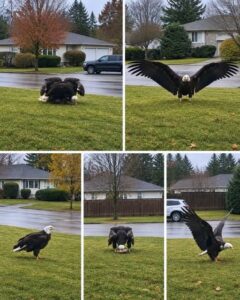
A remarkable wildlife mystery has captured public attention near the U.S.–Mexico border after hikers reportedly spotted an enormous bird soaring above the Rio Grande Valley near Brownsville, Texas. Witnesses described a massive silhouette moving across the sky, casting an unusually large shadow over the surrounding landscape.
At first, some observers believed they were looking at an ordinary eagle viewed from an unusual angle. But as more people reported similar sightings, speculation began spreading about the bird’s extraordinary size.
Several witnesses estimated that its wingspan could approach ten feet, considerably larger than that of most familiar North American eagles. The reports quickly attracted attention from wildlife enthusiasts, birdwatchers, and people fascinated by unexplained animal discoveries.
Nicknamed the Giant Eagle of the Border, the mysterious bird has inspired questions about its identity, possible origins, and whether an unusually large raptor could have remained unnoticed in the region.
But what exactly was flying over Brownsville?
A Sighting That Sparked a Wildlife Mystery
The reported sightings began attracting attention when hikers exploring areas near the Rio Grande described seeing an enormous bird flying above the landscape.
According to the accounts, the creature appeared to have unusually broad wings, powerful flight movements, and a silhouette that seemed considerably larger than familiar local birds.
Some witnesses compared its appearance to an eagle, while others suggested it resembled an enormous prehistoric predator.
The estimated wingspan became one of the most widely discussed details.
However, estimating the size of a flying animal from the ground is notoriously difficult. Distance, viewing angles, lighting conditions, and the absence of nearby reference objects can make an ordinary bird appear much larger than it actually is.
Wildlife experts would therefore need photographs, measurements, and physical evidence before determining whether the reported dimensions were accurate.
The Reported Capture Raises More Questions
Stories surrounding the mysterious bird describe a coordinated effort to locate and safely capture it.
Thermal imaging, GPS coordination, and observations of its movements were reportedly part of the search efforts.
The bird was said to have been transported to a protected conservation facility near Brownsville, where specialists could examine it without exposing it to unnecessary disturbance.
If such a capture has taken place, the next stage would be a careful veterinary assessment.
Researchers would need to establish the animal’s physical condition, identify its species, and determine whether its apparent size represents a genuine biological anomaly.
For now, however, the reported capture and the bird’s identity should be treated as unverified claims rather than established scientific findings.
Could It Be a Previously Unknown Species?
One of the most exciting possibilities being discussed is that the bird might represent an unusual or previously undocumented species.
Discovering a genuinely new large bird of prey would be an extraordinary scientific event.
However, researchers would first investigate more conventional explanations.
The animal could be a known eagle or another large raptor whose appearance was misunderstood by observers.
It might also be an unusually large individual within an established species, although exceptional size alone would not establish a new species.
Genetic variation, age, sex, nutrition, and environmental conditions can all influence an animal’s physical characteristics.
Scientists would also compare its anatomy with documented specimens from museums and wildlife collections.
A proper identification would require considerably more than an impressive wingspan.
The Connection to Prehistoric Giant Eagles
Another fascinating comparison involves the extinct Haast’s eagle of New Zealand.
<AsyncImage query=”Haast’s eagle prehistoric giant eagle scientific reconstruction flying” aspectRatio=”16:9″ width=”100%”/>
The <Entity value=”Haast’s eagle” category=”animal” disambig=”Extinct giant eagle from New Zealand”/> was one of the largest known eagles in the fossil record.
It lived in New Zealand and was adapted to hunting large flightless birds, particularly moa.
Its powerful legs, enormous talons, and impressive body structure made it an extraordinary predator.
Scientists estimate that its wingspan was generally around 2.5 to 3 meters, although estimates vary.
Its existence demonstrates that evolution has produced birds of prey considerably larger than most modern eagles.
Nevertheless, there is currently no verified evidence connecting the reported Brownsville bird to Haast’s eagle or suggesting that an extinct prehistoric species has survived in Texas.
The comparison is interesting because it highlights the remarkable diversity of raptors throughout evolutionary history.
What Scientists Would Need to Examine
If researchers obtained a living specimen matching the descriptions, several investigations could help establish its identity.
- DNA sequencing: Genetic analysis could identify its species and reveal its relationship to other known birds.
- Skeletal measurements: Scientists could examine its wings, legs, skull, and overall body proportions.
- Feather analysis: Feather structure and coloration could provide clues about species identification, age, and health.
- Metabolic testing: Veterinary examinations could help determine whether its unusually large body has specific physiological requirements.
- Dietary analysis: Naturally shed feathers, environmental samples, and other appropriate evidence could help establish what the bird eats.
- Movement tracking: If safe and appropriate, monitoring technology could help researchers understand its habitat and travel patterns.
Together, these investigations could provide a much clearer picture than eyewitness descriptions alone.
Why the Rio Grande Valley Matters
<AsyncImage query=”Rio Grande Valley Texas wildlife wetlands aerial landscape” aspectRatio=”16:9″ width=”100%”/>
The Rio Grande Valley is already recognized for its remarkable biodiversity.
Located in southern Texas near the Mexican border, the region contains wetlands, grasslands, agricultural landscapes, brush habitats, and important wildlife corridors.
Its location makes it especially valuable for migratory birds and other wildlife moving between North and Central America.
Birdwatchers travel to the region to observe numerous species that are difficult to find elsewhere in the United States.
The area’s varied habitats also support many raptors, making it an interesting location for wildlife research.
A genuinely unusual large bird would therefore attract considerable scientific interest.
However, the region’s biodiversity should not be confused with proof of an undiscovered giant eagle.
Could a Conservation Sanctuary Be Created?
The reported discovery has also inspired discussions about establishing a research sanctuary or ecotourism attraction.
Such a project could potentially support conservation education, wildlife monitoring, and public awareness.
Visitors might learn about regional bird species, migration routes, habitat protection, and the importance of preserving natural environments.
But any sanctuary would need to prioritize the animal’s welfare rather than public entertainment.
Wildlife specialists would have to consider suitable habitat, veterinary care, legal protections, and the potential consequences of exposing a sensitive animal to visitors.
If the bird were eventually confirmed to be a rare individual, minimizing human interference would be especially important.
What Happens Next?
The biggest question remains unanswered: what is the mysterious bird?
Without independently verified photographs, physical measurements, genetic results, or confirmation from recognized wildlife authorities, its identity cannot be established.
The estimated ten-foot wingspan should also be treated cautiously.
Scientists would need reliable evidence before describing the animal as a new species, a genetic anomaly, or a surviving representative of an extinct evolutionary lineage.
Until then, the story remains an intriguing wildlife mystery rather than a confirmed scientific discovery.
A Reminder That Nature Still Surprises Us
The possibility of encountering an extraordinary animal reminds us why wildlife observation and conservation matter.
Even familiar landscapes can contain remarkable biological diversity, and modern research continues to reveal new information about the animals sharing our environment.
But extraordinary claims deserve careful investigation.
Whether the reported Giant Eagle of the Border turns out to be an unusually large known bird, a case of mistaken identification, or an entirely different discovery, the most important thing is ensuring that wildlife is studied responsibly.
For now, the skies above the Rio Grande Valley continue to inspire curiosity.
And until reliable scientific evidence emerges, one question remains suspended in the air:
Was it really an enormous eagle, or did witnesses see something ordinary that simply appeared extraordinary?