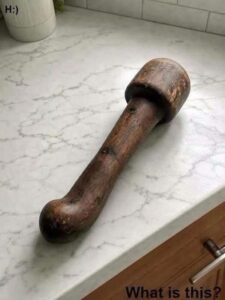
At first glance, the old wooden kitchen utensil looked more like something from a carpenter’s workshop than an ordinary household kitchen. Its curved handle, rounded end, and solid construction made it difficult to identify. There were no electrical parts, sharp blades, or complicated mechanisms. It was simply a piece of carefully shaped wood that appeared to have survived decades of everyday use.
For someone accustomed to modern kitchen appliances, it might seem almost useless. But for generations of home cooks, simple wooden utensils were essential tools that made preparing meals easier, faster, and more convenient.
The mystery becomes clearer when you consider how kitchens operated before electric mixers, food processors, and modern cooking equipment became common.
One of the most likely uses of this particular type of utensil was preparing mashed potatoes.
After potatoes had been boiled until tender, they needed to be broken down into a soft consistency. A wooden masher allowed someone to press the cooked potatoes repeatedly without scratching or damaging the cooking pot.
The rounded end distributed pressure across the potatoes, while the handle provided enough leverage for repeated movements.
It was a simple idea, but an effective one.
Families could prepare generous portions without needing expensive equipment or complicated machinery. The cook simply placed the softened potatoes in a suitable bowl or pot and pressed them until they reached the desired texture.
Depending on the design, the tool could also be used to mash other cooked vegetables, including carrots, turnips, and squash.
But mashed potatoes were only part of the story.
Older kitchens relied heavily on wooden utensils because wood was widely available, relatively inexpensive, and comfortable to handle. Unlike some metal tools, wooden implements were less likely to scratch traditional cookware.
They were also easy to clean and could last for many years when properly maintained.
In households where almost everything was prepared from scratch, a sturdy wooden utensil could serve several purposes.
Some cooks used similar tools to crush soft fruits for homemade sauces, prepare cooked vegetables for soups, or break down ingredients before combining them with other foods.
The exact purpose depended on the utensil’s shape.
A broad, flat end was particularly useful for pressing and mashing, while a rounded or slightly textured surface could help crush ingredients more evenly.
This explains why old kitchen tools sometimes look unfamiliar today. Their designs were developed around practical household needs rather than modern convenience.
Another reason these utensils remained popular was their simplicity.
There were no motors to maintain, no electrical connections to fail, and no complicated parts to replace. A wooden masher could be stored in a drawer, hung beside other utensils, or kept near the cooking area for easy access.
For families preparing several meals every day, reliability mattered.
A single wooden tool could be used repeatedly without requiring anything more than ordinary cleaning and occasional care.
Wooden kitchen utensils also carried a personal connection to family traditions.
In many households, cooking was a shared activity. Children watched parents and grandparents prepare familiar dishes, learning techniques through observation and practice.
A wooden masher might have been used by several generations of the same family. Its worn handle and softened edges could reflect years of regular use.
Some families even kept older utensils long after purchasing modern replacements because the familiar tools reminded them of parents, grandparents, and childhood meals.
There was something comforting about using an object that had helped prepare countless family dinners.
Of course, not every unusual wooden utensil was designed for potatoes. Without seeing its exact shape, dimensions, and working surface, identifying an antique kitchen tool with complete certainty can be difficult.
Similar-looking wooden implements were used for different tasks, including crushing spices, mixing ingredients, and preparing traditional foods.
That is why collectors and antique enthusiasts pay close attention to small design details.
The width of the handle, the shape of the head, the presence of grooves, and even the type of wood can offer clues about an object’s original purpose.
For example, a broad, solid head suggests a tool intended for pressing or mashing. A narrower end might indicate that it was designed for stirring or working with smaller quantities of ingredients.
The wear patterns can also provide useful information.
Repeated pressure may leave subtle marks on the working surface, while years of handling can smooth the wooden grip.
These details help explain how an otherwise ordinary-looking object became part of everyday kitchen life.
Today, electric appliances have made food preparation considerably faster. A modern food processor can perform in seconds what once required several minutes of repetitive hand movements.
Yet traditional wooden tools have not disappeared completely.
Many home cooks still prefer manual mashers because they offer greater control over texture. Potatoes, for example, can become overly sticky when processed too aggressively. A simple hand-operated masher allows the cook to decide exactly how smooth or chunky the final result should be.
Wooden utensils also remain popular in kitchens where people appreciate traditional cooking methods and durable household equipment.
Their continued use demonstrates that not every old-fashioned design needs to be replaced by technology.
Sometimes, the simplest tool is still the most practical.
The next time you discover an unusual wooden object in an old kitchen drawer, take a closer look before deciding that it belongs in the trash.
Its shape may reveal a forgotten cooking technique, a traditional family recipe, or a practical household invention that once made everyday life easier.
What appears mysterious today may have been an indispensable kitchen companion for someone decades ago.
And perhaps that is what makes old kitchen utensils so fascinating.
They are more than pieces of wood. They are reminders of a time when cooking depended on patience, experience, and simple tools that were built to last.