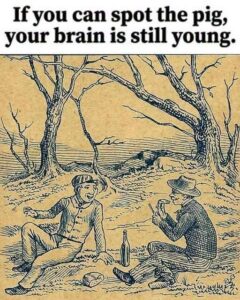
At first glance, this vintage illustration looks like an ordinary countryside scene. Two friends are enjoying a peaceful picnic beneath several bare trees. The atmosphere appears calm, the surroundings seem harmless, and nothing immediately suggests that the picture contains a hidden animal.
But there is a surprising secret waiting to be discovered.
Somewhere inside the illustration, a pig has been cleverly disguised among the different shapes and details. Finding it sounds easy, but many people discover that their eyes keep overlooking the animal even after several attempts.
This entertaining visual puzzle has become a fascinating challenge for people who enjoy brain teasers, optical illusions, and hidden-picture games.
The question is simple: Can you find the hidden pig before reading the answer?
A Simple Picture With a Clever Secret
The illustration features two people sitting outdoors, apparently enjoying a relaxing afternoon together. Several bare trees surround them, while picnic items help create the appearance of a traditional countryside gathering.
At first, most viewers concentrate on the obvious objects.
They notice the people, examine the picnic arrangement, and follow the branches stretching across the picture. Their attention naturally moves toward the most recognizable parts of the illustration.
However, the hidden pig is designed to blend into the surrounding details.
Rather than appearing as a clearly recognizable animal, its shape is incorporated into the existing visual patterns. This makes it difficult to identify because the brain initially interprets the unusual lines as ordinary parts of the scenery.
That is what makes the puzzle so entertaining.
Why Is the Hidden Pig So Difficult to Find?
The difficulty comes from the way our brains process visual information.
When we look at a familiar scene, our minds quickly organize objects into recognizable categories. Trees look like trees, people look like people, and picnic items appear to be ordinary household objects.
We rarely question those first impressions.
Hidden-picture puzzles take advantage of this natural habit. They place unexpected shapes inside familiar surroundings, encouraging viewers to overlook details that do not immediately attract attention.
In this particular challenge, the pig’s disguise makes it especially difficult to recognize.
Viewers may spend several minutes examining the same section without realizing that the answer has been sitting directly in front of them.
Sometimes, looking harder is not enough. Looking differently makes all the difference.
How to Find the Hidden Pig
If you are struggling to locate the animal, try changing the way you examine the illustration.
Here are several useful techniques:
1. Stop focusing only on the people.
The two friends are the most obvious subjects in the drawing, so it is natural to concentrate on them. Instead, move your attention toward the surrounding scenery.
2. Examine the tree branches.
Bare branches create unusual shapes, overlapping lines, and unexpected outlines. Look carefully at how different parts connect.
3. Look for unusual curves.
A pig has recognizable features, including a rounded body, a snout, and ears. Look for shapes that resemble these characteristics.
4. Change your viewing distance.
Move slightly away from the picture or zoom out if you are viewing it on a screen. Sometimes, a hidden shape becomes easier to recognize when you stop examining individual lines.
5. Turn your attention away briefly.
After looking at the same picture for several minutes, your eyes may become accustomed to its patterns. Take a short break and return with a fresh perspective.
These techniques can help you approach many other hidden-object challenges, too.
The Science Behind Optical Illusions and Hidden Pictures
Hidden-picture puzzles are more than simple entertainment. They demonstrate how perception and attention work together.
Our brains constantly receive information through our eyes, but they cannot consciously focus on every detail at once.
Instead, the brain prioritizes information that appears important or familiar.
This process is sometimes called selective attention.
For example, when looking at a picture of a picnic, you naturally recognize the people, food, and surrounding trees. Your brain organizes these objects into a familiar scene.
An unusual shape hidden inside a tree branch may therefore remain unnoticed.
Another interesting concept is figure-ground perception. This describes how the brain separates an object of interest from its background.
When an animal is disguised using the same lines and shapes as the surrounding scenery, distinguishing it from the background becomes much harder.
That is why some people suddenly recognize the hidden pig after someone gives them a small clue.
The picture has not changed. Their way of interpreting it has.
Why People Love These Picture Challenges
Visual puzzles have remained popular for generations because they offer a simple form of entertainment that almost anyone can enjoy.
Unlike complicated games, they require no special equipment, expensive materials, or previous experience.
All you need is a picture and a little patience.
They are also excellent conversation starters. Families can challenge one another, friends can compete to find the hidden object first, and children can enjoy searching for unusual shapes.
These puzzles can encourage:
- Careful observation and attention to detail.
- Creative thinking and visual interpretation.
- Patience when solving difficult challenges.
- Friendly competition among family members.
- A fun break from everyday routines.
The best part is the moment when someone finally spots the hidden object. What once looked like an ordinary collection of lines suddenly becomes something completely different.
Have You Found the Pig Yet?
Before giving up, take another look at the illustration.
Ignore the obvious picnic scene for a moment. Examine the unusual outlines, follow the branches, and search for a shape that doesn’t quite belong.
Don’t rush.
Sometimes the easiest objects to recognize are the ones we overlook because we expect them to look completely different.
If you have already discovered the pig, congratulations! Your observation skills have helped you solve a tricky visual challenge.
If you are still searching, don’t worry. These puzzles are designed to make familiar shapes surprisingly difficult to recognize.
Final Thoughts
This vintage hidden-pig puzzle proves that an ordinary-looking picture can contain an unexpected surprise.
What appears to be a peaceful picnic scene becomes an entertaining test of observation, concentration, and visual imagination.
Whether you solve it in a few seconds or spend several minutes searching, the experience is part of the fun.
So share the challenge with your friends and family. See who can discover the cleverly disguised animal first, and find out who has the sharpest eyes.
Remember, sometimes the biggest mystery is hiding in the smallest detail!