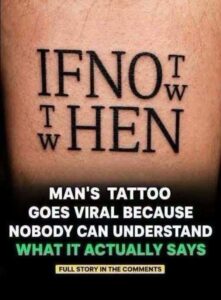
At first, the photograph seemed ordinary. It showed a person’s forearm with a black-ink tattoo containing several words arranged in an unusual pattern. But the longer people looked at it, the more confusing it became.
The letters appeared to overlap, some were upside down, and others seemed to disappear into the surrounding design.
Within hours, the photograph had been shared thousands of times.
People started offering their own interpretations.
One person claimed the tattoo said, “Never give up on yourself.” Another insisted it read, “Everything happens for a reason.” Someone else suggested that the words were written backward and needed to be viewed in a mirror.
But nobody could provide a convincing explanation.
The mystery became even more interesting when someone noticed that the tattoo might not be intended to be read from left to right.
Instead, the letters appeared to follow a particular visual pattern.
A user commented, “Stop trying to read it like a normal sentence. Look at the entire design.”
That suggestion changed the conversation.
People began examining the photograph differently. They rotated their screens, enlarged individual sections, and compared the shapes of the letters.
Some thought the tattoo was an example of ambigram lettering, a style in which words or symbols are designed to remain recognizable when viewed from different angles.
Others believed it was a form of optical illusion.
The unusual arrangement made it difficult to distinguish where one letter ended and another began.
Soon, tattoo enthusiasts joined the discussion.
One professional tattoo artist explained that decorative lettering can become difficult to read when the artist prioritizes visual appearance over clarity. Certain fonts use elaborate curves, extended strokes, and overlapping lines that look attractive on paper but become confusing when transferred onto skin.
The artist also pointed out that tattoos can change in appearance over time. Ink spreads slightly beneath the skin, and fine details may become less distinct as the tattoo ages.
That could make an already complicated design even harder to understand.
However, there was another possibility.
Perhaps the tattoo wasn’t supposed to be immediately readable.
Some people choose tattoos that carry private meanings. A phrase may represent a personal experience, a difficult period in life, or a promise that only the person wearing it truly understands.
A hidden message can make such a tattoo more meaningful to its owner.
One commenter wrote, “Maybe the point isn’t for everyone else to understand it. Maybe it’s something personal.”
That comment received considerable attention.
As the photograph continued circulating, people began debating whether the tattoo was actually beautiful or simply confusing.
Some admired the creativity.
Others questioned why anyone would permanently place words on their body if nobody could read them.
A tattoo designer entered the discussion with an interesting observation.
According to the designer, unusual lettering often involves several competing elements: readability, artistic expression, placement, and the natural shape of the body.
A design that looks perfectly clear on a flat computer screen might appear completely different when wrapped around an arm.
The direction of the viewer’s eyes also matters.
When someone looks at a tattoo from the side, the letters may appear distorted. When the arm turns, the design changes again.
This means a photograph taken from one particular angle might not show the tattoo as its creator intended.
People began asking the most obvious question: Had anyone actually asked the person wearing it what it said?
Eventually, someone claimed to have found an explanation.
The tattoo was reportedly designed around a motivational message, but the unusual lettering made the phrase difficult to recognize without knowing the intended reading direction.
That possibility brought a new wave of comments.
Some users said they had spent several minutes studying the image before finally understanding the arrangement.
Others admitted that even after reading the explanation, they still struggled to recognize the words.
The discussion also raised an interesting question about tattoos themselves.
Why do people choose designs that other people might misunderstand?
For many, tattoos are deeply personal forms of expression. They can commemorate loved ones, represent important milestones, or serve as reminders of lessons learned through difficult experiences.
A phrase that looks confusing to a stranger may hold extraordinary meaning for the person wearing it.
Consider someone who chooses the words “Keep Moving Forward” after overcoming a difficult period in life.
To another person, those words might appear ordinary. But to the individual who carries them, they could represent years of determination, sacrifice, and personal growth.
That is what makes tattoos different from ordinary decorations.
They often tell stories that cannot be understood by looking at the artwork alone.
Still, the photograph’s popularity demonstrated something else: people love a visual mystery.
When an image presents something familiar in an unfamiliar way, our brains naturally try to make sense of it.
We recognize individual letters, but when those letters are arranged unexpectedly, reading becomes a challenge.
Our eyes attempt to identify patterns, connect shapes, and predict what should come next.
Sometimes that process helps us solve the puzzle.
Other times, it makes us see things that aren’t actually there.
That is why different viewers can interpret the same unusual lettering in completely different ways.
The tattoo photograph became a perfect example of how easily an ordinary image can turn into an internet mystery.
People weren’t necessarily looking at an extraordinary piece of artwork. They were looking at something that challenged their expectations.
And that was enough to keep thousands of people discussing it.
In the end, the biggest lesson may have nothing to do with the exact words written on the arm.
It is a reminder that appearance can be misleading. Something that seems meaningless at first glance may have a story behind it that we cannot immediately see.
Perhaps the tattoo was an artistic experiment. Perhaps it represented a deeply personal message. Or perhaps it was simply a design that didn’t turn out as clearly as its owner expected.
Without a clear photograph or confirmation from the person wearing it, the exact wording remains uncertain.
But one thing is certain: the image succeeded in making people stop scrolling, look closer, and question what they thought they were seeing.
And sometimes, that is all a photograph needs to become an internet sensation.