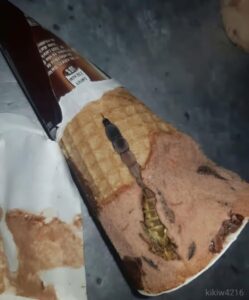
An ordinary afternoon can quickly become unforgettable when something unexpected turns a familiar family routine into a frightening experience. For one mother, what began as a simple after-school treat for her eight-year-old daughter became a disturbing discovery that raised questions about food safety, manufacturing standards, and the importance of protecting children from potentially contaminated products. While enjoying her favorite chocolate ice cream cone, the young girl noticed something unusual hidden beneath the creamy surface. What appeared to resemble a tiny scorpion immediately transformed a happy moment into one filled with fear, confusion, and disbelief.
The discovery was particularly unsettling because the ice cream had been purchased in its original packaging, which appeared completely intact. The mother initially assumed her daughter had encountered an ordinary piece of chocolate or another ingredient that looked unusual. However, after examining the object more closely, she noticed its distinctive shape, including what appeared to be a segmented body and curved tail. Although its actual identity remained uncertain, its resemblance to a small scorpion was enough to frighten both mother and daughter.
For the child, the experience was especially difficult because ice cream had always represented happiness and comfort. A favorite dessert suddenly became associated with something frightening and unfamiliar. Her mother understood that the situation required more than simply throwing away the product. It was important to preserve the available evidence, determine what the object actually was, and establish whether there might be a genuine food safety concern.
The first priority was to stop eating the product. Rather than attempting to identify the object by touching or tasting it, the mother carefully separated the remaining ice cream and packaging. She photographed the unusual material, including its appearance and the product information printed on the wrapper. Keeping the original packaging, receipt, expiration date, and batch number could help identify the product and assist any subsequent investigation.
These details are particularly important when reporting suspected contamination. Manufacturers need accurate information to trace products through their distribution and production systems. Photographs can also help investigators understand the nature of the complaint before examining the physical object. If possible, consumers should preserve the product safely according to guidance from the relevant food safety authority rather than sending potentially contaminated material without instructions.
Another important step involves contacting the retailer and manufacturer. A customer service department can register a formal complaint, request photographs, and explain how suspected foreign materials should be submitted for examination. Consumers should ask for a reference number and retain copies of all correspondence. If the manufacturer provides an explanation, requesting written findings can make it easier to understand what was discovered and whether additional action is necessary.
Food contamination is a subject that deserves serious attention, even when an unusual discovery eventually turns out to be harmless. Food manufacturing involves multiple stages, including ingredient preparation, mixing, processing, freezing, packaging, storage, and transportation. Each stage requires appropriate hygiene procedures and quality controls. Foreign materials can occasionally enter food through raw ingredients, damaged equipment, packaging materials, or unexpected production failures.
However, an unusual object should not automatically be identified as an insect or dangerous animal based on appearance alone. Chocolate, caramel, and other confectionery ingredients can form irregular shapes during manufacturing. Frozen mixtures can also produce unusual textures and patterns that appear surprisingly realistic. Professional examination is necessary before making claims about the object’s identity or origin.
This distinction matters because dramatic photographs and alarming descriptions can quickly spread online without providing reliable evidence. A photograph showing something that resembles a scorpion does not establish that a real scorpion was present in the product. Similarly, an intact-looking package does not independently prove that contamination occurred inside a factory. Careful investigation helps separate verified information from assumptions and speculation.
For parents, the emotional consequences can extend beyond the immediate incident. Children may develop temporary fears about unfamiliar foods, packaged desserts, or even products they previously enjoyed without hesitation. An experience that seems relatively minor to an adult can feel overwhelming to a young child who does not fully understand how manufacturing and food safety work.
Parents can help by listening patiently, acknowledging the child’s feelings, and explaining what happened in age-appropriate language. There is no need to dismiss the fear or repeatedly expose the child to the frightening object. Instead, reassurance should focus on practical steps being taken to understand the situation and ensure that future meals are handled safely.
If a child has swallowed an unknown object or may have been exposed to a potentially harmful substance, parents should seek appropriate medical advice. Symptoms such as persistent vomiting, abdominal pain, difficulty breathing, or signs of an allergic reaction require prompt attention. Even when no symptoms are present, professional guidance can help determine whether further evaluation is necessary.
Food safety authorities also play an important role in investigating complaints involving foreign materials. Depending on the country and the product involved, consumers may report suspected contamination to a local health department or national food safety regulator. These organizations can assess whether the complaint requires additional investigation, laboratory examination, or communication with other agencies.
For manufacturers, incidents involving unexpected materials can damage consumer confidence even when no serious health consequences occur. Customers expect packaged foods to meet established hygiene and quality standards. Transparent communication, careful investigation, and appropriate corrective measures are essential for maintaining that confidence. If a production problem is confirmed, companies may need to review equipment, inspect manufacturing processes, and determine whether other products from the same batch could be affected.
The incident also highlights the importance of avoiding unnecessary panic when sharing food safety concerns online. Parents understandably want to warn others when something appears dangerous, but unverified claims can create confusion and unfairly damage reputations. Sharing clear photographs, product information, and confirmed findings is more useful than presenting speculation as established fact.
Ultimately, the discovery of a scorpion-like object inside a chocolate ice cream cone illustrates how quickly an ordinary family moment can become a source of concern. It also demonstrates why food safety complaints deserve thoughtful attention, proper documentation, and transparent investigation. Whether an unusual object turns out to be a manufacturing irregularity, an ingredient formation, or something more concerning, identifying it accurately is essential.
For families, the most important priorities remain protecting children’s health, responding calmly, and seeking reliable answers. A favorite dessert should represent enjoyment rather than fear. With appropriate investigation, responsible communication, and compassionate support, families can address unsettling experiences without allowing uncertainty to overshadow every ordinary pleasure. The lasting lesson is simple: food safety depends on vigilance, accountability, and trust, while emotional recovery begins with reassurance, patience, and the confidence that genuine concerns deserve to be taken seriously.