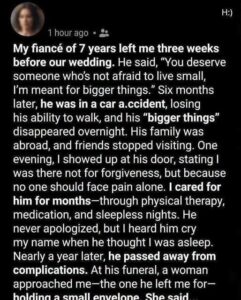
I never imagined that the man I had loved for seven years would become a stranger just three weeks before our wedding. We had planned everything together: the ceremony, the reception, our future home, and the little details that make a wedding unforgettable. Our invitations had already been delivered, my wedding dress was waiting at the tailor, and both families were preparing for the celebration.
Then, without warning, everything changed.
My fiancé looked directly into my eyes and told me he wanted something different from life.
“You deserve someone who isn’t afraid to live small. I’m meant for bigger things.”
Those words broke something inside me. I wanted to ask what had changed, whether there was someone else, or why seven years together suddenly meant so little. But I couldn’t find the strength to argue.
I watched him leave, closed the door, and cried until morning.
Seven Years of Love Ended in One Conversation
For seven years, I had believed we were building something permanent.
We had shared birthdays, holidays, family celebrations, difficult financial moments, and countless ordinary evenings. I knew his habits, his dreams, and the little things that made him laugh.
I had imagined growing old beside him.
That was why his decision felt impossible to understand.
The wedding preparations became painful reminders of everything I had lost. I had to explain the cancellation to relatives, contact vendors, and face questions from people who could not understand what had happened.
Some offered sympathy. Others suggested I had probably missed warning signs.
I didn’t have answers.
Eventually, I packed away the wedding dress and stopped looking at the invitations. I needed to accept that the future I had imagined was no longer mine.
Six Months of Learning to Live Again
The months following the breakup were difficult.
At first, everything reminded me of him. A familiar song could bring back an entire evening. Passing a restaurant where we had celebrated an anniversary sometimes made me want to turn around.
But gradually, I began rebuilding my life.
I spent more time with friends and family, returned to activities I had neglected, and learned to enjoy being alone.
I stopped checking his social media and resisted the temptation to ask mutual friends about his life.
It wasn’t easy, but I began understanding that healing did not require forgetting someone. It required accepting that loving someone did not mean I had to wait for them.
By the sixth month, I was finally beginning to feel like myself again.
Then one rainy evening, my telephone rang.
The Phone Call That Changed Everything
The voice on the other end delivered news I never expected.
My former fiancé had been involved in a serious accident.
He had survived, but his injuries were severe, and his recovery would be long and uncertain.
For several moments, I couldn’t speak.
Despite everything that had happened between us, hearing that someone I had once loved was seriously injured brought back emotions I thought I had buried.
I asked where he was and whether he had family with him.
The person explained that his situation was complicated and that he would need considerable support.
I spent the rest of the evening thinking about what to do.
Part of me remembered the humiliation of being abandoned shortly before our wedding. Another part remembered the seven years during which he had been my closest companion.
By morning, I had made a decision.
Standing Outside the Door
The following day, I drove to his apartment.
Rain was still falling lightly when I arrived. I stood outside his door, wondering whether I was making a terrible mistake.
What would he say when he saw me?
Would he apologize? Would he ask me to leave? Would I regret reopening a chapter I had worked so hard to close?
Finally, I knocked.
When the door opened, I discovered a man who looked very different from the person I remembered.
The accident had changed his appearance and left him facing challenges he had never imagined.
For a moment, neither of us spoke.
Then he looked at me and whispered my name.
I stepped inside.
I had not come to pretend the past never happened. I had come because, despite the pain between us, I could not ignore the suffering of someone who had once been an important part of my life.
The Conversation We Never Had
During the following days, I visited whenever I could.
Our conversations were difficult at first. There were long silences and moments when neither of us knew what to say.
Eventually, he began talking about the accident and the months leading up to it.
He admitted that he had become obsessed with the idea of achieving something extraordinary. He believed marriage would limit his freedom and that leaving would somehow bring him closer to the life he imagined.
But his decision had consequences he had never properly considered.
He apologized for the way he had ended our relationship and for the pain he had caused.
I listened, but I did not immediately offer forgiveness.
Some wounds need time, and an apology does not erase what happened.
Still, I recognized that we were both different people now.
When Forgiveness Became More Important Than Anger
As his condition changed, I found myself thinking less about the wedding that never happened and more about the fragile nature of life.
I remembered the younger version of us, making promises without understanding how unpredictable the future could be.
I also realized that helping someone through suffering did not mean accepting everything they had done.
I could care about him without returning to the relationship. I could forgive without pretending the abandonment had not happened.
That distinction became important.
My visits were no longer about rebuilding the romance we had lost. They were about compassion, shared history, and offering kindness during an extremely difficult time.
The Final Goodbye
Eventually, his condition deteriorated.
One evening, I received another call asking me to come.
When I arrived, he was extremely weak. I sat beside him and held his hand.
He looked at me with an expression I will never forget.
“I’m sorry,” he whispered.
I squeezed his hand.
There were so many things I could have said. I could have reminded him of the wedding, the promises, and the night he walked away.
Instead, I told him that I hoped he could find peace.
He struggled to speak again, but I stayed beside him.
As his breathing became weaker, I held his hand and remembered the seven years we had shared.
I was there when he took his final breath.
The silence afterward was unlike anything I had experienced before.
Learning to Live With Two Different Endings
Losing him brought a different kind of grief.
I mourned the person I had once loved, the future we never shared, and the painful circumstances that had brought us to that final moment.
But I also felt grateful that our last interaction had not been another argument.
I had been given an opportunity to choose compassion without abandoning my own dignity.
That did not make everything right, and it did not erase the pain of being left before our wedding.
It simply allowed me to move forward without carrying the same anger.
The Meaning of Love Beyond Promises
Today, I understand that love is not only about promises made during happy moments.
It is also about the choices we make when life becomes complicated.
Sometimes relationships end before we are ready. Sometimes people hurt us in ways that cannot be undone. And sometimes we discover that forgiveness is something we do for our own peace, not necessarily to restore what was lost.
I never became his wife.
But I was beside him when he needed someone, and I will always remember that final act of kindness.
Our story did not end with the wedding we had planned. It ended with a goodbye neither of us could have imagined.
And although I will always wish things had been different, I have learned that compassion and self-respect can exist together.
Sometimes the heart finds peace not by changing the past, but by deciding what kind of person it wants to be after everything has happened.