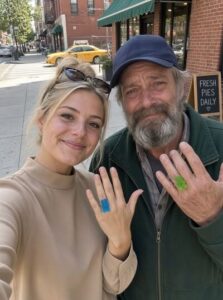
I never imagined that the quiet homeless man who stood outside my coffee shop every morning was actually my father. For three years, I served him coffee, listened to his occasional stories, and watched him disappear down the street without ever asking for anything more. I thought his name was Douglas, and I believed he was simply another lonely person struggling to survive.
Then, one morning, everything changed.
Douglas was missing. His usual place beside the front window was empty, and his cardboard sign was nowhere to be seen. I assumed he had found somewhere warmer to stay. But when I opened the shop, I noticed a small envelope tucked beneath the door.
My name was written across it.
Inside were several handwritten pages, a photograph of a little girl wearing yellow pajamas, and a letter that began with five words:
“Maggie, I am your father.”
I read the sentence again and again, unable to understand what I was seeing.
My father had abandoned me when I was five years old. My mother had told me he was gone and that I should never expect him to return. For most of my childhood, I believed he had chosen a different life without me.
Now, the stranger I had been helping for three years had revealed that he was the man I had spent my entire life trying to forget.
I closed the coffee shop early and took the letters home.
The first pages described the night he left. He admitted that he had struggled with alcohol, argued constantly with my mother, and made promises he never kept. He remembered me standing in the hallway holding a stuffed rabbit, asking whether he would be home for breakfast.
He had promised that he would.
He never returned.
He wrote that shame had followed him for years. He tried contacting my mother twice, but she refused to let him see me. Eventually, she moved away and changed her telephone number.
He admitted that he had no right to blame her.
Then came the part that hurt most.
He explained that he had recognized me immediately when he first saw the sign above my coffee shop: Maggie’s Corner.
He had stood across the street for nearly an hour, watching me welcome customers and arrange the chairs.
He wanted to walk inside and introduce himself.
But he couldn’t.
He feared I would look at him and see only the father who had abandoned a little girl waiting for breakfast.
So he returned the following morning, carrying his cardboard sign.
For three years, he watched me build my business. He learned my routine, my favorite coffee, and the way I smiled whenever someone complimented the shop.
He accepted my kindness without telling me who he was.
One sentence was underlined twice:
“I know I have no right to ask her to love me, but for three years she gave me kindness without knowing she was giving it to her father.”
I cried until I could barely see the pages.
The following morning, I contacted the attorney whose details appeared at the bottom of the letter.
Mr. Franklin confirmed that Douglas had left behind a life insurance policy worth approximately $61,000.
He had maintained the policy for nineteen years, paying the premiums whenever he could afford them.
Sometimes he worked temporary jobs. Other times, he struggled to find enough money for food.
Yet he continued making those payments.
I asked why he had never contacted me directly.
The attorney explained that Douglas believed my mother had legally removed him from my life. He had also been ashamed of his past and uncertain whether I would ever accept him.
Then I asked about a confusing reference to a marriage certificate in his paperwork.
Mr. Franklin gently explained that Douglas had married another person as part of a legal arrangement intended to help organize his affairs. I was not his spouse, but I was the person he ultimately wanted to benefit from what he had saved.
The money had been intended to give me a more secure future.
“He never believed the money could replace the years he lost,” the attorney told me. “He simply wanted to leave you something meaningful.”
I sat silently after the call.
My father had spent nineteen years preparing a gift for a daughter he believed might never forgive him.
For months, I couldn’t decide what to do with the money.
Eventually, I visited several shelters mentioned in his letters. I met a retired nurse named Helen who remembered Douglas bringing blankets to people even when he barely had enough clothing for himself.
She told me he often spoke about his daughter.
“He was proud of you,” she said. “He used to talk about your coffee shop as though it were the greatest place in the world.”
That conversation changed something inside me.
I decided to use part of his inheritance to open a small community space near the subway.
I called it The Open Door.
We served free coffee, soup, and sandwiches to people who needed somewhere warm to sit. Volunteers helped visitors prepare job applications, find clothing, and connect with local support services.
At first, only three people came.
But gradually, more people discovered the place.
An older man arrived every morning with two plastic bags. A woman named Patricia always chose the chair beside the window. A young father began bringing his daughter every Saturday.
Nobody was required to purchase anything.
Nobody had to explain why they needed help.
One winter morning, I placed Douglas’s photograph behind the counter.
Beneath it, I wrote:
“Everyone deserves a place to sit.”
I still miss my father, and I wish he had told me the truth while he was alive. I wish I could have called him Dad, asked him about his childhood, and given him the chance to explain everything face-to-face.
I cannot change the past.
I also cannot pretend that his abandonment didn’t hurt me.
But I can choose what I do with the future he left behind.
Every morning, I unlock The Open Door, switch on the lights, and prepare a fresh pot of coffee.
The first cup is always free.
Sometimes, when the room is quiet, I imagine Douglas sitting in his old chair, folding his cardboard coffee sleeve into that familiar little square.
I used to believe his greatest gift was the $61,000 he had saved.
Now I understand that the money was only part of it.
His final gift was a lesson I will carry forever: sometimes the people who appear to have nothing are carrying stories we cannot imagine.
And sometimes, a simple cup of coffee can become the beginning of something much bigger than either person realizes.
My father spent three years standing outside my door, believing he didn’t deserve to enter.
I wish I had known who he was.
But I am grateful that, even without knowing his name, I gave him a little kindness when he needed it most.