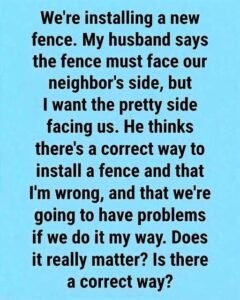
When my neighbor announced that he was building a new fence between our properties, I thought it would be a simple improvement. We had lived beside each other for years without any serious disagreements, and I assumed the project would make both yards look better.
But everything changed when I discovered that the attractive, finished side of the fence would face his garden, leaving me with a view of exposed wooden posts, rough supports, and unfinished boards.
At first, I thought it was an honest mistake.
I decided to speak with him before construction began, hoping we could reach a reasonable agreement. I wasn’t asking him to spend extra money or abandon his plans. I simply wanted both sides of the fence to look equally attractive.
His response surprised me.
He laughed and explained that since he was paying for the entire project, he could decide which side faced where.
I tried to explain that we would both have to look at the fence every day. He shrugged and told me that the appearance of my yard wasn’t his responsibility.
I was about to walk away when he added something that completely changed the conversation.
Apparently, the fence wasn’t entirely on his property.
And that small detail was about to become much more important than either of us had expected.
A disagreement I never expected
My name is David, and I had lived in my house for almost eleven years. My neighbor, Mark, had moved in a few years after me. We weren’t particularly close, but we usually exchanged greetings, occasionally helped each other with small household problems, and had never experienced a serious disagreement.
Our properties were separated by an old wooden fence that had gradually deteriorated.
Several boards were loose, the paint had disappeared in places, and one section leaned noticeably toward my garden.
When Mark announced that he intended to replace it, I thought it was an excellent idea.
He explained that he had contacted a contractor and planned to install a modern wooden fence. I agreed that the old structure needed attention and assumed we would discuss the details before construction began.
However, I soon discovered that Mark had already made several decisions.
He had selected the materials, chosen the design, and arranged the installation without consulting me.
I wasn’t particularly concerned about those choices because he was paying for the project.
But when the contractor began explaining how the finished fence would look, I noticed something.
The smooth, attractive side would face Mark’s garden.
My side would show the supporting posts and unfinished structural elements.
I asked whether the panels could be installed differently.
The contractor explained that the design allowed for different arrangements, although the final decision belonged to the property owners and would need to follow the relevant installation requirements.
That was when I decided to speak with Mark.
His answer made everything worse
I approached Mark that afternoon while he was standing near the proposed fence line.
I explained that I appreciated his willingness to replace the old structure, but I hoped we could find a design that looked attractive from both gardens.
He immediately became defensive.
“Why should I pay extra to make your side look nice?”
I told him that I wasn’t asking him to pay extra. I simply wanted us to consider a different arrangement.
He laughed.
“David, I’m paying for this fence. I can put the finished side wherever I want.”
I reminded him that the fence separated two properties and that both households would have to live with its appearance.
He shrugged.
“Then plant some bushes if you don’t like looking at it.”
I was disappointed by his attitude, but I didn’t want a neighborhood argument.
I was preparing to leave when Mark casually mentioned that the fence would follow the existing boundary.
I asked what he meant.
He explained that the contractor intended to replace the old fence using the same alignment, including the section that had apparently been placed several inches inside my property years earlier.
I stopped walking.
“Are you saying the new fence will also be partly on my land?”
Mark looked at me.
“That’s where the old one is. It’s always been there.”
That was the detail that changed everything.
The boundary nobody had checked
I had purchased my house eleven years earlier, and the property documents included a survey showing the legal boundaries.
I remembered that the old fence had never been precisely aligned with the boundary markers. At the time, the difference seemed insignificant, and neither neighbor had considered it worth discussing.
But Mark’s new project made the issue important.
I explained that I wanted to review my property survey before anyone started digging or installing posts.
He rolled his eyes.
“You’re making this unnecessarily complicated.”
I remained calm.
“I’m not trying to stop your project. I just want to make sure the fence is installed in the correct place.”
He told me that the contractor had already measured everything and that there was no reason to delay.
I didn’t argue further.
Instead, I went inside and retrieved the documents from my property file.
The survey showed the boundary line and the location of the old fence. Although the measurements needed professional confirmation, it appeared that part of the existing structure crossed onto my property.
I decided to contact a licensed surveyor.
I also checked the local requirements concerning boundary fences, because I knew that rules about ownership, placement, height, and shared responsibilities could vary depending on the location.
I wasn’t interested in creating a legal battle over a few inches of land.
I simply wanted accurate information before construction began.
The conversation takes an unexpected turn
Two days later, the surveyor visited the property.
He examined the existing boundary markers, reviewed my documents, and explained that the fence alignment should be checked before the contractor proceeded.
I arranged for Mark to be present during the discussion.
Initially, he seemed irritated.
But when the surveyor explained that the old fence might not accurately represent the legal boundary, Mark became noticeably quieter.
The surveyor did not make any dramatic accusations or declare that either of us had intentionally occupied someone else’s land.
He simply explained that the available measurements needed to be verified and that the new fence should not be installed based solely on the position of the old structure.
Mark finally asked whether this meant he would have to change his plans.
The surveyor explained that the final arrangement would depend on the confirmed boundary and the applicable local requirements.
I could see that Mark was beginning to understand the situation.
His assumption that he could simply replace the old fence wherever it stood was no longer something he could take for granted.
I turned toward him.
“I don’t want trouble with you. I just want us to get this right.”
For the first time, he didn’t respond with a sarcastic comment.
A better solution for both properties
After the boundary information was clarified, Mark and I sat down to discuss the project again.
The conversation was considerably more productive than our first one.
I suggested that we consider a fence design with a finished appearance on both sides.
The contractor explained that there were several options, including alternating-board designs and other arrangements that could provide a more balanced appearance.
We also discussed how the structure would be positioned, how much space it would require, and how maintenance responsibilities would be handled.
Mark initially worried about additional costs.
I offered to contribute toward a reasonable improvement if it meant both gardens would look better.
We eventually agreed on an arrangement that worked for both households, subject to the confirmed boundary and local requirements.
The new fence was installed several weeks later.
It looked clean and attractive from both gardens, and neither of us had to stare at an unfinished collection of posts and supports.
More importantly, the construction took place without creating another disagreement about property ownership.
What I learned from a simple fence
A few weeks after the project was completed, Mark approached me while I was working in my garden.
He admitted that he had reacted badly during our original conversation.
He explained that he had been focused on the cost and had not considered how the finished fence would look from my side.
I appreciated his honesty.
We didn’t suddenly become best friends, but our relationship improved.
We began greeting each other more regularly, and the tension that had developed during construction gradually disappeared.
Looking back, I realized that the fence itself had never been the biggest problem.
The real issue was the assumption that paying for something automatically gave one person the right to ignore everyone else affected by the decision.
Property boundaries matter. So do local regulations, written agreements, and clear communication.
A fence might appear to be a simple household improvement, but it can involve questions about ownership, maintenance, costs, privacy, and long-term relationships.
If I had simply accepted Mark’s original arrangement, we might have ended up with a poorly positioned fence and years of resentment.
Instead, taking the time to review the property documents and obtain professional advice helped us avoid a much bigger disagreement.
Today, whenever I look at the fence, I remember how close we came to turning a minor home improvement into a neighborhood feud.
And I remember one important lesson:
Sometimes the smallest detail reveals the biggest misunderstanding.
A good neighbor doesn’t necessarily have to agree with every suggestion, share every expense, or make every decision together.
But when a project affects both properties, a little consideration and an honest conversation can make all the difference.