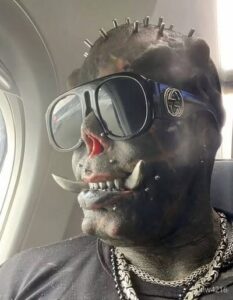
Around the world, people express their individuality through fashion, hairstyles, tattoos, and other forms of personal style. However, few individuals have taken body modification as far as Brazilian artist Diabão Faro do Prado, internationally recognized by the nickname “Human Satan.” His extraordinary appearance has attracted worldwide attention, sparked heated discussions, and challenged conventional ideas about beauty, identity, and artistic expression. With extensive tattoos, prominent horn-like implants, and numerous permanent physical modifications, Diabão has transformed himself into a living example of extreme body art. His story is not simply about appearance; it also raises important questions about personal freedom, individuality, and the boundaries of physical transformation.
Who Is Diabão, the Human Satan?
Diabão Faro do Prado was born in 1975 in Santos, São Paulo, Brazil. Before becoming internationally recognized for his unusual appearance, he worked as a tattoo artist.
His professional background introduced him to the creative possibilities of body art and helped develop his interest in using the human body as a canvas for artistic expression.
Over time, ordinary tattooing became only one part of his personal vision. He gradually explored increasingly unusual forms of body modification, developing an appearance inspired by supernatural and demonic imagery.
The nickname “Diabão,” which translates approximately to “Big Devil,” eventually became closely associated with his public identity.
His transformation attracted attention from international media outlets, photographers, and online audiences curious about the person behind the extraordinary appearance.
A Transformation That Took Decades
Unlike a costume or temporary theatrical appearance, Diabão’s transformation involved numerous permanent physical changes accumulated over many years.
His body features extensive dark tattoos, creating an almost completely covered appearance. His head includes prominent horn-like implants, while other modifications have changed the appearance of his ears, tongue, teeth, and facial features.
He has also undergone procedures such as scarification, which creates permanent patterns or textures on the skin.
Each modification contributes to the overall aesthetic he has chosen to develop.
For Diabão, these changes represent a continuing artistic project rather than a temporary experiment. His appearance has become an important part of his identity and the public image associated with his work.
However, extensive body modification is not without consequences. Surgical procedures, implants, and other invasive alterations can involve infection, scarring, complications, and permanent changes to bodily function.
His experience should therefore not be interpreted as a recommendation for others to pursue similar procedures.
The Artistic Meaning Behind His Appearance
One of the most interesting aspects of Diabão’s story is the relationship between physical appearance and personal identity.
For many people, tattoos and body modifications are ways to communicate experiences, beliefs, memories, or creative interests.
In his case, the overall transformation reflects a deliberately unconventional aesthetic inspired by demonic imagery.
Rather than attempting to meet traditional expectations of attractiveness, he has developed a visual identity that challenges them.
His appearance encourages questions about why certain physical characteristics are considered beautiful while others are viewed as unusual or disturbing.
This discussion extends beyond body modification. Throughout history, different cultures have used tattoos, piercings, scarification, and decorative alterations to communicate social status, cultural belonging, spirituality, and individuality.
Diabão’s approach represents an especially extreme contemporary interpretation of this broader tradition.
The Role of Tattoos and Body Modification Culture
Tattooing has existed across different civilizations for thousands of years. Although its meaning has changed throughout history, it continues to serve as a powerful form of personal expression.
Modern body modification culture includes many different practices, ranging from relatively common piercings to more specialized procedures involving implants and permanent alterations.
For artists and enthusiasts, the human body can become a medium through which they explore creativity and identity.
Diabão’s work has attracted attention partly because it pushes these ideas far beyond what most people encounter in everyday life.
His appearance demonstrates how body modification can become an ongoing artistic commitment, although the medical and social implications become increasingly significant as procedures become more invasive.
His Wife and Their Shared Identity
Another interesting part of Diabão’s public story involves his wife, who also embraces an unconventional appearance and shares an interest in body modification.
Together, they have attracted attention as a couple whose visual identities challenge conventional beauty standards.
Their shared aesthetic has helped create a recognizable public image, particularly through social media photographs and media coverage.
For some observers, their appearance represents freedom of expression and the ability to choose an identity outside traditional expectations.
Others find their modifications difficult to understand or question the risks associated with extensive physical alterations.
These contrasting reactions demonstrate how strongly personal appearance can influence public perception.
Nevertheless, their story illustrates that unconventional forms of self-expression can become an important part of how individuals build relationships, communities, and personal identities.
Fame, Social Media, and International Attention
Social media has played a major role in bringing Diabão’s transformation to international audiences.
Photographs and videos documenting his appearance have circulated widely, attracting curiosity from people who might never otherwise encounter extreme body modification culture.
His unusual look has made him a recognizable figure in online discussions about tattoos, alternative lifestyles, and physical transformation.
However, internet attention often comes with conflicting reactions.
Some viewers admire his commitment to personal expression, while others criticize the risks or question the decisions involved.
This mixture of fascination and controversy has helped keep his story visible.
It also demonstrates how social media can transform individuals with highly specialized interests into internationally discussed personalities.
The Medical Risks Behind Extreme Transformations
Although Diabão’s appearance attracts attention because of its artistic qualities, the medical implications of extensive body modification deserve serious consideration.
Implants and surgical alterations can introduce risks that do not exist with ordinary decorative changes.
Potential complications include infection, inflammation, nerve damage, scarring, implant rejection, and difficulties requiring additional medical treatment.
Procedures involving the tongue, ears, teeth, and other sensitive areas may also affect everyday functions.
The risks vary depending on the procedure, the individual’s health, the qualifications of the professional performing it, and the quality of aftercare.
Anyone considering body modification should seek qualified medical advice and carefully understand the possible short-term and long-term consequences.
Diabão’s transformation is an individual example, not evidence that extreme procedures are safe or suitable for everyone.
Challenging Conventional Ideas About Beauty
Perhaps the most significant cultural aspect of Diabão’s story is the conversation it creates about beauty.
Society often promotes relatively narrow standards of attractiveness through advertising, entertainment, fashion, and popular culture.
People who deliberately move outside those expectations can receive intense attention, both positive and negative.
Diabão’s appearance challenges the assumption that everyone wants to look conventional.
His transformation raises questions about bodily autonomy, personal freedom, artistic identity, and society’s tendency to judge people based on appearance.
It also reminds us that an individual’s visual choices do not automatically reveal their personality, intelligence, values, or personal history.
Understanding unconventional forms of expression requires separating personal taste from assumptions about the people who embrace them.
Final Thoughts
Diabão Faro do Prado, widely known as the Human Satan, has become one of the most recognizable personalities associated with extreme body modification.
From his beginnings as a tattoo artist in Brazil to his internationally discussed physical transformation, his story reflects an unusual intersection of art, identity, social media, and personal freedom.
His appearance continues to generate fascination and controversy, demonstrating how dramatically individuals can challenge traditional expectations of beauty.
Whether viewed as a form of living art or an example of the risks associated with extreme physical alteration, his journey raises important questions about individuality and bodily autonomy.
Ultimately, Diabão’s story reminds us that human identity cannot always be understood through conventional appearances. Behind even the most unusual exterior is an individual with a personal history, creative ambitions, and the freedom to define their own sense of self.