My name is Robert, I’m forty-eight years old, and I’ve spent the last twenty-two years working as a groundskeeper at Pine Ridge Golf Club. I’ve always believed that a beautiful lawn requires patience, dedication, and a little bit of love. Whether I’m trimming hedges, maintaining flower beds, or repairing damaged grass, I take pride in making outdoor spaces look their best.
That same passion extended to my own home.
After my divorce, my garden became my sanctuary. Every Saturday morning, I would wake up early, make a cup of coffee, and spend hours mowing, watering, and trimming my lawn. It wasn’t just grass to me. It was something I had built with my own hands, and maintaining it gave me a sense of peace.
Then my wealthy neighbor, Richard Vance, decided my lawn was his personal parking space.
Richard owned a silver Mercedes-Benz and lived in an enormous house next door. He drove an expensive car, wore designer clothes, and seemed convinced that the world should accommodate his wishes.
The first time he parked on my grass, I assumed it was an accident. His driveway was being cleaned, and perhaps he needed somewhere temporary to leave his vehicle.
I politely asked him to move it.
He barely looked at me.
“It’s just for a few minutes,” he said.
But those few minutes turned into hours. Then it happened again the following week.
Soon, Richard was treating my lawn like an extension of his driveway.
Every time he parked there, the weight of his Mercedes crushed the grass and left deep tire impressions. I spent hours repairing the damaged patches, only to find the same vehicle sitting there again a few days later.
I tried being reasonable.
I spoke to Richard several times and explained that the property belonged to me. I left polite notes on his windshield and even suggested that he use his own driveway.
His response was always the same.
“It’s just grass, old man. Don’t make such a big deal out of it.”
I was forty-eight, but apparently, that made me an old man in Richard’s world.
Over six months, I documented twenty-three separate incidents. I took photographs, saved messages, and kept a record of every time I asked him to stop.
Eventually, I contacted the authorities to ask about my options. Unfortunately, the situation wasn’t resolved as quickly as I had hoped.
Richard continued parking on my lawn.
What bothered me most wasn’t the damage itself. It was the complete lack of respect. He knew I didn’t want his vehicle there, understood that he was damaging my property, and continued doing it anyway.
One evening, I sat on my back porch looking at the tire marks across my freshly repaired grass.
I decided that something had to change.
A friend named Fletcher, who worked in construction, suggested that I consider installing proper boundary protection along the property line. We discussed several options, including landscaping stones, reinforced edging, and decorative barriers.
I liked the idea of making it impossible for Richard to mistake my lawn for a parking space.
However, I knew that any permanent structure would need to comply with local regulations and property boundaries.
I began researching the requirements for installing a concrete landscape wall. I contacted the relevant local office, checked the property survey, and arranged for professional advice.
Meanwhile, Richard continued his usual routine.
Then, one Saturday morning, I discovered his Mercedes parked on my lawn again.
I stood by the window for several minutes, staring at it.
I wasn’t angry anymore. I was determined to make sure this situation never happened again.
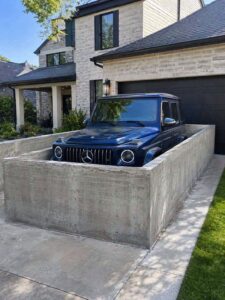
Over the following weeks, I arranged for a properly planned concrete boundary wall to be installed along the section of my property Richard repeatedly used. It wasn’t a temporary prank or an attempt to damage his vehicle. It was a permanent property improvement designed to protect my lawn.
When Richard returned home and saw the construction work, he immediately marched over.
“What on earth are you building?” he demanded.
“A boundary wall,” I answered.
“You can’t put that there!”
I showed him the property survey and explained that the work was being completed according to the approved plans.
He looked furious.
For the first time, he seemed to understand that I wasn’t going to abandon my property simply because he disliked my decisions.
A few days later, the wall was completed.
Richard’s Mercedes could no longer enter my lawn.
He complained to other neighbors, claiming that I had ruined the appearance of the street. But several people who had witnessed his behavior privately admitted that they were relieved someone had finally addressed the problem.
Then something unexpected happened.
Richard received a notice concerning an earlier property complaint and the damage caused by repeated unauthorized parking. The photographs and records I had collected became important evidence in the dispute.
He also discovered that his own driveway had been improperly altered years earlier, creating a drainage problem that affected part of the neighboring property.
The matter became more complicated than he had anticipated.
Instead of simply demanding that I remove my wall, Richard suddenly had to deal with questions about his own property improvements.
A few weeks later, he approached me while I was trimming the hedges.
For once, he wasn’t smiling arrogantly.
“Robert, can we talk?”
I put down my gardening shears.
He explained that the situation had become expensive and stressful. He complained about legal advice, contractors, and the difficulties he was experiencing with his driveway.
Then he asked whether I would consider changing part of the boundary arrangement.
I told him I was willing to discuss reasonable solutions, provided everything respected the property boundaries and applicable regulations.
He looked at my lawn.
“I suppose I should have just used my own driveway,” he admitted.
I nodded.
“That would have saved both of us a lot of trouble.”
For several seconds, neither of us spoke.
Then he surprised me by apologizing.
It wasn’t a dramatic apology, and it certainly didn’t erase six months of frustration. But it was the first time he had acknowledged that his behavior was wrong.
Eventually, we reached a practical understanding. Richard agreed to stop using my property, and I agreed to discuss any legitimate concerns about the boundary through the proper channels.
Today, my lawn is healthy again.
The damaged patches have been replaced, the grass is growing beautifully, and my Saturday mornings have returned to normal.
Richard still drives his Mercedes, but he keeps it on his own property.
Sometimes, when I see him pulling into his driveway, I remember those words he used to repeat.
“It’s just grass.”
Perhaps to him, it was.
But to me, it represented years of hard work, personal pride, and the simple right to enjoy my own home without someone treating it as their personal parking lot.
I learned an important lesson from the entire experience.
Being a good neighbor doesn’t mean allowing someone to walk all over you. Patience is valuable, but boundaries matter too.
And sometimes, the best response to someone who refuses to respect your property isn’t revenge.
It’s making sure they can never take advantage of your kindness again.