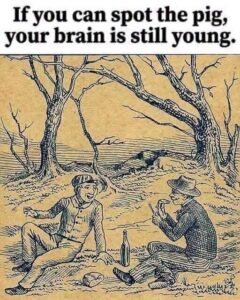
At first glance, this charming vintage illustration looks like an ordinary countryside scene. Two friends appear to be enjoying a peaceful picnic outdoors, surrounded by bare trees, simple belongings, and the quiet beauty of nature. Nothing seems unusual, and there is no obvious mystery waiting to be discovered. But hidden somewhere within this seemingly innocent picture is an unexpected surprise that has been challenging viewers for generations.
The challenge is simple: find the hidden pig.
Although the instructions sound easy, many people discover that locating the animal is surprisingly difficult. The pig is cleverly incorporated into the surrounding shapes, making it easy for the eyes to overlook. What initially appears to be an ordinary arrangement of branches, shadows, and objects may actually contain the outline of something completely different.
This is what makes traditional optical puzzles so entertaining. They encourage us to slow down, question our first impressions, and examine familiar objects from a different perspective.
Most viewers immediately focus on the two people enjoying their picnic. Their clothing, body positions, and the objects surrounding them naturally attract attention. The trees also provide an interesting backdrop, drawing the eyes toward their complicated branches and unusual shapes.
However, the secret may be hiding in an area that seems completely unimportant.
Rather than examining the entire illustration randomly, try dividing the picture into smaller sections. Look carefully at the outlines of the people, the branches extending across the background, and the spaces between the objects. Sometimes the shape you are searching for becomes visible only when you stop looking at individual details and begin examining how those details connect.
One useful technique is to turn your attention away from the obvious picnic scene. Instead of asking what each object represents, ask yourself whether its outline could resemble something else. A curved branch might look like an animal’s back, while a shadow or unusual combination of lines might suggest a head, nose, or pair of ears.
The human brain is naturally designed to recognize familiar patterns. This ability helps us understand our surroundings quickly, but it can also make visual puzzles difficult. Once we identify a picture as a picnic scene, our minds tend to interpret everything else according to that initial assumption.
That is precisely why hidden-object challenges can be so frustrating.
You might stare at the illustration for several minutes, convinced that you have examined every corner, only to discover that your eyes have repeatedly passed over the answer without recognizing it.
Another helpful trick is to briefly look away from the picture and then return to it. A fresh glance can sometimes reveal shapes that were previously overlooked. You can also slightly change your viewing distance. Looking at the illustration from farther away may help you recognize a larger outline formed by several smaller details.
Don’t rush.
The most enjoyable part of this challenge is the moment when the hidden shape finally becomes recognizable. What previously looked like an ordinary collection of lines suddenly takes on a completely different meaning.
And once you see it, you may wonder how you missed it in the first place.
These puzzles are also a wonderful way to bring people together. You can show the illustration to friends, family members, or children and ask everyone to find the hidden pig. Some people may discover it almost immediately, while others might spend several minutes searching.
It can be particularly entertaining to compare everyone’s strategies. One person may concentrate on the trees, another may examine the picnic objects, and someone else may notice an unusual outline in the background.
There is no need to rush or feel discouraged if the answer doesn’t appear immediately. Visual perception differs from person to person, and the challenge is designed to encourage careful observation rather than speed.
Before looking for a hint, give yourself another opportunity to examine the illustration.
Pay attention to unusual curves, overlapping outlines, and spaces that appear too strangely shaped to be accidental. Sometimes the answer isn’t an object hidden behind something else. Instead, it is an image created by combining several ordinary elements.
That is the clever secret behind many classic optical illusions.
So, did you find the hidden pig?
If you spotted it without assistance, congratulations! You have demonstrated excellent attention to detail and a willingness to look beyond the obvious.
If you are still searching, don’t give up. Take another look at the branches and surrounding outlines, and try viewing the illustration as a collection of shapes rather than a picnic scene.
The little pig may have been hiding in plain sight all along.
And remember: the real fun isn’t simply finding the answer. It’s discovering how easily our eyes can overlook something that was right in front of us the entire time.