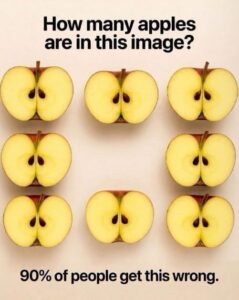
At first glance, this picture appears to present one of the easiest counting challenges imaginable. There are several apple halves arranged together, and the task seems simple: look carefully and count how many apples are shown. Yet what initially looks like an ordinary visual puzzle quickly becomes a surprisingly interesting exercise in mathematics, observation, and interpretation.
The image shows eight apple halves. Since two halves can be combined to make one complete apple, the most straightforward mathematical answer is four whole apples.
However, that is not necessarily the only correct answer.
Depending on how the original question is interpreted, there are actually three possible answers. One counts the original fruits, another counts the visible pieces, and the third considers only apples that remain completely whole and uncut.
This is what makes the puzzle more interesting than it first appears. It demonstrates how a seemingly simple question can produce different answers when the wording changes.
Before choosing your answer, take another look at the picture and decide what you believe is being counted.
The First Answer: Four Whole Apples
The most common interpretation is that the question asks how many original apples are represented by the pieces in the picture.
There are eight visible halves.
Every complete apple consists of two halves. Therefore, dividing eight by two gives the number of original apples.
The calculation is straightforward:
8 ÷ 2 = 4
Under this interpretation, the picture represents four complete apples.
This is the answer most people are likely to give when they approach the puzzle mathematically.
It is also a useful reminder of a basic mathematical concept: fractions.
A half represents one of two equal parts of a whole. When two halves are combined, they form one complete unit.
The same principle applies to many everyday objects. Two half sandwiches make one complete sandwich, two half pizzas represent one whole pizza, and two halves of an apple can be combined to represent the original fruit.
The puzzle uses this familiar idea to test whether viewers can look beyond the individual pieces and recognize the larger quantity they represent.
The Second Answer: Eight Apple Pieces
Now consider the question from a slightly different perspective.
Instead of asking how many original apples are represented, imagine that someone simply wants to know how many individual pieces are visible.
In that case, the answer changes immediately.
There are eight separate apple halves.
You do not need to combine them mentally or perform any additional calculations. Each visible half counts as one individual piece.
Therefore, the answer is eight.
This distinction might seem obvious, but it reveals something important about visual puzzles.
The same image can contain several different quantities depending on what is being measured.
For example, imagine looking at a sliced orange. You might count the original fruit, the individual slices, or the number of pieces remaining on a plate.
All three measurements describe the same object, but they answer different questions.
The apple puzzle works in exactly the same way.
It encourages viewers to pay attention to the wording instead of automatically assuming that every counting question is asking for the same thing.
The Third Answer: Zero Whole, Uncut Apples
Here is where the puzzle becomes even more interesting.
What if the question specifically asks how many completely whole, uncut apples can be seen?
The answer would be zero.
Every visible apple is already divided into two pieces. Although the halves represent complete apples when paired together, none of the individual pieces is an intact, uncut apple.
This is a subtle but important difference.
Four complete apples are represented mathematically, but zero completely uncut apples are physically visible.
The distinction between something being represented and something being directly present is central to understanding this interpretation.
For example, four broken eggshells might represent two original eggs, but they would not count as two intact eggs sitting on a table.
Likewise, the eight apple halves represent four original fruits without displaying any completely uncut apples.
This is the interpretation that often surprises people who initially believe there can only be one correct answer.
Why Simple Picture Puzzles Can Be So Confusing
Visual puzzles are popular because they challenge people to slow down and examine something they might otherwise overlook.
Our brains are remarkably good at recognizing familiar objects and making quick assumptions.
When we see apples, we immediately recognize the fruit. When we see several halves, we automatically begin grouping them together.
This ability is useful in everyday life, but it can sometimes cause us to overlook important details.
A puzzle may deliberately use ambiguous wording to encourage viewers to question their first reaction.
Instead of simply asking, “What do I see?” it encourages another question: “What exactly am I being asked to count?”
That small change can completely alter the answer.
Similar challenges appear in classroom activities, family games, newspaper puzzles, and social media posts because they encourage discussion without requiring advanced mathematical knowledge.
They also demonstrate that careful reading can be just as important as calculation.
A Little Mathematics Behind the Puzzle
Although the challenge looks simple, it introduces several useful mathematical ideas.
The first is division.
When eight halves are divided into pairs, the result is four complete apples.
The second is fractions.
Each visible piece represents one-half of an original apple, assuming the pieces were created by cutting the original fruit into two equal portions.
The third is the difference between counting objects and measuring quantities.
These concepts appear throughout everyday life.
When shopping, for example, people frequently compare individual packages with the total quantity of food they contain. When cooking, recipes may require half a cup, a quarter of an ingredient, or several complete units.
Understanding the difference between parts and wholes helps make these calculations easier.
Even young learners can benefit from puzzles like this because they turn abstract mathematical ideas into something visual and familiar.
Try the Puzzle With Your Family
One enjoyable way to use this challenge is to show the picture to family members without revealing the possible answers.
Ask everyone to count the apples independently.
You may discover that different people immediately arrive at different conclusions.
Some will say four because they combine the halves mentally.
Others will answer eight because they count every visible piece.
A few may notice that none of the apples remains completely whole.
Rather than immediately deciding that someone is wrong, ask each person to explain how they reached their answer.
This turns a simple counting exercise into a conversation about interpretation and reasoning.
It is also a reminder that two people can look at exactly the same picture and arrive at different answers because they are answering slightly different questions.
That is part of what makes these little challenges entertaining.
So, What Is the Correct Answer?
The answer depends on the exact meaning of the question.
Here is the complete breakdown:
- 4 apples: If you are counting the original complete apples represented by the eight halves.
- 8 pieces: If you are counting every individual apple half visible in the picture.
- 0 whole apples: If you are counting only intact, uncut apples.
All three answers can be correct under their respective interpretations.
The important thing is understanding what is being counted.
At first, this puzzle looks like nothing more than a basic division exercise. But its clever wording turns it into a lesson about observation, fractions, and the importance of asking precise questions.
Sometimes the most interesting puzzles are not difficult because the mathematics is complicated. They are difficult because we assume we already know what the question means.