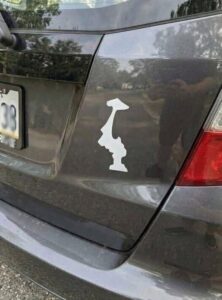
Sometimes, the smallest symbols carry the biggest stories. Across Washington State, a curious variation of a familiar geographical outline has attracted attention among residents, travelers, and people with a connection to the Pacific Northwest. At first glance, it looks like an ordinary state-shaped decal, except that something about it seems different. The outline has been turned upside down, transforming a familiar map shape into a distinctive visual statement.
It can appear on vehicle windows, water bottles, laptop covers, outdoor equipment, and other everyday belongings. For people who recognize it, the unusual design can inspire a smile, a memory, or a feeling of regional connection. For newcomers, however, it often raises an interesting question: Why would someone deliberately display Washington State upside down?
The answer is not necessarily simple. The symbol has attracted different interpretations involving local humor, rainy weather, mountain landscapes, and the understated pride associated with life in the Pacific Northwest. Its appeal demonstrates how an ordinary design can become meaningful through shared experiences and personal expression.
A Familiar Shape With an Unexpected Twist
Washington has a distinctive geographical outline that many residents can recognize immediately. Its northern border follows the Canadian boundary, while its western edge meets the Pacific Ocean and Puget Sound region. The state’s eastern and southern boundaries create an unmistakable shape on a map.
Turning that outline upside down changes its appearance without completely removing its identity.
This visual transformation is part of what makes the design interesting. It remains recognizable enough to communicate a connection to Washington, yet unusual enough to encourage people to look twice.
Unlike conventional state decals that display geographical outlines in their standard orientation, the inverted version introduces an element of humor and individuality.
It also demonstrates how familiar images can take on new meanings through small creative changes. Sometimes, a simple adjustment is enough to turn an ordinary geographical symbol into something memorable.
The Rainy Weather Connection
One popular interpretation connects the upside-down Washington outline to the region’s reputation for frequent rainfall.
Western Washington, particularly areas around Seattle, Olympia, and the Olympic Peninsula, experiences a climate characterized by regular periods of rain and overcast weather. Residents become accustomed to carrying umbrellas, wearing waterproof jackets, and planning outdoor activities around changing conditions.
The inverted state outline has sometimes been interpreted as a playful reference to this familiar weather pattern.
The humorous suggestion is that Washington has experienced so much rain that the state itself has effectively been turned upside down.
Whether people interpret the design literally or simply enjoy the joke, the connection reflects an attitude familiar to many Pacific Northwest residents. Instead of treating rainy weather as something worth constantly complaining about, people often incorporate it into their everyday identity.
Rain becomes part of the landscape, part of the conversation, and occasionally even part of the local sense of humor.
For someone who has spent years living through gray winter mornings and drizzly afternoons, the inverted outline can feel like a small acknowledgment of a shared experience.
A Symbol That Brings Mountains to Mind
Another interpretation comes from the distinctive natural landscape surrounding Washington.
The Pacific Northwest is famous for its mountains, evergreen forests, rivers, and dramatic coastal scenery. Among its most recognizable landmarks is Mount Rainier, whose impressive volcanic peak dominates the landscape southeast of Seattle.
The upside-down state outline can remind some observers of mountain silhouettes or the dramatic shapes found throughout the region.
Although this resemblance is subjective rather than an established geographical explanation, it provides another interesting way to interpret the symbol.
For hikers, campers, photographers, and outdoor enthusiasts, Washington’s natural environment is an important part of everyday life. Weekend adventures might involve exploring forest trails, visiting alpine lakes, photographing mountain views, or driving through winding roads surrounded by towering evergreen trees.
A small state-shaped decal can become a personal reminder of those experiences.
It might represent a favorite hiking destination, a memorable camping trip, or simply the feeling of standing beneath an enormous mountain surrounded by fresh mountain air.
How Everyday Objects Become Expressions of Regional Pride
One reason unusual symbols become recognizable is their appearance on ordinary personal belongings.
A sticker on the back of a car may be seen by hundreds of people during a daily commute. A decal attached to a reusable water bottle might attract attention at a coffee shop, gym, or outdoor gathering.
These small objects allow people to communicate something about themselves without making a formal statement.
A person displaying an inverted Washington outline might be expressing hometown pride, affection for the region, appreciation for local humor, or simply an interest in unusual designs.
The meaning can differ from one individual to another.
This flexibility is part of the appeal. Unlike official state emblems, which have clearly defined meanings and established designs, informal regional symbols can develop through personal interpretation.
They become recognizable because people choose to use them, share them, and associate them with their own experiences.
The Quiet Language of Belonging
Regional identity does not always require large flags, elaborate decorations, or obvious displays of patriotism.
Sometimes, belonging is communicated through small details that only certain people immediately recognize.
Someone might notice the inverted Washington outline on another person’s vehicle and recognize it as something connected to their home state. That moment can create an opportunity for conversation or an unspoken sense of familiarity.
It is similar to recognizing a local reference, a familiar landmark, or an expression commonly used by people from the same community.
For individuals who have moved away from Washington, such symbols can also become meaningful reminders of home.
Seeing the outline on a suitcase, laptop, or vehicle might bring back memories of familiar neighborhoods, rainy mornings, favorite restaurants, and scenic drives through evergreen forests.
In this way, the symbol can represent more than geography. It can represent personal history.
The Influence of Pacific Northwest Culture
The Pacific Northwest has developed a recognizable cultural identity shaped by its natural environment, outdoor recreation, creative communities, and distinctive relationship with the weather.
People living in the region often develop strong connections to its forests, mountains, coastlines, and waterways.
Cities such as Seattle and Tacoma offer urban lifestyles, while smaller communities provide different experiences connected to agriculture, fishing, tourism, and outdoor activities.
The region also has a long association with independent artistic expression and unconventional design.
The upside-down Washington outline fits naturally into this broader world of personal creativity. It takes something familiar and presents it differently, allowing people to express regional affection through a simple visual idea.
However, it is important to remember that not everyone interprets the symbol in the same way. Some may associate it with rain, others with mountain scenery, and others may simply enjoy the unusual appearance.
Its meaning is therefore better understood as an informal cultural interpretation than as an officially recognized symbol with one universally accepted explanation.
A Growing Interest in Vintage-Style Regional Symbols
Today, geographical decals and regional designs remain popular among people who enjoy collecting stickers, decorating personal belongings, and displaying connections to places they love.
The upside-down Washington outline fits particularly well into this trend because it is simple, recognizable, and visually distinctive.
Unlike complicated artwork, its basic design can be reproduced in different sizes, colors, and materials. It can appear as a small window decal, a larger vehicle sticker, or part of a customized outdoor accessory.
Some people may choose a minimalist black-and-white version, while others prefer colorful designs that complement their personal style.
The attraction is not necessarily about following a trend. For many, it is about finding a small object that reflects a place or experience that matters to them.
Why a Simple Inverted Outline Continues to Fascinate
The most interesting thing about the upside-down Washington outline is how much conversation can develop around such a simple design.
It begins with an ordinary geographical shape. A small creative adjustment makes it unusual. Repeated appearances encourage curiosity, and different interpretations gradually give it cultural personality.
There may not be one definitive explanation that applies to everyone who displays it. Its significance comes partly from that openness.
For some, it is a humorous reference to Washington’s rainy reputation. For others, it evokes mountain scenery, outdoor adventures, or a personal connection to the Pacific Northwest.
For people who have lived in the region for decades, it might simply feel like a familiar reminder of home.
Ultimately, the inverted Washington outline illustrates how regional identity can develop through everyday objects and shared experiences. It does not need an official announcement or an elaborate explanation to attract attention.
Sometimes, a small sticker on a car window can communicate something meaningful about where a person comes from and the experiences that have shaped their life.
And perhaps that is the enduring charm of this unusual design: it turns a familiar state outline into a quiet conversation about humor, belonging, memory, and the places we never entirely leave behind.