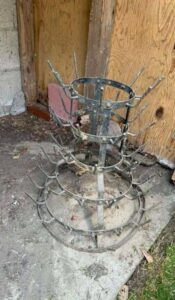
At first glance, this unusual metal object might look like an ordinary piece of kitchen decoration or something rescued from an old farmhouse. Its thin metal frame, carefully arranged hooks, and simple construction may seem mysterious to anyone unfamiliar with traditional household equipment. Yet generations ago, this humble invention served an important purpose in kitchens across America and Europe. It was a vintage bottle drying rack, a practical household tool designed to hold washed glass bottles upside down while excess water drained away.
Long before disposable packaging became common, families depended heavily on reusable glass containers. Milk bottles, beer bottles, juice bottles, and jars used for homemade preserves were valuable household items that needed regular cleaning and careful storage. Throwing them away after a single use would have been wasteful and expensive. Instead, people washed them, dried them, and prepared them for another round of everyday use.
The bottle drying rack made this process easier. Its simple design reflected an era when household objects were created to serve practical purposes, conserve resources, and remain useful for many years.
Although modern kitchens rarely include such equipment, the vintage bottle drying rack remains a fascinating reminder of how differently families once approached everyday chores.
A Kitchen Tool Designed for Everyday Necessity
During the early twentieth century, glass bottles played an essential role in household life.
Families purchased milk in returnable glass bottles, stored homemade beverages in sturdy containers, and reused bottles whenever practical. In rural households, glass containers were particularly valuable because trips to nearby stores could require considerable time and effort.
Cleaning these bottles properly was important.
A container that had held milk or another perishable liquid needed to be washed thoroughly before being used again. However, drying the inside of a narrow bottle was not particularly easy.
Placing bottles upright on a kitchen counter allowed water to collect at the bottom. Using towels to dry the inside was difficult, especially when dealing with containers that had narrow necks.
The bottle drying rack offered a straightforward solution.
By holding bottles upside down, it allowed remaining water to drain naturally. The open arrangement also encouraged air circulation, helping the interior dry without requiring additional equipment.
It was a small invention that addressed a surprisingly common household problem.
How the Metal Rack Actually Worked
The design of these racks was generally uncomplicated.
Most examples featured a metal base or supporting frame with several upright rods, hooks, or bottle holders. Depending on the model, bottles could be positioned individually or arranged in several rows.
After washing, the household user placed each bottle upside down over one of the supports.
Gravity did most of the work.
Water gradually moved toward the opening and dripped away, while air circulated through the bottle. This reduced the amount of moisture remaining inside compared with simply leaving bottles standing upright.
Some designs included additional horizontal supports or removable components to accommodate different bottle shapes and sizes.
The materials also varied. Older examples could feature iron or steel construction, sometimes with protective coatings intended to resist moisture and corrosion.
Their appearance was often utilitarian rather than decorative. Nevertheless, many surviving examples have developed an attractive aged appearance that appeals to antique collectors today.
Why Reusing Glass Bottles Was So Important
Today, replacing an empty bottle is usually inexpensive and convenient. In earlier generations, however, reusable glass containers represented a meaningful household investment.
Milk delivery systems commonly relied on returnable bottles. Customers received their milk in glass containers and returned the empties through established collection arrangements.
The bottles were then cleaned and reused.
Families also reused glass containers for homemade products. Depending on local customs and availability, bottles could store fruit juices, homemade sauces, syrups, and other liquids.
This practice reduced the need to purchase new containers constantly.
Glass was especially suitable because it could withstand repeated washing and did not easily absorb odors or flavors. It also provided a convenient way to see the contents without opening the container.
A bottle drying rack supported this entire routine.
It helped transform washing and drying from a messy kitchen activity into an organized process that could be repeated whenever necessary.
A Familiar Sight in Traditional Kitchens
For older generations, a bottle drying rack may bring back memories of kitchens where almost nothing was wasted.
Imagine a farmhouse kitchen on a quiet morning.
A family member has finished washing several milk bottles at the sink. The bottles are carefully placed upside down on a metal rack near the window.
Sunlight falls across the counter, and droplets of water slowly collect beneath the frame.
Nearby, other household activities continue. Bread is being prepared, vegetables are being cleaned, and someone is organizing jars for the next preserving season.
The rack is not the centerpiece of the kitchen, but it plays an important role.
It represents the practical organization that made daily household work manageable.
Many older household objects were designed around the same philosophy. Washing boards, hand-operated egg beaters, manual coffee grinders, and mechanical food choppers all helped families complete everyday tasks without electricity or complicated machinery.
The bottle drying rack belonged to this tradition of simple, dependable equipment.
The Connection to Homemade Preserving
Bottle drying racks were also useful for households that prepared and preserved their own food.
Before modern supermarkets offered countless ready-made products, many families prepared preserves, fruit juices, sauces, and other foods at home.
Glass containers were essential to these activities.
After washing jars and bottles, people needed a suitable place to let them drain and dry before filling them again.
A drying rack provided an organized space for several containers at once.
However, it is important to distinguish ordinary drying from proper food preservation. Simply drying a bottle on a rack does not sterilize it or make it safe for storing preserved foods. Appropriate cleaning, sterilization, and processing procedures were still necessary, depending on the product being prepared.
Nevertheless, the rack helped make the preparation process more convenient.
For busy households, having a dedicated place for cleaned containers was a valuable advantage.
Why These Old Racks Eventually Disappeared
As household habits changed, the bottle drying rack gradually became less common.
Commercial packaging evolved, disposable containers became widespread, and many families stopped routinely washing and reusing glass bottles.
Modern refrigerators, dishwashers, drying mats, and specialized kitchen accessories also changed the way people handled bottles and containers.
In many homes, the need for a dedicated metal bottle rack simply disappeared.
The traditional milk delivery system declined in many communities, and single-use packaging became increasingly familiar.
Although reusable glass bottles never completely disappeared, the everyday routines that once made bottle drying racks essential became less common.
Consequently, many examples were discarded, stored in barns, or forgotten in the backs of kitchen cupboards.
Today, surviving pieces offer a glimpse into an earlier period of household life.
Why Vintage Collectors Appreciate Them Today
Old bottle drying racks have developed a new appeal among antique enthusiasts, vintage kitchen collectors, and people interested in traditional household equipment.
Their attraction comes partly from their unusual appearance and partly from the history they represent.
Some people display them in farmhouse-style kitchens, antique shops, or country-themed interiors.
Others appreciate their original practical purpose and occasionally use suitable examples for drying bottles.
Collectors often look for details such as the condition of the metal, the number of bottle holders, the construction of the frame, and any surviving manufacturer’s markings.
Older pieces may show signs of rust, worn coatings, or minor bends resulting from decades of use.
These imperfections can contribute to their historical character, although heavily corroded examples should be inspected carefully before being used with food-related items.
A vintage rack can also serve as an interesting conversation piece because many younger generations have never encountered one before.
A Small Invention With a Bigger Story
The vintage bottle drying rack reminds us that household innovation does not always require complicated machinery or advanced technology.
Sometimes, the most useful inventions are the simplest.
A few carefully positioned metal supports made it possible for families to clean and reuse valuable glass containers more efficiently. The design saved counter space, encouraged organization, and supported household habits built around careful resource management.
It also reflects a different relationship with everyday possessions.
People often repaired, cleaned, reused, and maintained household items because replacing them was not always practical or affordable.
Today, as more households reconsider food waste, reusable packaging, and sustainable living, the principles behind these traditional practices feel relevant once again.
The old metal rack may no longer be essential in most modern kitchens, but its purpose remains easy to appreciate.
What once seemed like an ordinary household accessory now represents a forgotten chapter of domestic history.