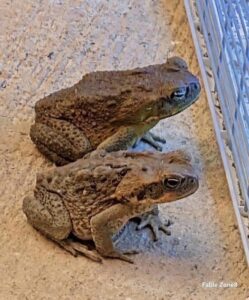
Finding a toad in or around your home can feel like a small but unsettling interruption to an otherwise ordinary day. It might be sitting quietly near a doorway, tucked into a corner of the garden, or unexpectedly discovered in a garage or hallway. Its stillness, combined with its unfamiliar presence, often sparks immediate questions: Why is it here? How did it get in? Does it mean something unusual?
Despite how it may feel in the moment, the answer is almost always simple—and far more grounded in nature than mystery.
Toads are not drawn to homes for symbolic reasons or hidden purposes. They are guided by survival. Every movement they make is influenced by basic needs: moisture, shelter, and food. If your home or yard provides these conditions, even unintentionally, it becomes a suitable environment.
Moisture is especially important. Unlike many animals, toads rely heavily on their skin to absorb water and maintain hydration. Dry environments can be dangerous for them, which is why they seek out damp soil, shaded areas, or spaces where humidity is naturally higher. After rainfall, their activity increases significantly, often bringing them into more visible areas.
Shelter is another key factor. During the day, toads avoid direct sunlight and heat by hiding in cool, protected spaces. This can include places like under flower pots, beneath porches, along foundations, or inside garages. These spots offer safety not only from the environment but also from predators.
Food completes the picture. Toads feed primarily on insects—mosquitoes, flies, beetles, and other small creatures. If your outdoor lights attract insects at night, you may unknowingly be creating a feeding ground that draws them closer. In this sense, their presence is less about intrusion and more about opportunity. They have simply found a place where their needs are met.
If a toad appears inside your home, it is usually accidental. An open door, a small gap, or even a momentary lapse in awareness can provide an entry point. Once inside, the toad is typically just as disoriented as you are surprised. It is not exploring with intent—it is trying to find its way back to a suitable environment.
Understanding this can shift the initial reaction from concern to calm awareness. Toads are harmless to humans. They do not chase, attack, or behave aggressively. Their primary instinct is avoidance. When approached, they may remain still, relying on camouflage, or slowly move away in search of cover.
In many ways, they are quiet visitors—present, but not intrusive.
Beyond their harmless nature, toads offer a surprising benefit: they are natural pest controllers. A single toad can consume a large number of insects in one night. For homeowners and especially gardeners, this makes them valuable allies.
Instead of relying on chemical pesticides, which can harm both the environment and other beneficial species, the presence of toads supports a more balanced ecosystem. They reduce populations of unwanted insects in a way that is both efficient and environmentally friendly.
Their contribution often goes unnoticed, but it is significant. Healthier plants, fewer pests, and a more stable outdoor environment are all part of the quiet impact they provide.
Toads also serve as indicators of environmental health. As amphibians, they are highly sensitive to changes in their surroundings. Their skin absorbs not just water, but also chemicals and pollutants. Because of this, they tend to thrive only in areas where the ecosystem is relatively clean and balanced.
If a toad has chosen your yard as a habitat, it can be a subtle sign that the environment is supportive of life. It suggests that the soil, water, and surrounding conditions are not heavily contaminated or disrupted. In a way, their presence reflects a level of ecological stability that benefits everything in that space—including you.
While science explains their presence clearly, cultural interpretations add another layer of meaning that many people find compelling.
Across different traditions, toads have often been associated with transformation and change. This symbolism is closely tied to their life cycle. Beginning as tadpoles in water and gradually developing into land-dwelling creatures, they undergo a remarkable physical transformation. This process has made them enduring symbols of adaptability, growth, and transition.
For some, encountering a toad becomes more than a random event. It can feel like a reminder—subtle and quiet—that change is a natural part of life. That growth often comes through unexpected moments. That adaptation is not just possible, but necessary.
In certain belief systems, particularly within traditions like Feng Shui, toads are also linked to luck and prosperity. They are sometimes represented as symbols of abundance or positive energy, often placed intentionally in homes as decorative elements meant to attract financial well-being.
Other interpretations view them as protectors or as creatures that help shift stagnant energy, encouraging movement and renewal in spaces that feel stuck or unbalanced.
These perspectives are not scientific, but they reveal something meaningful about human nature. People often look to the natural world not just for explanation, but for reflection. Animals, in this sense, become symbols through which we understand our own experiences.
Whether or not one believes in these interpretations, they offer an interesting way to think about an otherwise ordinary encounter.
At its core, the appearance of a toad in your home or yard is not a mystery. It is a result of environment, behavior, and circumstance. It reflects the presence of moisture, shelter, and food. It indicates a space that supports life, even in small and often overlooked ways.
And yet, it can still carry a kind of quiet significance.
Not because it signals something supernatural, but because it invites awareness.
It encourages a pause.
A moment to observe rather than react.
A chance to recognize how closely our lives are connected to the natural world, even in the smallest interactions.
What initially feels like an intrusion can become an opportunity to understand the environment around you more deeply. To notice the balance that exists just beyond routine attention. To appreciate the role that even the simplest creatures play in maintaining that balance.
In the end, a toad is just a toad.
A small, quiet animal following instinct.
But the moment of encountering it—unexpected, slightly strange, and briefly unsettling—can reveal something larger.
That nature is always present, even when unnoticed.
That meaning is often something we create, not something imposed.