In a world increasingly defined by complex devices, digital systems, and rapidly evolving technology, it is easy to overlook the quiet brilliance of simple, everyday tools. Objects like scissors, safety pins, toothbrushes, and nail clippers rarely receive attention because they are so familiar. We use them automatically, almost unconsciously, without pausing to consider how they work or why they are designed the way they are.
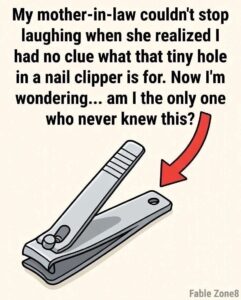
Yet within these ordinary tools lies a long history of problem-solving, experimentation, and refinement. Among them, the nail clipper stands out as one of the most understated examples of functional design. Compact, inexpensive, and globally used, it seems almost too simple to warrant deeper analysis. And yet, one of its smallest features—the tiny circular hole at the end of its lever—reveals a surprising depth of engineering thought.
At first glance, the hole appears insignificant. Many people have used nail clippers for years without ever questioning its purpose. It seems decorative or incidental, something included by default rather than intention. But in reality, this small detail is the result of deliberate design choices that combine practicality, ergonomics, manufacturing efficiency, and historical evolution.
Understanding why this feature exists offers insight into how everyday objects are shaped not just by function, but by human behavior, convenience, and long-term usability.
A Feature Designed for Portability and Everyday Convenience
One of the most practical functions of the hole is portability. Nail clippers are small enough to be easily misplaced. They slip into drawers, vanish into bags, or disappear into pockets, only to be urgently needed at inconvenient times. The inclusion of a hole solves this problem in a simple but effective way.
By allowing the clipper to be attached to a keychain, cord, hook, or travel pouch, the hole transforms the object from something easily lost into something consistently accessible. It becomes part of a larger system of personal organization.
This small adaptation reflects a broader principle in design: reducing friction in everyday life. The best tools are not just functional—they are dependable. A feature that prevents loss, improves accessibility, and increases convenience directly enhances the user experience without adding complexity or cost.
An Ergonomic Detail That Supports Different Users
Beyond portability, the hole also serves an ergonomic function. While it may seem too small to matter, it can assist in grip and control during use. Some users insert a finger into the opening to stabilize the tool or improve leverage when clipping thicker or more resistant nails.
This becomes especially useful for individuals with reduced hand strength, limited dexterity, or joint discomfort. Instead of requiring a redesigned tool or additional accessories, the existing structure quietly accommodates different needs.
This adaptability is a hallmark of effective design. A well-designed object does not assume a single type of user. Instead, it remains flexible enough to serve a wide range of physical abilities and usage styles. The hole exemplifies this philosophy by offering optional support without interfering with standard use.
A Hidden Link to Historical Design Practices
The presence of the hole also reflects historical patterns of tool usage that predate modern storage habits. In earlier periods, small personal tools were often carried directly on the body. Keys hung from chains, pocket watches were clipped to clothing, and essential grooming tools were kept within immediate reach.
In such contexts, the hole served a very practical role. It allowed the nail clipper to be attached to a chain or loop, ensuring it would not be lost during daily movement. Portability was not a convenience—it was a necessity.
Even as lifestyles evolved and storage became more structured, the feature remained. Rather than being removed, it persisted because it continued to provide value in modern contexts such as travel kits, toolboxes, and personal hygiene bags.
This continuity highlights an important principle in design evolution: useful features tend to survive across generations, even when their original purpose changes.
Manufacturing Efficiency and Industrial Design Logic
While end users benefit from the hole in visible ways, it also plays a role in manufacturing. In production environments, small structural features can assist with handling, alignment, and assembly processes. A hole provides a stable point for machinery or tools to hold, position, or adjust components during fabrication.
Even if this function is not obvious to the consumer, it contributes to the consistency and precision of mass production. It helps ensure that each unit is properly formed and functionally reliable.
This dual-purpose design—benefiting both manufacturing and user experience—is a key principle in industrial engineering. It reduces production complexity while enhancing usability, achieving efficiency on multiple levels simultaneously.
Why the Design Has Remained Unchanged for Decades
One of the most interesting aspects of the nail clipper’s design is its stability over time. Unlike many consumer products that undergo frequent redesigns, the basic structure of the nail clipper has remained largely unchanged for decades.
This is not due to stagnation, but optimization. The design has reached a level of effectiveness where major changes are unnecessary. Each component serves a clear purpose, and even minor elements like the hole contribute meaningfully to the tool’s overall performance.
In design philosophy, this is known as refinement rather than reinvention. Instead of continuously replacing what works, designers refine what already exists until it becomes nearly optimal in its simplicity.
The Psychology of Overlooked Design
What makes the hole so fascinating is not only its function, but the fact that most people never notice it. This reveals something important about human perception: we tend to ignore details that work seamlessly.
When a design is effective, it disappears into the background of experience. We focus on the outcome—trimmed nails—rather than the mechanism that made it possible. The better the design, the less visible it becomes.
This invisibility is not a flaw; it is a sign of success. It means the tool integrates so naturally into behavior that it no longer demands attention.
A Reflection of Human-Centered Thinking
At its core, the nail clipper’s design reflects an understanding of real human behavior. People misplace small items. They benefit from tools that are easy to hold. They prefer objects that are simple, reliable, and intuitive.
Rather than requiring users to adapt to the tool, the tool adapts to the user. The hole is a small but powerful example of this philosophy in action.
It anticipates needs without requiring explanation. It solves multiple problems without adding complexity. It remains useful even when its original context has changed.
The Broader Lesson in Everyday Objects
The nail clipper’s tiny hole invites a broader reflection on the objects we use every day. Many seemingly simple tools contain hidden design decisions that shape how we interact with them.
The curve of a handle, the angle of a blade, the texture of a surface—each element is the result of deliberate thought. These decisions are often invisible because they are so well integrated into function.
This is the essence of good design: not to impress through complexity, but to serve through simplicity.
Conclusion: The Power of Small Design Decisions
The small hole on a nail clipper may seem insignificant at first, but it represents a convergence of thoughtful engineering, ergonomic awareness, historical continuity, and manufacturing efficiency. It demonstrates how even the smallest design choices can have multiple layers of purpose.
More importantly, it reminds us that innovation does not always require radical change. Sometimes, it is found in subtle refinements that quietly improve everyday life without drawing attention to themselves.
The next time you pick up a nail clipper, that tiny hole may stand out differently. It is not just an empty space in metal—it is a connection point between design and use, between intention and habit, between problem and solution.