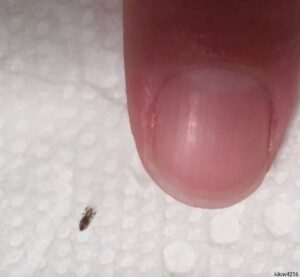
Few things trigger immediate concern for parents quite like discovering a small insect in their child’s hair. It’s a moment that can quickly spiral from mild curiosity into full-blown worry, especially when the child attends daycare regularly. In shared environments where close contact is unavoidable, the first thought for many families is head lice. The image of a tiny dark bug resting on a paper towel beside a fingertip is enough to send most parents searching for answers, wondering whether they’re dealing with a common nuisance or something more unusual.
The most likely suspect in such scenarios is the Head louse, a parasite that has long been associated with young children, particularly those in daycare or preschool settings. These insects thrive in environments where head-to-head contact is frequent—during playtime, group activities, or even naps. Despite their reputation, head lice are not a sign of poor hygiene or neglect. In fact, they tend to spread simply because children are naturally social and often unaware of the ways in which close contact can facilitate transmission.
However, not every bug found in hair is a louse. This distinction is crucial, as the response depends entirely on accurate identification. The insect described in your situation—small, dark, and somewhat elongated—does not immediately match the typical appearance of a head louse. Adult lice are usually light-colored, ranging from tan to grayish-white, and are roughly the size of a sesame seed. They have six legs equipped with claw-like structures designed to grip hair shafts tightly, allowing them to move quickly but not jump or fly.
If the insect you found appears darker, more segmented, or resembles a tiny beetle, it may be something entirely different. Daycare environments, while generally clean and well-maintained, are not sterile. Children move between indoor and outdoor spaces, interact with shared toys, and occasionally come into contact with insects that have nothing to do with human hosts. Small beetles, carpet beetle larvae, or even stray outdoor bugs can sometimes end up in a child’s hair purely by chance.
One possibility is a carpet beetle larva, which can occasionally be found in indoor environments. These larvae are small, elongated, and may appear bristly or segmented. While they are not parasites and do not live on humans, they can sometimes cause mild skin irritation if they come into contact with sensitive areas. Another possibility is a small ground beetle or similar insect that simply hitched a ride after outdoor play. These insects do not infest hair and pose no ongoing risk.
Fleas are another consideration, particularly for families with pets. Unlike lice, fleas are excellent jumpers and tend to move quickly. They are darker in color and more laterally compressed, making them appear thinner when viewed from the side. However, fleas typically target animals rather than humans and are more likely to bite exposed skin than remain in hair. If your child has no signs of bites—small, itchy red bumps, often around the ankles or lower legs—fleas are less likely.
The key difference between these possibilities and lice lies in behavior and evidence. A single bug, found incidentally and not accompanied by other signs, is often just that—an isolated encounter. Lice infestations, on the other hand, tend to leave a trail of clues. Persistent itching is one of the most common symptoms, caused by an allergic reaction to lice bites. You may also notice small red bumps on the scalp or neck, or see tiny white or yellowish eggs (nits) attached firmly to the base of hair shafts.
Nits are particularly important in identifying lice. Unlike dandruff or debris, they do not flake off easily. They are glued to the hair and require careful removal, often with a fine-toothed comb. Finding nits, especially close to the scalp, is a strong indicator of an active or recent infestation. In contrast, if you find no additional bugs and no nits after a thorough check, the likelihood of lice decreases significantly.
For parents in this situation, the best next step is a careful inspection rather than immediate treatment. Wet combing is widely recommended as an effective and non-invasive method of checking for lice. This involves dampening the hair, applying conditioner, and using a fine-toothed lice comb to systematically go through sections of hair under bright light. This process not only helps identify any remaining insects but also removes them if present.
It’s worth noting that daycare attendance does increase the risk of lice exposure. Children who spend time in group settings are more likely to come into close contact with others, making transmission easier. However, this does not mean that every child in daycare will experience lice, nor does it mean that every bug found in hair is cause for alarm. Awareness and routine checks are far more effective than reactive panic.
Modern guidance from health authorities emphasizes a balanced approach. Head lice, while inconvenient, are not dangerous. They do not transmit diseases and are considered a manageable condition rather than a serious health threat. Policies that exclude children from daycare or school until all nits are removed have largely been phased out, as they create unnecessary disruption without significantly reducing spread.
If lice are confirmed, treatment options are straightforward. Over-the-counter products containing permethrin or pyrethrin are commonly used and are effective when applied correctly. These treatments typically require a second application after about a week to ensure that newly hatched lice are eliminated. For younger children or those with sensitivities, manual removal through repeated combing can be a safe and effective alternative.
Household cleaning, while important, does not need to be extreme. Lice cannot survive long away from the human scalp, so efforts should focus on items that have had recent contact with the head. Washing bedding, hats, and clothing in hot water and drying them on high heat is usually sufficient. Vacuuming carpets and upholstery adds an extra layer of precaution, but extensive measures like pesticide sprays are unnecessary and discouraged.
Equally important is communication with the daycare. Informing staff allows them to monitor for additional cases and notify other parents if needed, without singling out any individual child. This collective awareness helps manage potential outbreaks while maintaining a supportive environment.
Beyond the immediate concern, experiences like this highlight the importance of perspective. Finding a bug in your child’s hair can feel alarming, but it is often a routine part of childhood, especially for those in group care settings. Children explore, play, and interact with their environment in ways that naturally expose them to minor, manageable risks.
Establishing simple habits can help reduce future चिंता. For example, tying back longer hair, avoiding the sharing of hats or hair accessories, and performing regular head checks can all contribute to early detection and prevention. These measures are practical and unobtrusive, allowing children to continue their normal activities without unnecessary ограничения.
It’s also helpful to approach the topic with openness and reassurance. Children may not fully understand what lice are, but they can sense parental चिंता. Framing the situation calmly—as something common and treatable—helps prevent fear or शर्म. This approach fosters resilience and ensures that children do not associate such experiences with embarrassment.
In the end, the discovery of a small bug in your toddler’s hair is a prompt to observe, not panic. While head lice are a possibility, the characteristics described suggest that the insect may simply be a harmless पर्यावरणीय intruder. Careful inspection, awareness of symptoms, and measured action provide clarity and control.
Parenting often involves navigating moments of uncertainty, and this is one of them. By focusing on evidence rather than assumptions, you can determine the appropriate response and avoid unnecessary stress. Whether it turns out to be lice or just a случай bug, the situation is manageable—and far more common than it might initially seem.