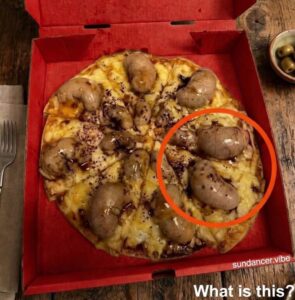
When my pizza arrived that evening, I expected the usual—golden crust, evenly melted cheese, and that familiar, comforting look that makes you reach for a slice without hesitation. Instead, I paused.
Something about it felt off.
At first glance, everything seemed normal. The crust had a nice color, the toppings were in place, and nothing looked burned or undercooked. But then I noticed it—the surface wasn’t smooth. Beneath the melted cheese were odd, rounded bubbles scattered across the pizza, creating small domes that distorted its usual appearance.
It wasn’t dramatic enough to scream “something’s wrong,” but it was just unusual enough to make me hesitate.
I didn’t grab a slice right away. Instead, I stared at it for a moment, trying to make sense of what I was seeing. Pizza is one of those foods you don’t usually question. It’s familiar, predictable, and consistent. Yet here I was, second-guessing something I’d eaten countless times.
The Moment of Doubt
There’s a very specific kind of hesitation that comes when something looks slightly unfamiliar. Not enough to alarm you—but enough to make you pause.
That’s exactly what happened.
I leaned closer, studying the surface. The bubbles weren’t random or chaotic. They were smooth, rounded, almost glossy under the light. Some were small and subtle, while others were larger, lifting sections of cheese into gentle domes.
My first thought? Maybe it was undercooked.
Then I considered the opposite—maybe it had been overcooked.
But neither explanation seemed to fit. The crust looked perfect. The edges were crisp without being burnt. The cheese had melted evenly. There were no obvious signs of anything going wrong.
And yet, those bubbles remained.
Curiosity Takes Over
Instead of eating right away, curiosity kicked in. I wanted to understand what I was looking at.
So I did what most people do in moments like this—I looked it up.
It didn’t take long to realize I wasn’t the only one who had noticed this before. In fact, many people had asked the exact same question: Why does my pizza have bubbles under the cheese?
And the answer turned out to be surprisingly simple—and surprisingly fascinating.
The Science Beneath the Surface
Those bubbles weren’t a mistake.
They were the result of a natural process that happens during baking.
At the center of it all is the dough. Pizza dough contains tiny pockets of air and moisture, created during mixing and fermentation. When the pizza is placed in a hot oven, those pockets begin to expand.
This is basic physics at work—heat causes gases to expand.
At the same time, moisture inside the dough turns into steam. That steam needs somewhere to go, and as it rises, it pushes upward against the layers above it.
Now add cheese into the equation.
As the cheese melts, it forms a soft, stretchy layer across the surface. In some areas, it creates a seal that traps the expanding air and steam beneath it. With nowhere else to escape, that pressure forms bubbles—lifting the cheese into those smooth, rounded domes.
What I was seeing wasn’t a flaw.
It was a visible reaction to heat, moisture, and structure all interacting at once.
Why Some Pizzas Have More Bubbles
Not all pizzas look like this, which is why it can feel surprising when it happens.
Several factors influence how noticeable these bubbles become:
1. Oven Temperature
High heat plays a major role. In hotter ovens, the expansion happens more quickly and more dramatically. This can create larger, more visible bubbles.
2. Dough Composition
The amount of air and moisture in the dough affects how much it expands. Well-fermented dough often contains more trapped gas, leading to more pronounced bubbling.
3. Cheese Type
Cheeses with higher moisture content melt differently. They can create a tighter seal on the surface, making it easier for steam to get trapped underneath.
4. Distribution of Toppings
If cheese is spread unevenly, some areas may trap more air than others. This leads to uneven bubbling across the surface.
Once you understand these variables, the randomness starts to make sense. Each pizza is slightly different because each baking process is slightly different.
From Concern to Appreciation
Armed with this new understanding, I looked at the pizza again.
Nothing about it had changed—but my perception had.
What had felt strange just minutes earlier now felt completely normal. More than that, it felt interesting. Those bubbles weren’t something to worry about—they were evidence of the cooking process in action.
So I picked up a slice.
As I lifted it, the cheese stretched slightly, just as expected. The crust held firm. The bubbles softened and collapsed gently under the pressure of my fingers.
I took a bite.
It tasted exactly like pizza should—warm, flavorful, satisfying.
No strange texture. No unusual flavor. No hidden problem.
If anything, the bubbled areas felt slightly lighter, adding a subtle variation in texture that made the bite more interesting.
The Bigger Lesson
What stood out most wasn’t the pizza itself—it was how quickly my reaction changed.
A small visual difference had been enough to create doubt. But a simple explanation was enough to remove it.
That moment highlighted something broader: how often we judge things based on appearance alone.
When something looks unfamiliar, we tend to assume something is wrong. But in many cases, it’s not a problem—it’s just something we don’t yet understand.
The bubbles on that pizza were a perfect example.
They weren’t defects. They weren’t mistakes.
They were simply part of the process.
The Hidden Complexity of Simple Food
We often think of cooking as straightforward—apply heat, and food is ready.
But in reality, there’s a lot happening beneath the surface.
In a single pizza, multiple processes occur at once:
- Air expands within the dough
- Moisture turns into steam
- Proteins change structure
- Sugars caramelize
- Cheese melts and redistributes
Each of these reactions contributes to the final result.
Most of the time, we don’t see these processes—we just enjoy the outcome. But occasionally, like with those bubbles, the process becomes visible.
And when it does, it offers a glimpse into the science behind something we usually take for granted.
Why Imperfection Isn’t a Problem
One of the reasons the bubbles felt strange at first is because we expect food to look “perfect.”
We’re used to uniformity—smooth surfaces, even textures, predictable shapes.
But real cooking isn’t perfectly uniform.
Small variations happen all the time. Heat isn’t distributed exactly the same way in every oven. Ingredients aren’t identical in every batch. Timing can vary slightly.
These differences create subtle changes in appearance.
And sometimes, those changes make something look unusual—even when it’s completely fine.
In fact, those variations are often a sign that the food is freshly made rather than mass-produced.
A Shift in Perspective
By the time I finished the pizza, my initial hesitation felt almost unnecessary.
What had started as a moment of doubt turned into a small lesson in observation and understanding.
It reminded me that not everything unfamiliar is a problem.
Sometimes, it’s just something we haven’t noticed before.
Or something we’ve never taken the time to understand.
What I’d Do Differently Now
If I saw the same bubbles again, I wouldn’t hesitate.
I’d recognize them immediately for what they are—a natural result of baking.
In fact, I might even appreciate them more, knowing they reflect the interaction of heat, air, and moisture working together.
It’s a small detail, but it changes the experience.
Final Thought
That evening, I expected nothing more than a simple meal.
Instead, I ended up learning something.
Not just about pizza—but about perception.
A small visual difference had been enough to create doubt. But curiosity replaced that doubt with understanding.
And in the end, the pizza didn’t just taste good.
It made sense.
And somehow, that made it even better.