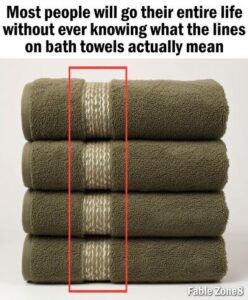
What the Lines on Towels Really Mean: A Deep Dive into the Dobby Border and Textile Engineering
Introduction: The Quiet Intelligence of Everyday Objects
Most people never think twice about towels. They hang in bathrooms, stack in closets, and appear in our daily routines as simple, soft rectangles meant to dry water. Yet beneath that simplicity lies a surprising level of engineering. Every stitch, loop, and edge is designed with intention.
One of the most overlooked but important features of a towel is the subtle line near its edges. Known as the dobby border, this woven strip is far more than decoration. It is a structural component that improves durability, preserves shape, and enhances performance over time.
Understanding this small detail opens a window into the larger world of textile design—where function and form are carefully balanced to create objects that are both practical and long-lasting.
1. What the Dobby Border Actually Is
The dobby border is a tightly woven section located at both ends of a towel. Unlike the main body of the towel, which is made of soft, looped fibers designed for absorbency, the border uses a denser weave pattern.
This difference in structure is intentional. While the center of the towel prioritizes softness and water absorption, the edges prioritize stability. The dobby border acts as a frame, holding the entire structure together.
In weaving terms, dobby refers to a type of loom mechanism that allows for small, geometric patterns to be created in fabric. In towels, this technique is used not just for aesthetics but for reinforcement.
2. Preventing Fraying: The First Line of Defense
One of the biggest challenges in textile manufacturing is fraying. Over time, repeated washing, drying, and physical handling can cause fabric edges to unravel. This is especially true for materials like cotton, which rely on looped fibers.
The dobby border solves this problem by tightening the weave at the edges. Instead of loose loops, the fibers are interlocked more densely, reducing movement and friction.
This reinforced structure distributes stress more evenly across the towel. As a result, the edges remain intact even after hundreds of wash cycles.
Without this feature, towels would quickly degrade, losing both appearance and functionality.
3. Maintaining Shape Through Repeated Use
Another critical function of the dobby border is shape retention. Towels without reinforced edges tend to warp over time. They may stretch unevenly, curl at the ends, or lose their rectangular structure.
The dobby border acts like a stabilizing frame. By creating a firm boundary, it prevents the fabric from expanding or contracting irregularly.
This structural consistency is especially important in commercial settings like hotels or gyms, where towels are washed frequently and must maintain a uniform appearance.
Even in home use, shape retention contributes to a sense of order and quality. A towel that folds evenly and hangs straight feels more durable and well-made.
4. The Relationship Between Borders and Absorbency
At first glance, it might seem that a tightly woven border would reduce performance. After all, if absorbency depends on soft, open loops, wouldn’t a dense edge interfere?
In reality, the opposite is true.
The dobby border does not exist to absorb water. Instead, it supports the absorbent section of the towel. By stabilizing the edges, it prevents distortion in the central fabric where absorbency matters most.
Think of it as a frame around a sponge. The frame itself doesn’t soak up water, but it ensures the sponge maintains its shape and efficiency.
Without this support, the towel’s structure could become uneven, reducing its ability to absorb water effectively over time.
5. Durability: Extending the Life of a Towel
Durability is one of the most important qualities in any textile product. Towels are subjected to frequent washing, exposure to heat, and constant mechanical stress.
The dobby border significantly increases lifespan by reinforcing the most vulnerable part of the fabric: the edges.
When fibers at the edge are left unprotected, they begin to unravel. Once unraveling starts, it spreads inward, gradually destroying the towel.
The dobby border prevents this chain reaction. By locking the structure in place, it slows down wear and tear, allowing towels to remain usable for much longer periods.
This not only benefits consumers but also reduces textile waste, making it a small but meaningful contribution to sustainability.
6. Comfort and Usability in Everyday Life
Beyond structural benefits, the dobby border also influences how a towel feels and functions in daily use.
The edges of a towel without reinforcement can feel bulky or uneven. This can make folding awkward or uncomfortable. The dobby border creates a flatter, more uniform edge that improves handling.
This subtle refinement affects several everyday interactions:
- Towels fold more neatly
- Hanging is more balanced and stable
- Stacking requires less adjustment
These improvements may seem minor, but they significantly enhance user experience over time.
Comfort in textiles is not just about softness—it is also about predictability and ease of use. The dobby border contributes to both.
7. Aesthetic and Design Expression
While the dobby border is primarily functional, it also serves an aesthetic purpose. Because it is woven differently from the rest of the towel, it naturally creates a visual contrast.
Manufacturers often use this section to incorporate patterns, lines, or subtle branding elements. This allows towels to have a distinct identity without compromising performance.
In some cases, the border becomes a marker of quality. A well-designed dobby border can signal craftsmanship, attention to detail, and higher production standards.
Historically, woven borders were even associated with luxury textiles, where decorative weaving techniques were used to indicate skill and value.
Today, while mass production has made towels widely accessible, the dobby border still carries echoes of that tradition.
8. The Science of Textile Engineering Behind It All
To fully understand the dobby border, it helps to step back and look at textile engineering as a whole.
Modern towels are designed using a careful balance of three main properties:
- Absorbency
- Strength
- Softness
These properties often conflict with one another. For example, increasing softness can reduce strength, while increasing strength can reduce softness.
The dobby border helps resolve this tension by separating functions within the same object. The central area prioritizes absorbency and softness, while the edges prioritize strength and structure.
This division of labor within a single fabric is a hallmark of intelligent design. It allows towels to perform multiple roles without compromise.
9. Why Small Details Matter in Design
The dobby border is a powerful example of how small details can have large effects. At first glance, it appears insignificant—a simple line running along the edge of a towel.
But that line represents a series of deliberate engineering decisions aimed at solving real problems: fraying, distortion, inefficiency, and wear.
This principle extends far beyond textiles. In many fields of design and engineering, the most important innovations are not dramatic changes but subtle refinements.
A small adjustment in structure can dramatically improve longevity. A minor reinforcement can prevent failure. A quiet detail can transform user experience.
10. The Hidden Complexity of Everyday Objects
The dobby border also highlights something more universal: everyday objects are often far more complex than they appear.
A towel is not just a piece of fabric. It is a carefully constructed system designed to interact with water, pressure, movement, and time.
Each element of its design serves a purpose:
- Loops for absorbency
- Fibers for softness
- Weave patterns for strength
- Borders for stability
When combined, these elements create a product that feels simple but is actually the result of centuries of textile evolution.