When my fiancé got down on one knee, I expected the moment to feel like something out of a film—soft lighting, happy tears, and a ring that instantly made sense in my mind. Instead, what I saw when he opened the box stopped me in a completely different way.
The ring wasn’t what I had pictured at all.
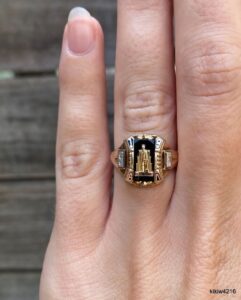
It wasn’t a delicate diamond solitaire or a simple modern band. It was bold, heavy, and unmistakably vintage. A thick gold setting framed a dark black onyx center, carved with an intricate architectural design that looked almost like a miniature monument. On either side, baguette diamonds caught the light in sharp geometric flashes, giving it a structured, almost masculine presence.
For a few seconds, I didn’t say anything. I just stared at it, trying to understand how I felt.
He smiled, waiting for my reaction. And I realized I didn’t have one that fit the moment.
Instead of joy or instant excitement, I felt confusion.
Not because it wasn’t beautiful—it was. But because it wasn’t what I had ever imagined for myself.
The moment that didn’t match the expectation
From the time I was young, I had a very specific idea of what an engagement ring would look like. Something light. Sparkly. Timeless in a familiar way. A symbol that felt soft and romantic at first glance.
This ring was none of those things.
It felt like it belonged to another era entirely. Like it carried weight—literally and emotionally. It didn’t whisper commitment. It declared something.
I forced myself to smile when he slipped it onto my finger. He looked so proud, so sure. And I didn’t want to ruin the moment.
But inside, my thoughts were spiraling.
Why this ring? Why this style? Did he think I would love it, or did he choose it for himself? And the question I didn’t want to fully admit even to myself: had it belonged to someone else before me?
That last thought lingered more than I expected.
When beauty and discomfort coexist
In the days after the proposal, I kept noticing the ring in different lighting. Sometimes I caught myself admiring it—how the black stone absorbed light, how the gold felt warm against my skin. Other times, I found myself staring at it with unease.
People noticed it immediately.
Friends called it unique, dramatic, artistic. Some said it looked like something from a museum. Others said it was “so him,” referring to my fiancé’s love of architecture and old city buildings.
But their compliments didn’t erase my internal conflict.
Because every compliment also came with curiosity.
“Where did he find that?”
“Is it antique?”
“Does it have a story?”
And I didn’t have answers that felt satisfying.
His perspective on the ring
My fiancé, Daniel, seemed completely at ease with his choice. If anything, he was proud in a way I didn’t fully understand at first.
He told me he didn’t want a generic ring. He wanted something with character. Something that didn’t look like everyone else’s.
He explained that he found it in a small antique shop during a solo afternoon walk. It had caught his attention immediately, sitting in a case among other vintage pieces. According to him, the shop owner told him it was from the early 20th century—an Art Deco-era piece, likely inspired by architectural design principles of strength and structure.
He loved that idea.
He said the ring represented building something lasting. Something intentional. Something strong enough to endure time.
And while I understood the sentiment, I still couldn’t shake the feeling that the meaning he saw wasn’t the same as the one I felt wearing it.
The private spiral
At night, when everything was quiet, I found myself researching.
Art Deco rings. Vintage onyx settings. Antique signet styles. I learned more than I expected to know about early 1900s jewelry design.
And with every new search result, my imagination ran further.
Some rings like this had been family heirlooms. Some had been custom pieces made for men. Some had been passed through collectors. Some had unclear histories that left room for interpretation.
That uncertainty became the real source of my discomfort—not the ring itself, but the unknown behind it.
I didn’t want to feel like I was stepping into a story that had already begun without me.
The emotional gap that opened quietly
What surprised me most wasn’t the ring itself, but how it started to affect the way I interpreted everything else.
Small things began to feel heavier.
When he said he loved it, I wondered if he loved it more than he understood me.
When he talked about our future, I wondered if we were picturing the same version of it.
Even simple conversations about wedding planning started to feel slightly off balance, like there was an unspoken topic sitting between us.
The ring had become more than jewelry.
It had become a question I didn’t know how to ask out loud.
The conversation I kept avoiding
For weeks, I hesitated to bring it up.
I didn’t want to sound ungrateful. I didn’t want him to think I was rejecting something he chose with care. And I didn’t want to admit how much space it was taking up in my mind.
But silence doesn’t remove uncertainty. It just makes it grow quieter and heavier at the same time.
One evening, I finally asked if we could talk.
He immediately sensed something was off.
We sat down, and for the first time, I told him everything—not as an accusation, but as honestly as I could manage.
I told him I was confused by the ring. That I didn’t fully understand it yet. That part of me loved its uniqueness, but another part of me felt disconnected from it.
And then I asked the question I had been avoiding.
“Is there a story behind it I should know?”
The truth behind the choice
He didn’t hesitate.
He explained again that he found it at an estate sale through a collector who specialized in vintage pieces. The ring had belonged to an architect decades ago, someone who had it custom-designed as a symbolic piece tied to his work and philosophy.
There was no romantic history attached to it. No previous engagement. No hidden relationship story.
Just craftsmanship, history, and design.
He admitted he chose it quickly because it felt meaningful to him in a way he struggled to fully explain at the time. He saw structure, permanence, and creativity in it—qualities he associated with our relationship.
Then he paused and added something more important.
He said he realized he hadn’t stopped to ask what I would want.
The shift in understanding
That moment changed the tone completely.
Not because everything was suddenly perfect, but because the misunderstanding finally had language.
It wasn’t about suspicion anymore. It was about difference.
Different expectations. Different emotional interpretations. Different ways of attaching meaning to objects.
We weren’t arguing about a ring. We were learning how we communicate when something matters deeply but doesn’t align immediately.
And that realization softened something between us.
Redefining what the ring meant
Over time, we started talking more openly about it.
Instead of treating the ring as a fixed symbol, we began treating it as something we could shape together.
We visited jewelers. We explored redesign options. We talked about keeping parts of it while softening others. We discussed adding lighter stones, changing the setting slightly, or even resetting the design entirely.
What mattered wasn’t preserving the original object—it was making sure it reflected both of us.
Not just him. Not just me. Both.
What I learned about expectations
The biggest lesson wasn’t about jewelry at all.
It was about the gap between imagined symbolism and real-life intention.
I had attached meaning to what an engagement ring “should” be based on culture, media, and expectation. He had attached meaning based on history, aesthetics, and personal interpretation.
Neither of us was wrong. But neither of us was fully aligned either.
And that gap created confusion that felt much bigger than it actually was.
A different kind of proposal story
Looking back now, I don’t see that moment as imperfect anymore.
It didn’t unfold the way I expected. It didn’t match the script I had unconsciously written in my head.
But it did something else instead.
It revealed how we handle misunderstanding.
It showed how quickly assumptions can fill silence.
And it forced a conversation we might have avoided until much later.
Where we are now
The ring still sits on my hand, but it feels different now.
Not because it changed overnight, but because my understanding of it did.
It’s no longer just an object I’m trying to decode. It’s part of a process we went through together—one that involved confusion, honesty, and adjustment.
We’re still deciding on final modifications. Still shaping what it will ultimately look like.
But the most important part has already happened.
We talked.
We listened.
We adjusted.
Final reflection
Engagement isn’t just about the moment someone proposes. It’s about everything that follows the moment when reality and expectation meet.
Sometimes those two things align perfectly.
Sometimes they don’t.
In our case, they didn’t at first.
But what mattered most wasn’t the initial reaction—it was what we did afterward.
And in that space between confusion and understanding, something stronger than expectation began to form.
Not a perfect ring.
Not a perfect moment.
But a shared one.