There are moments in life that seem small when they happen—ordinary exchanges wrapped in everyday conversation, spoken without hesitation because we believe we understand enough to judge, to define, to conclude. In those moments, words feel light. They move quickly, without resistance, shaped by certainty and carried by confidence. We don’t pause to measure them, because we assume their impact will be just as fleeting as the moment itself.
But some words don’t fade.
They remain, quietly waiting, gaining weight over time until they return—not as memories, but as something heavier. Something that reshapes how you see yourself.
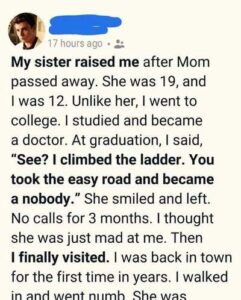
I remember my graduation day with striking clarity. It was a moment filled with celebration, applause, and a sense of completion that felt absolute. Years of effort had led to that stage, to that recognition, to that feeling of arrival. Standing there, surrounded by approval, I felt certain—not just about what I had achieved, but about what it meant.
In my mind, success was simple. It was earned. It belonged to those who worked for it. There was no space in that belief for complexity, no recognition of circumstances, sacrifices, or unseen contributions. It was a clean equation: effort equals outcome.
And within that framework, I had already placed everyone in my life—including my sister.
To me, she had chosen differently. Settled earlier. Expected less. I didn’t question it. I didn’t look deeper. I didn’t consider that what I saw might not be the full story.
I spoke to her that day with the confidence of someone who believes they are stating a fact. My words were not loud or emotional. They were calm, measured, and far more damaging because of it. There was a certainty in them—a quiet dismissal that reduced her life to something smaller than my own.
For a brief moment, I felt powerful.
As though I had defined something clearly.
As though I had drawn a line that separated us.
But what followed was not what I expected.
There was no argument. No anger. No attempt to correct me.
Only silence.
A silence so complete it seemed to absorb everything around us. It didn’t push back—it simply existed, heavy and undeniable. She looked at me, not with resentment, but with something I couldn’t understand at the time. Something calm. Something knowing.
She smiled softly.
And then she walked away.
In that moment, I believed I had won something.
I didn’t realize I had lost something I couldn’t yet name.
Life moved forward, as it always does.
In the months that followed, I built the life I had always envisioned. I worked relentlessly, driven by the same belief system that had shaped my words that day. Effort, discipline, focus—these were the tools I trusted, and they delivered results.
Promotions came. Recognition followed. Stability grew.
From the outside, everything aligned perfectly.
There were no visible cracks.
But beneath that surface, something began to shift—quietly, almost imperceptibly at first.
It started with small moments.
A passing thought of calling her.
A memory surfacing without warning.
An instinctive reach for my phone that stopped halfway, interrupted by the echo of that last conversation.
Each time, I dismissed it.
Distance, I told myself, was natural.
People needed space.
She was strong. Independent. Capable.
These explanations felt reasonable. They allowed me to move forward without confronting anything deeper. They protected me from the discomfort of uncertainty.
Pride rarely announces itself.
It doesn’t demand attention.
Instead, it works quietly, shaping the narratives we tell ourselves. It offers explanations that feel logical, even when they are incomplete. It reassures us that nothing needs to be fixed, that time will resolve what we choose not to face.
And so I waited.
Days became weeks.
Weeks became months.
Silence settled into place, not as something temporary, but as something normal.
Yet even as life progressed, something remained unsettled.
It wasn’t overwhelming.
It didn’t disrupt my routine.
But it lingered—subtle, persistent, impossible to fully ignore.
Like a quiet imbalance.
Like something slightly out of alignment.
When I finally returned home, it wasn’t because I had found clarity.
It was because the unease had grown too steady to dismiss.
The streets were the same.
The house stood unchanged.
Everything looked exactly as I remembered it.
But something felt different.
Or perhaps I had changed enough to notice what had always been there.
The moment I stepped inside, the silence felt heavier than before.
Not peaceful.
Not restful.
But still.
As if time had paused and never resumed.
I called her name once.
Then again.
Each time expecting the familiar response that had always followed.
But there was nothing.
As I moved through the house, small details began to stand out.
Unopened mail.
Objects left untouched.
Spaces that felt abandoned, not temporarily—but indefinitely.
And then I saw the note.
Placed carefully.
Deliberately.
Waiting.
My hands trembled as I picked it up.
Before I even read it, I felt something shift.
A quiet understanding that whatever was written inside would change everything.
Her handwriting was the same—steady, calm, unmistakably hers.
But the words carried a weight I wasn’t prepared for.
She wrote that she was tired.
Not physically.
Not in a way that sleep could fix.
But in a way that came from years of giving without pause.
She said she didn’t blame me.
That understanding often comes too late.
That my words hadn’t broken her—but they had revealed something she could no longer ignore.
That her sacrifices had become invisible.
Even to me.
She explained that she was leaving.
Not out of anger.
But to discover who she was beyond everything she had carried for others.
And at the end, she wrote something I wasn’t ready to accept.
She said she was proud of me.
That she always had been.
And that she hoped one day, I would learn to truly see people—not for what they appear to be, but for what they quietly endure.
I read the note over and over again.
Each time hoping it would feel different.
Each time realizing it didn’t.
The meaning didn’t change.
Only my understanding did.
For the first time, I allowed myself to look back—without defensiveness, without justification.
And slowly, the past began to shift.
Moments I had overlooked took on new meaning.
Details I had ignored became impossible to dismiss.
I began to see things differently.
The late nights when she stayed awake while I slept.
The choices she made that shaped my opportunities.
The way she carried responsibility without ever drawing attention to it.
What I had seen as ordinary was anything but.
It was effort.
It was sacrifice.
It was love—given quietly, without expectation of recognition.
And I had missed all of it.
Not because it wasn’t visible.
But because I hadn’t been looking.
The realization didn’t come all at once.
It unfolded gradually.
Relentlessly.
Each memory adding weight to a truth I could no longer avoid.
I was not self-made.
I had been supported.
Shaped.
Sustained.
And the person who had given the most was the one I had understood the least.
That truth didn’t just hurt.
It changed me.
In the days that followed, I searched for her.
Through people.
Through places.
Through every possibility I could find.
But the search became something more than physical.
It became internal.
I began to examine the way I saw the world.
The assumptions I made.
The ease with which I categorized people based on what I could see.
I started to notice things I had overlooked before.
The quiet effort behind simple actions.
The strength in people who never spoke about it.
The sacrifices that went unrecognized because they were given without demand.
My definition of success began to change.
It was no longer just about achievement.
It was about awareness.
About understanding.
About recognizing that no one reaches anything alone.
Work, once the center of my identity, began to feel incomplete without that perspective.
Every interaction became an opportunity to listen more carefully.
To look deeper.
To question what I thought I understood.
I carried her note with me—not as a burden, but as a reminder.
A reference point.
Something that grounded me when I felt myself slipping back into old patterns.
Change didn’t happen instantly.
It wasn’t perfect.
But it was real.
And it was consistent.
I don’t know where she is now.
That uncertainty never fully disappears.
Some days, it feels distant.
Manageable.
Other days, it returns with a sharpness that brings everything back.
The silence.
The house.
The note.
I’ve accepted that some apologies may never be spoken directly.
That some gratitude arrives too late.
That some understanding comes after the moment where it could have made a difference.
But regret is not empty.
It carries responsibility.
It asks something of you.
It demands change.
Growth.
Awareness.
If I ever see her again, I know the words I will say won’t undo anything.
They won’t erase the past.
They won’t change the silence that followed.
But they will come from a place that didn’t exist before.
A place shaped by humility.
By understanding.
By the recognition of everything I once failed to see.
And if that moment never comes, then the life I live becomes the only way to honor what she gave me.
Not through promises.
Not through intention alone.
But through action.
Through awareness.
Through the way I treat others.
Because in the end, the most powerful lesson she left behind wasn’t in what she wrote.
It was in what followed.
The silence.
A silence that forced me to stop.