In a world that constantly celebrates cutting-edge technology and complex innovation, it’s easy to overlook the brilliance of simple objects. Yet some of the most refined examples of human ingenuity aren’t found in advanced devices—they’re embedded in everyday tools we barely think about. The nail clipper is one of those objects.
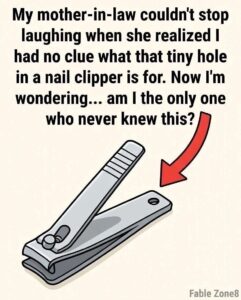
Small, inexpensive, and nearly universal, it exists quietly in drawers, travel kits, and bathroom shelves across the world. Most people use it regularly without ever questioning its design. But hidden within its compact structure is a detail that often goes unnoticed: the tiny hole at the end of its lever.
At first glance, this hole seems insignificant—almost decorative. But in reality, it reflects layers of thoughtful engineering, historical habit, and practical design. Looking closer reveals how even the simplest tools are shaped by deep intention.
A Feature Designed for Real Life
The most obvious function of the hole is portability.
Because a nail clipper is so small, it’s easy to misplace. The addition of a hole transforms it from a loose object into something that can be anchored—attached to a keychain, loop, or cord.
This small change has a surprisingly large impact. Instead of being stored and forgotten, the clipper becomes part of a system:
- Attached to keys
- Hooked inside a bag
- Kept in a travel kit
- Hung in a consistent place
It shifts the tool from something passive to something accessible.
In modern life, where convenience matters, that accessibility is everything.
Preventing the “Small Object Problem”
Everyone has experienced it: small items disappearing into drawers, bags, or pockets, only to be needed at the worst possible moment.
The hole solves this problem without adding complexity.
It doesn’t require extra parts or mechanisms. It doesn’t change how the tool works. It simply adds an option—a way to secure it.
This is a hallmark of good design: solving a problem without creating new ones.
Subtle Ergonomics and Control
Beyond portability, the hole also offers an ergonomic advantage.
For some users, especially those with reduced grip strength or dexterity, it can act as a point of control. A finger can be placed through the hole to:
- Stabilize the clipper
- Improve leverage
- Increase precision
This is particularly useful when trimming thicker nails or when a steady grip is needed.
What makes this feature effective is its flexibility. It doesn’t force a new way of using the tool—it simply supports it when needed.
That’s adaptive design at its best.
A Link to the Past
The presence of the hole also reflects older habits that many people no longer think about.
Before modern storage solutions, people carried essential tools directly on their bodies. Small items like keys, watches, and grooming tools were attached to chains or loops for easy access.
In that context, the nail clipper wasn’t just a bathroom item—it was part of a daily carry.
The hole made that possible.
Even though lifestyles have changed, the feature remained. Why? Because it still works.
This continuity shows how strong design can outlast the era it was created in.
Manufacturing Efficiency Hidden in Plain Sight
There’s also a less visible benefit: manufacturing.
During production, small structural features like this hole can help:
- Position parts during assembly
- Improve handling in automated systems
- Assist with alignment and quality control
While users rarely see this side of the design, it contributes to consistency and reliability.
It’s a perfect example of dual-purpose thinking—serving both the maker and the user at the same time.
Why the Design Hasn’t Changed Much
Unlike many products that evolve dramatically over time, the nail clipper has remained largely the same.
That’s not a lack of innovation—it’s a sign of refinement.
Its design has been shaped over decades through repeated use and small improvements. Every element, including the tiny hole, exists because it proved useful enough to stay.
This reflects a key principle of industrial design:
The best designs don’t need constant reinvention—they just need to work.
Simplicity That Anticipates Human Behavior
What makes this tiny detail remarkable is how well it understands people.
It accounts for real-life behavior:
- People lose small objects
- People value convenience
- People benefit from better grip and control
Instead of adding complexity, it addresses these needs with a single, simple feature.
That’s not accidental—that’s thoughtful design.
A Reminder Hidden in Plain Sight
The hole on a nail clipper is easy to ignore because it works so seamlessly. It doesn’t demand attention. It doesn’t stand out.
But that’s exactly why it matters.
The most successful designs often disappear into use. They feel natural, intuitive, and obvious—once you notice them.
The Bigger Lesson
This small detail invites a larger reflection.
How many other everyday objects contain features we never question?
- The curve of a handle
- The texture of a grip
- The placement of a button
Each one is the result of human decisions, shaped by experience and refined over time.
The nail clipper’s tiny hole is just one example—but it represents something much bigger.
Final Thought
The next time you pick up a nail clipper, take a closer look at that small opening.
It’s not just a hole.
It’s a solution:
- To portability
- To usability
- To manufacturing efficiency
- To real human needs
And more than that, it’s a quiet reminder that even the simplest tools can carry remarkable thought behind them.
Because sometimes, the most powerful design isn’t what stands out—
it’s what works so well that you never think to question it.