Introduction: The Rise of AI-Generated Political Futures
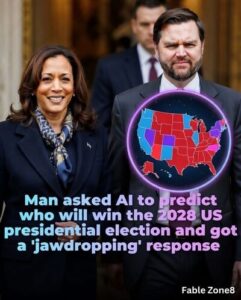
Artificial intelligence has increasingly moved beyond technical and industrial applications into cultural, social, and political domains. One of the most controversial and widely discussed uses of AI today is in the simulation of future political events, particularly elections. Among the most viral examples of this trend is a hypothetical 2028 U.S. presidential election scenario featuring Kamala Harris and JD Vance as the two major party nominees.
This simulation, which circulated widely across online platforms, was not presented as a prediction of actual future events. Instead, it was framed as a probabilistic exploration of possible electoral outcomes using historical data, polling trends, demographic modeling, and assumed political trajectories. Despite this disclaimer, the scenario sparked intense debate, with audiences splitting between those who viewed it as a fascinating analytical exercise and those who criticized it as misleading political speculation.
The viral nature of the simulation highlights a growing tension in modern political culture: the increasing authority of algorithmic systems in interpreting human behavior versus the inherent unpredictability of democratic decision-making.
The Nature of AI Political Simulations
AI systems used for political forecasting operate fundamentally differently from human analysts. They do not “understand” politics in a conscious sense. Instead, they process large datasets to identify statistical relationships between variables such as voting history, demographic shifts, economic indicators, approval ratings, and polling averages.
In the case of a hypothetical election simulation, the model typically constructs thousands or even millions of possible scenarios. Each scenario assigns probabilities to outcomes based on weighted variables. These variables might include:
- Historical voting patterns by state and region
- National polling averages over time
- Voter turnout projections among demographic groups
- Economic conditions such as inflation and employment
- Incumbency advantage or disadvantage
- Campaign fundraising strength
- Betting market sentiment
The output is not a single prediction but a distribution of possibilities. However, when simplified for public consumption, these probabilistic models are often reduced to a single narrative outcome, which can lead to misunderstanding about their precision.
Why the 2028 Scenario Attracted Attention
The imagined contest between Kamala Harris and JD Vance gained traction for several reasons beyond its technical construction. First, it involved two recognizable political figures already occupying high-profile national roles. This gave the simulation a sense of plausibility, even though it was speculative and far in advance of any actual election cycle.
Second, the pairing itself represented contrasting political identities. Harris was associated with an established Democratic leadership structure, while Vance represented a newer generation of Republican leadership aligned with evolving party dynamics. This contrast created a compelling narrative structure for audiences interested in political futures.
Third, the simulation arrived during a broader cultural moment in which AI-generated content is increasingly treated as both entertainment and analytical insight. This blending of categories contributes to confusion about how seriously such outputs should be interpreted.
Methodological Assumptions Behind the Simulation
The model behind the simulation reportedly relied on several key assumptions. First, it assumed continuity in current political trends, meaning that existing voting patterns and demographic shifts would continue in relatively stable trajectories through 2028.
Second, it incorporated polling data as a directional indicator, even though long-term polling accuracy is highly limited. Polling data tends to be more reliable closer to an election and significantly less predictive years in advance.
Third, the model included economic indicators as a proxy for incumbent party performance. Economic conditions such as inflation rates, wage growth, and employment levels were treated as influencing voter sentiment, consistent with historical election behavior.
Finally, the simulation used electoral college weighting as the structural mechanism for determining outcomes, meaning that state-by-state results were aggregated rather than relying solely on national popular vote projections.
Hypothetical Primary Dynamics
Within the simulation, the Democratic primary field was portrayed as competitive but ultimately consolidating around Kamala Harris. This outcome was attributed to several modeled advantages, including national recognition, prior executive experience, and established political networks.
Other potential candidates were included in the simulation as variables influencing the early stages of the race. However, as the model progressed through iterative polling simulations, Harris gained a structural advantage due to name recognition and institutional support.
On the Republican side, JD Vance was projected as an early frontrunner in the hypothetical primary landscape. This projection was based on assumed alignment with dominant ideological trends within the party and strong support among key voter blocs. The model also assumed reduced fragmentation compared to earlier election cycles, allowing for faster consolidation around a leading figure.
It is important to note that these assumptions are highly speculative and depend heavily on conditions that may or may not exist in a real future political environment.
Electoral College Modeling and Structural Bias
A central feature of the simulation was its Electoral College projection. The model divided states into categories: solid, likely, lean, and toss-up. This classification system reflects common forecasting methodologies used in political analysis.
In the early stages of the simulation, traditional strongholds for both parties were assigned based on historical voting patterns. This created a baseline map that already reflected structural advantages for each side.
The next stage involved assigning likely states, which further expanded the electoral vote totals for both candidates. At this point, the simulation showed a narrowing gap but still no decisive winner.
The final stage focused on battleground states, which historically determine the outcome of close elections. These states included regions with fluctuating voting patterns and diverse demographic compositions. Small shifts in voter turnout or preference within these states significantly altered the projected outcome.
The model ultimately favored JD Vance in a narrow majority of simulated scenarios, though the margin remained sensitive to small changes in assumptions.
Battleground States as Decision Points
The simulation emphasized the importance of battleground states as decisive electoral factors. These states often serve as indicators of broader national political sentiment due to their demographic diversity and competitive partisan balance.
In the modeled scenario, slight advantages in voter turnout or demographic shifts in these states had outsized effects on the final electoral outcome. For example, modest increases in suburban voter participation or shifts among younger voters were enough to swing entire states.
This reflects a known feature of the Electoral College system: national elections are often determined not by overall vote totals but by narrow margins in specific regions.
The Final Simulated Outcome and Its Interpretation
The final projection of the simulation suggested a victory for JD Vance with 326 electoral votes compared to 212 for Kamala Harris. However, this outcome was explicitly framed as one of many possible scenarios rather than a definitive prediction.
The model itself emphasized uncertainty, noting that small changes in assumptions could produce significantly different results. This includes changes in economic conditions, international events, political scandals, or shifts in public opinion.
Despite these caveats, many viewers interpreted the result as a forecast rather than a simulation, highlighting a common misunderstanding of probabilistic modeling.
Why AI Election Simulations Go Viral
AI-generated political forecasts often achieve viral status due to their psychological appeal. Humans are naturally drawn to predictive narratives, particularly those involving uncertain future events. Elections, as high-stakes and widely followed processes, amplify this interest.
Visual representations such as electoral maps further enhance engagement by simplifying complex data into easily interpretable color-coded outcomes. These visuals create a strong impression of certainty, even when underlying models are highly uncertain.
Additionally, AI-generated content carries an aura of authority. Many users assume that algorithmic outputs are inherently objective or superior to human analysis, even though they are ultimately based on assumptions encoded by human designers.
Limitations of Long-Term Political Modeling
Despite their sophistication, AI political simulations face significant limitations. One of the most important is the unpredictability of future events. Elections are influenced by factors that cannot be reliably forecast years in advance, including geopolitical crises, economic shocks, candidate behavior, and cultural shifts.
Another limitation is data dependency. Models rely heavily on historical data, but historical patterns may not repeat in future contexts. Political realignments, demographic transitions, and technological changes can all disrupt established trends.
Polling data, a key input in many simulations, is particularly unreliable over long time horizons. Public opinion can shift rapidly, and early polling often reflects name recognition rather than genuine electoral preference.
Media Amplification and Public Interpretation
Once released into online environments, AI simulations often take on lives of their own. Social media platforms amplify simplified interpretations of complex models, stripping away methodological nuance.
Users frequently reinterpret probabilistic outputs as deterministic predictions. This transformation from analysis to perceived forecast contributes to misunderstanding and, in some cases, misinformation.
Political audiences may also selectively interpret results in ways that reinforce existing beliefs, further polarizing reactions to the same simulation.
Ethical Considerations in AI Political Forecasting
The growing use of AI in political simulation raises important ethical questions. One concern is the potential for premature narrative shaping. Even hypothetical models can influence perceptions of candidates and political viability long before actual campaigns begin.
Another concern involves transparency. Users may not fully understand the assumptions embedded in models or the degree of uncertainty involved in outputs.
There is also the question of whether AI systems should be used to simulate sensitive political outcomes at all, given the potential for misinterpretation.
Conclusion: AI as a Tool for Exploring Possibilities, Not Predicting Certainties
The viral 2028 election simulation illustrates both the power and the limitations of artificial intelligence in political analysis. While such models can provide structured frameworks for exploring possible futures, they cannot account for the full complexity of human behavior and democratic systems.
The imagined contest between Kamala Harris and JD Vance is not a forecast of reality but a reflection of how data, assumptions, and computational modeling can be combined to generate plausible narratives about the future.
Ultimately, the value of these simulations lies not in their predictive accuracy but in their ability to stimulate discussion, encourage analytical thinking, and highlight the uncertainty inherent in political systems.
As artificial intelligence continues to evolve, its role in shaping public understanding of politics will likely expand. However, the distinction between simulation and prediction must remain clear if such tools are to be used responsibly in public discourse.