The Truth Behind the “Mysterious Pink Creature” in Your Home
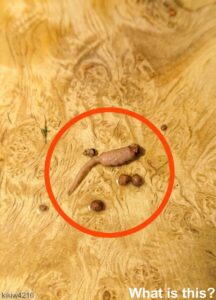
At first glance, the image is unsettling—a soft, pink, elongated body with a long, thread-like tail, resting on a wooden surface and surrounded by small brown pellets. It looks alien, even alarming.
But the reality is far less threatening—and far more fascinating.
What you’re seeing is a rat-tailed maggot, the larval stage of a hoverfly, most commonly Eristalis tenax.
What Makes It Look So Strange?
The defining feature is that long “tail.” It isn’t a tail at all, but a breathing tube—an adaptation tied to a concept known as Respiratory siphon.
This tube acts like a snorkel, allowing the larva to breathe air while living in low-oxygen environments like:
- Stagnant water
- Drains
- Compost
- Organic sludge
Its body is soft, semi-transparent, and often pinkish due to oxygen-binding compounds—giving it that unusual appearance.
Why It Shows Up Indoors
Finding one inside your home doesn’t mean infestation.
It usually means:
- It was washed in from a drain or gutter
- It crawled away from a wet breeding site to pupate
- It ended up in the wrong place by accident
These larvae cannot survive long on dry surfaces like wood.
The small brown pellets nearby? Most likely waste material (frass) or debris—not eggs, not parasites.
Harmless, Despite the Appearance
Despite how it looks, a rat-tailed maggot is:
- Non-toxic
- Non-biting
- Not parasitic
- Not a disease carrier
It’s often confused with worms or dangerous larvae, but it poses no risk to humans or pets.
In fact, it plays an important ecological role.
A Hidden Environmental Worker
These larvae are part of the order Diptera and contribute to decomposition.
They feed on:
- Bacteria
- Decaying organic matter
- Nutrient-rich waste
By doing this, they help recycle nutrients back into the environment.
In some systems, they’re even used as indicators of water quality—because they can survive in conditions that many organisms cannot.
From “Maggot” to Pollinator
What’s even more surprising is what they become.
After completing development, the larva undergoes Metamorphosis and transforms into a hoverfly.
Adult hoverflies:
- Resemble bees or wasps
- Feed on nectar
- Act as important pollinators
So the strange creature you found is actually an early stage of something beneficial to gardens and ecosystems.
Why People Panic
The reaction is understandable.
Its appearance triggers assumptions:
- “Is it a parasite?”
- “Is it dangerous?”
- “Is my home contaminated?”
This is a classic case of unfamiliarity leading to fear.
But proper identification changes everything.
What You Should Do If You Find One
No drastic action is needed.
Simple steps:
- Remove it with tissue or rinse it away
- Check for standing water nearby
- Clean drains or gutters if needed
Avoid pesticides—they’re unnecessary and ineffective in this case.
A Small Lesson With Bigger Meaning
Encounters like this reveal something deeper:
Nature is always present—even in our homes.
Most of it goes unnoticed.
Creatures like this are part of a hidden ecosystem that operates quietly around us, breaking down waste, supporting plant life, and maintaining balance.
Final Thought
What looks like something alarming is actually something ordinary—just misunderstood.
The rat-tailed maggot isn’t a threat.
It’s a reminder.
That even in the most unexpected places, life is adapting, evolving, and playing a role.
And sometimes, the difference between fear and fascination…
…is simply knowing what you’re looking at.