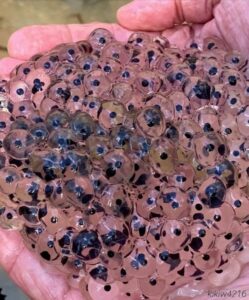
At first glance, the strange cluster resting in a human hand appears almost otherworldly—like something imagined for a science fiction film or crafted as an elaborate visual illusion. Dozens, sometimes hundreds, of tiny translucent spheres press gently against one another, each containing a dark, circular center that looks uncannily like a miniature eye. The effect is immediate and striking. It feels as though the cluster is staring back, alive in a way that is difficult to explain and even harder to ignore.
Yet what appears mysterious, even unsettling, is in fact one of nature’s most ordinary and remarkable phenomena: amphibian egg masses. These so-called “eyeball eggs” are not alien or artificial. They are the earliest stage of life for frogs, representing a biological process that has unfolded on Earth for millions of years, largely unnoticed except by those who pause long enough to truly see it.
The fascination begins with appearance. Human perception is wired to recognize patterns, especially those resembling faces or eyes. This tendency, deeply rooted in our evolutionary history, helps us quickly identify living beings and potential threats. When we encounter a cluster of frog eggs, the dark embryos suspended within clear gelatin trigger that instinctive recognition. The brain interprets them not as developing organisms, but as something familiar—watchful, aware, almost sentient.
This reaction is not a flaw. It is a reflection of how efficiently the human mind processes visual information. But it also reveals a deeper truth: we often see not what is there, but what we expect or are primed to recognize. In the case of these eggs, nature unintentionally creates an illusion that bridges biology and psychology, turning a simple reproductive strategy into a moment of wonder and curiosity.
Beyond their visual intrigue, these egg masses are feats of evolutionary engineering. Each individual egg is enclosed within a protective layer of gelatin, a substance composed largely of water but reinforced with specialized proteins and compounds. This jelly serves multiple purposes at once. It shields the developing embryo from physical damage, prevents dehydration if water levels fluctuate, and provides a barrier against harmful microorganisms.
Equally important, the transparent nature of the jelly allows sunlight to penetrate. Light plays a crucial role in warming the eggs, accelerating development in cool aquatic environments. At the same time, the dark pigmentation of the embryo helps regulate exposure, absorbing heat while offering a degree of protection from ultraviolet radiation. Every detail, from color to composition, reflects a delicate balance shaped by countless generations of adaptation.
The clustering of the eggs is another critical feature. Rather than being scattered randomly, they are often laid in dense masses. This strategy increases survival in several ways. Predators may consume some eggs, but the sheer number ensures that many remain untouched. Additionally, the outer layer of eggs can act as a buffer, protecting those within from environmental stress. It is a quiet demonstration of strength in numbers, a principle that appears throughout the natural world.
The environment in which these eggs are found is just as important as their structure. Most amphibians choose shallow, still waters for reproduction—ponds, marshes, temporary pools formed by rain. These locations are not chosen at random. They often lack large predators such as fish, creating a safer space for vulnerable early life stages. The water is typically rich in organic material, providing the nutrients that will later support the growth of tadpoles.
Timing also plays a crucial role. Many species lay their eggs in early spring, when temperatures begin to rise and water becomes more abundant. This seasonal synchronization ensures that the developing embryos have the best possible conditions for survival. It also aligns their growth with the availability of food sources, creating a finely tuned cycle that connects climate, habitat, and life itself.
Inside each tiny sphere, an extraordinary transformation is underway. What begins as a single fertilized cell rapidly divides and organizes into complex structures. Within days, the foundations of a living organism take shape: a developing nervous system, a beating heart, the early formation of eyes and a tail. The dark “pupil” that gives the egg its distinctive appearance is not merely a visual trick—it is a visible sign of life in progress.
As development continues, the embryo gradually takes on the recognizable form of a tadpole. It remains enclosed within the jelly for a time, sustained by nutrients stored within the egg. Eventually, when conditions are right, it breaks free, entering the water as an independent organism. This moment marks the beginning of a new phase, one defined by growth, exploration, and vulnerability.
The tadpole stage is a world of its own. Equipped with gills for underwater breathing and a tail for movement, the young amphibian begins feeding on algae and organic debris. It occupies a niche that is both humble and essential, contributing to the balance of its ecosystem while preparing for its next transformation. Over time, legs begin to form, lungs develop, and the tail gradually recedes. The shift from water to land is one of the most dramatic transitions in the animal kingdom.
This process, known as metamorphosis, is more than a biological curiosity. It is a testament to adaptability, illustrating how life can bridge different environments and modes of existence. The creature that emerges at the end of this journey is fundamentally different from the one that began it, yet it carries within it the continuity of its origin.
The presence of amphibian eggs in a habitat also serves as an important ecological indicator. Amphibians are highly sensitive to changes in their environment. Their permeable skin and reliance on both water and land make them particularly vulnerable to pollution, climate shifts, and habitat destruction. When egg masses are abundant, it often signals a healthy ecosystem. When they disappear, it can be an early warning of deeper problems.
This sensitivity has led scientists and conservationists to view amphibians as sentinels of environmental health. Monitoring their populations provides valuable insights into the state of wetlands and freshwater systems. In this way, the simple act of observing a cluster of eggs becomes part of a larger story—one that connects individual organisms to global ecological processes.
Despite their importance, these natural phenomena often go unnoticed. In a world dominated by fast-paced routines and digital distractions, moments of quiet observation are increasingly rare. A cluster of frog eggs might be overlooked entirely, dismissed as an unremarkable detail in the landscape. Yet when viewed closely, it reveals layers of complexity that rival any human-made system.
There is also a cultural dimension to this fascination. Images of “eyeball eggs” frequently circulate online, capturing attention precisely because they defy expectations. They blur the line between the familiar and the strange, inviting viewers to question what they are seeing. This blend of curiosity and discomfort is a powerful driver of engagement, turning a simple biological subject into a shared experience of discovery.
For educators, such moments are invaluable. They provide an accessible entry point into discussions about biology, ecology, and perception. A single image can spark questions that lead to deeper understanding: What are these? How do they develop? Why do they look this way? Each question opens a door to knowledge, transforming curiosity into learning.
From a broader perspective, the story of amphibian egg masses is also a story about resilience. These organisms have persisted through dramatic changes in the Earth’s history, adapting to shifting climates and evolving ecosystems. Their continued existence depends on the preservation of habitats that are increasingly under threat. Wetlands, in particular, are among the most vulnerable environments, often drained or altered for human use.
Protecting these spaces is not only about preserving biodiversity; it is about maintaining the systems that support life as a whole. Wetlands play a crucial role in water purification, flood control, and carbon storage. The presence of frog eggs is just one visible sign of their vitality, a small but meaningful indicator of a much larger network of interactions.
On a more personal level, encountering something like “eyeball eggs” can change the way we see the world. It encourages us to slow down, to look beyond initial impressions, and to appreciate the hidden intricacies of everyday life. What once seemed strange becomes understandable, even beautiful, when viewed through the lens of knowledge.
This shift in perspective is perhaps the most lasting impact of such discoveries. It reminds us that wonder is not confined to distant places or extraordinary events. It exists all around us, waiting to be noticed. A quiet pond, a cluster of jelly-like spheres, a moment of curiosity—these are the building blocks of a deeper connection to the natural world.
In the end, the appeal of these translucent, eye-like eggs lies not only in their appearance but in what they represent. They are a beginning, a fragile stage in a complex journey. They embody the interplay of form and function, the balance of vulnerability and resilience, and the intricate relationships that sustain life.
What starts as a puzzling image becomes a story—one of growth, transformation, and continuity. It is a reminder that even the smallest details can hold profound meaning, and that understanding often begins with a single question: what am I really looking at?