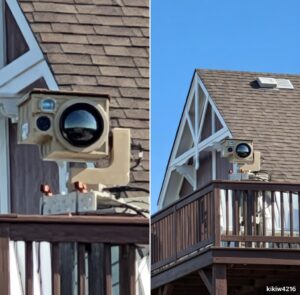
It began, as many unsettling shifts now do, with something deceptively small. Not an explosion, not a siren, not even a formal announcement—just an image. A photograph taken without ceremony, passed from one neighbor to another, accompanied by a simple question: What is that?
The object in the image sat on a second-floor balcony overlooking a row of quiet suburban homes. It did not belong there—not in any conventional sense. Its form was too deliberate, too engineered. Smooth, matte surfaces caught the light in a way that suggested purpose rather than decoration. At its center, a spherical module rested within a reinforced frame, capable—judging by its design—of rotating with precise, controlled motion. Clustered around it were lenses, sensors, or apertures of some kind. Even to the untrained eye, it felt unmistakably technical.
At first, people speculated casually. Maybe it was an experimental camera rig. Perhaps an ambitious hobbyist’s project. A piece of modern art, even. But that interpretation did not hold for long. Someone recognized the design language. Someone else confirmed it with a quick search. Within hours, the tone of the conversation shifted.
This was not art. It was not decorative. It was not benign.
It was a counter-drone turret.
The implications of that realization did not arrive all at once. They unfolded gradually, as neighbors began to process what it meant for such a device to exist—not in a restricted facility or a military perimeter—but here, above backyard fences and garden sheds, overlooking spaces defined by normalcy. Spaces where children played, where families gathered, where routines unfolded without expectation of scrutiny beyond the occasional glance from a nearby window.
Suburban life depends, in ways often unspoken, on a shared illusion of distance—from danger, from conflict, from the kinds of technologies designed for environments far removed from everyday existence. That illusion is fragile, but powerful. It allows people to relax into their surroundings, to trust that what exists beyond their immediate awareness is not actively observing, analyzing, or preparing to respond.
The turret disrupted that illusion instantly.
Even inactive, even silent, it carried a presence that could not be ignored. Its design communicated intention. It was built to detect, to track, to interpret. Its capabilities—high-resolution optical systems, thermal imaging, motion detection, and automated targeting frameworks—were not speculative features. They were standard components of its class. In another context, they would be described as protective, even necessary. In this context, they felt intrusive.
The shift in perception was subtle at first. People lingered a little less in their backyards. Conversations turned inward, held inside rather than out. Curtains that once remained open began to close earlier in the evening. None of these changes were dramatic enough to attract attention on their own. But collectively, they signaled something deeper: behavior was adapting to the possibility of observation.
This is the quiet power of surveillance. It does not require active intervention to shape outcomes. The mere suggestion that one could be watched is often enough.
What made the situation more unsettling was not just the presence of the device, but the absence of context. No explanation had been offered. No notice given. There was no indication of whether the turret was operational, experimental, or purely symbolic. The homeowner who installed it had not addressed neighbors, had not clarified intent, had not engaged in any visible attempt to frame the decision within a shared understanding.
Silence, in this case, carried weight.
In most neighborhoods, boundaries are negotiated informally. Security cameras, motion lights, alarm systems—these are familiar technologies, and while they can occasionally spark debate, their purpose is broadly understood. They operate within a social contract: visible, limited, and generally accepted as defensive rather than assertive.
A counter-drone turret exists outside that contract.
Its presence implies a perception of threat that exceeds the ordinary. It suggests anticipation, preparedness, even escalation. Whether or not that interpretation reflects the installer’s actual intent becomes almost irrelevant. Meaning, once projected into a shared space, is shaped collectively.
Neighbors began asking questions—not just about the device itself, but about what it represented.
Who installs something like this?
What are they expecting to happen?
What do they believe about the world just beyond their balcony?
These questions did not have easy answers, and in their absence, speculation filled the gap.
Some residents attempted to rationalize the situation. Drones, after all, are increasingly common. Concerns about privacy, about unauthorized aerial surveillance, about potential misuse—these are not unfounded. Perhaps the turret was a response to a specific incident. A preventative measure. A personal solution to a perceived vulnerability.
But even this more charitable interpretation raised further issues. If individuals begin adopting advanced countermeasures independently, without coordination or transparency, what prevents a gradual escalation?
Technology rarely remains static. Once introduced into a new environment, it tends to evolve—through iteration, imitation, and normalization.
Today, a passive surveillance turret.
Tomorrow, integrated detection systems.
Soon after, automated responses.
Each step might be justified in isolation. Each might be legal, or at least not explicitly prohibited. But together, they point toward a transformation that is harder to reverse.
The concept of a neighborhood begins to shift under these conditions. It becomes less a shared social space and more a patchwork of individually fortified zones. Trust, once assumed, becomes conditional. Interactions become filtered through an awareness of capability—who can see what, who can record, who can respond.
This is not the result of a single decision, but of cumulative change.
The legal framework surrounding such technologies struggles to keep pace. Regulations often address outcomes rather than presence. A device may be permissible until it is used in a way that clearly violates established rules. By that point, however, the impact may already be felt.
Privacy laws, zoning codes, and aviation regulations intersect in complex ways. A system capable of monitoring beyond property lines occupies a gray area. Enforcement mechanisms exist, but they are typically reactive. They rely on complaints, investigations, and interpretations that can take time to resolve.
For the average resident, navigating this landscape is not straightforward. It requires knowledge, persistence, and often collective action. In the meantime, the burden of adaptation falls unevenly. Those most sensitive to privacy concerns may feel compelled to alter their behavior significantly, while others may remain indifferent or unaware.
This imbalance introduces tension.
Communities function not just through rules, but through shared expectations. When those expectations are disrupted without consultation, the resulting friction can be difficult to manage. Conversations that might otherwise be simple become charged. Intent is questioned. Motives are scrutinized.
And yet, the individual at the center of the situation may see things very differently.
From their perspective, the installation of a counter-drone turret might represent responsibility. Preparedness. A proactive approach to emerging risks. They may view it as an extension of personal rights—the ability to secure one’s property using available tools.
This divergence in perspective is at the heart of the issue.
Security, as a concept, is inherently subjective. What feels like protection to one person may feel like intimidation to another. What seems reasonable in isolation may become problematic in a shared environment.
The challenge lies in reconciling these viewpoints without dismissing either entirely.
It is not inherently unreasonable to want protection from potential threats, including those posed by evolving technologies. Nor is it unreasonable to expect that such protections should not come at the cost of communal trust or individual privacy.
The tension arises when these principles collide without a framework for resolution.
In the absence of clear guidelines, norms become the default mechanism of regulation. But norms are fragile. They depend on mutual adherence. Once broken, they are difficult to restore.
The appearance of the turret represents such a break.
It introduces a new baseline—one in which advanced surveillance and defensive capabilities are no longer confined to specialized contexts. One in which the line between civilian and tactical technology becomes increasingly blurred.
This blurring carries implications beyond the immediate situation.
If such devices become more common, how will communities adapt? Will there be an arms race of sorts, with residents incrementally upgrading their systems in response to one another? Or will there be a push for clearer regulations, driven by a desire to reestablish boundaries?
Neither outcome is guaranteed. Both are plausible.
What is certain is that the conversation cannot be avoided indefinitely.
Moments like this—small, localized, easily dismissed—often serve as early indicators of broader shifts. They reveal possibilities before they become widespread. They expose tensions before they are fully articulated.
The question is not just what will happen next in this particular neighborhood, but what it signals about the trajectory of technology in everyday life.
Tools designed for extreme scenarios have a way of migrating. As they do, they bring with them assumptions about risk, control, and response. When those assumptions are applied to environments that were not built around them, the results can be disorienting.
Home, traditionally, is defined by a sense of safety that does not require constant vigilance. It is a space where defenses are minimal because threats are presumed to be distant. Introducing systems that operate on a different premise—one of continuous monitoring and readiness—alters that definition.
It does not happen all at once. It happens gradually, through acceptance, adaptation, and normalization.
The turret on the balcony is not, in itself, a transformation. It is a signal. A point of friction. A prompt for reflection.
It asks, without speaking:
What kind of environment do we want to live in?
What trade-offs are we willing to accept in the name of security?
And who gets to decide?
These are not purely technical questions. They are social, ethical, and deeply human.
They require dialogue.
Not confrontation, necessarily, but communication. An acknowledgment that individual choices, when made in shared spaces, have collective consequences.
Transparency becomes essential in this context. Not as a constraint, but as a bridge. Explaining intent, outlining capabilities, engaging with concerns—these actions do not eliminate disagreement, but they create the conditions for understanding.
Without them, uncertainty fills the gap. And uncertainty, left unchecked, tends to amplify fear.
The situation also highlights the role of governance—not just formal, but communal. Regulations may eventually catch up, providing clearer boundaries and enforcement mechanisms. But in the interim, communities must navigate these challenges themselves.
This requires a degree of collective engagement that is not always easy to achieve. It involves conversations that may be uncomfortable, perspectives that may conflict, and outcomes that may not satisfy everyone.
Yet avoiding these conversations does not prevent change. It merely allows it to proceed without input.
The risk, in that case, is not just the adoption of new technologies, but the erosion of the processes that give communities a sense of agency over their environment.
Ultimately, the presence of a counter-drone turret in a suburban setting is less about the device itself and more about what it represents.
It is a convergence point—where innovation meets everyday life, where personal choice intersects with collective experience, where the future arrives not with fanfare, but quietly, on a balcony.
Whether that future becomes normalized, resisted, or reshaped depends on what happens next.
Not just in response to this instance, but in recognition of the broader pattern it reveals.
Because once a boundary has been crossed, it rarely returns to its original position unchanged.
And the question that remains—unanswered, but increasingly urgent—is whether that boundary was meant to move at all.