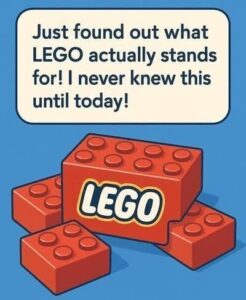
From the moment someone first holds a LEGO brick, there is an almost instinctive understanding of what it offers. The weight in the hand, the precision of its design, and the satisfying click as pieces connect all point to something deeper than entertainment. It is not merely a toy—it is an invitation. An invitation to create, to experiment, and to transform ideas into something tangible.
The name LEGO itself comes from a Danish phrase meaning “play well,” a philosophy that challenges the way play is often perceived. Rather than being separate from learning or productivity, play becomes a meaningful process through which people explore systems, test ideas, and develop confidence. In this sense, LEGO represents a quiet but powerful idea: creativity and intelligence are not separate from play—they are often born within it.
The origins of LEGO reinforce this philosophy. Founded by Ole Kirk Kristiansen during a time of economic hardship, the company was built on resilience, discipline, and a commitment to quality. His guiding principle, “only the best is good enough,” shaped not just the durability of the bricks, but the values embedded in them. LEGO products were designed to last—not just physically, but conceptually—encouraging imagination that could evolve over time rather than fade quickly.
A defining moment in LEGO’s history came with the transition from wooden toys to plastic interlocking bricks. What emerged was more than a product—it was a system. Each brick became part of a modular language, capable of forming endless combinations. Perhaps most remarkably, bricks made decades apart remain compatible. This continuity reflects a powerful idea: new creations do not replace the old—they build upon them. In many ways, this mirrors how human knowledge itself grows—incrementally, cumulatively, and through connection.
As LEGO expanded globally, its influence extended far beyond playrooms. For children, it became a natural tool for learning. Without formal instruction, they begin to understand balance, structure, and cause-and-effect relationships. When a creation collapses, it is not experienced as failure but as feedback. Something didn’t work, and that realization invites adjustment and improvement.
This process closely resembles the Scientific Method—testing ideas, observing outcomes, and refining approaches. Through this cycle, LEGO quietly teaches resilience. There are no penalties, no grades—only opportunities to try again. Children learn that their ideas matter because they can see them take shape in front of them. This builds a sense of agency that extends far beyond play into real-world problem-solving.
LEGO also fosters collaboration. When people build together, they communicate, share perspectives, and negotiate solutions. It becomes a kind of universal language—one that transcends age, culture, and even spoken words. A shared structure can represent a shared vision, built piece by piece through cooperation.
As society evolved, so did LEGO’s role. In educational settings, it became a bridge between abstract thinking and tangible understanding. Mathematical concepts can be visualized through patterns and symmetry. Engineering principles can be explored through trial and error. With the introduction of robotics systems, LEGO entered the realm of programming and logic, helping learners engage with complex ideas in a hands-on way.
For adults, LEGO takes on entirely new meanings. It becomes a form of artistic expression, a creative outlet, and even a source of relaxation. Many adult builders describe the experience as meditative—the repetitive act of assembling pieces providing focus and calm. In a fast-paced, often overwhelming world, this simple act of building offers a rare moment of clarity.
Others use LEGO to push creative boundaries, constructing detailed cityscapes, intricate sculptures, or functional models. These creations blur the line between play and art, demonstrating that creativity does not diminish with age—it evolves.
In therapeutic contexts, LEGO has also proven valuable. It offers a nonverbal way to express thoughts and emotions, particularly for individuals who find verbal communication challenging. By externalizing ideas through building, people can process internal experiences in a safe and structured way. This reinforces a sense of control, creativity, and emotional clarity.
At a deeper level, LEGO represents something philosophical: the power of constraints. Unlike digital environments that offer virtually unlimited possibilities, LEGO operates within a defined system of shapes and connections. Yet these limitations do not hinder creativity—they enhance it. Builders are challenged to think critically, adapt, and find innovative solutions within given boundaries.
This reflects a broader truth about human innovation. Many breakthroughs occur not in the absence of limits, but because of them. Constraints force creativity to become more focused, more resourceful, and often more meaningful. LEGO demonstrates that complexity can emerge from simplicity, and that extraordinary ideas can be built from modest beginnings.
In an increasingly digital world, LEGO’s physical nature becomes even more significant. It reconnects thought with action. It reminds us that ideas gain power when they are made tangible—when they can be tested, adjusted, and shared with others. The tactile experience of building engages both the mind and the senses, creating a deeper connection to the creative process.
Ultimately, LEGO endures because it aligns with something fundamental in human nature. We are builders. We seek to understand the world by assembling it—whether through physical structures, systems of knowledge, or creative expression. LEGO provides a medium for this instinct, one that adapts to each individual’s imagination.
It does not impose a single purpose or narrative. Instead, it offers tools and invites exploration. That is its greatest strength. It affirms that creativity is not rare or exclusive—it is universal, accessible to anyone willing to engage with it.
In a world that often feels complex and fragmented, LEGO offers something simple yet profound: a way to take pieces, connect them, and create something meaningful.