The Hidden Intelligence Inside an Everyday Tool
In daily life, some of the most sophisticated design work goes completely unnoticed. We interact constantly with objects shaped by engineering, testing, and refinement, yet rarely stop to consider why they look or function the way they do. A spoon curves in a particular way to balance comfort and control. A pair of scissors distributes force through a pivot system refined over centuries. Even something as small as a nail clipper carries within it a history of problem-solving and design evolution.
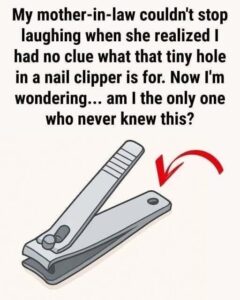
Among its many features, one detail is almost universally ignored: the small circular hole at the end of the nail clipper’s lever. It is so subtle that most users never question its purpose. Yet this modest opening is not decorative or accidental. It is a carefully considered design element that reflects decades of practical engineering, user behavior observation, and manufacturing logic.
Far from being insignificant, this tiny hole reveals how even the simplest objects can embody deep layers of function and intent.
Portability: A Solution to a Universal Problem
One of the most practical purposes of the hole is portability.
Nail clippers are small, lightweight objects—precisely the kind of items that are easily misplaced. Designers addressed this problem in a simple but effective way: they made it possible to attach the clipper to something larger.
The hole allows a split ring, chain, lanyard, or hook to pass through it, transforming the clipper from a standalone object into a secured accessory. This seemingly minor feature solves a very real everyday issue—losing small grooming tools at inconvenient moments.
With this design, a nail clipper can be:
- attached to a keychain
- stored in a travel kit
- clipped inside a toiletry bag
- hung in a bathroom organizer
The result is improved accessibility and reduced loss. Without adding complexity, the design ensures the tool is always within reach when needed.
This is design responding directly to human behavior: people misplace small objects, so the object is designed to be carried more intelligently.
Ergonomics: A Subtle Enhancement in Control
Beyond portability, the hole also offers unexpected ergonomic benefits.
While not its primary purpose, it can provide an alternative grip point. Some users place a finger through the opening or use it as a stabilizing anchor while cutting thicker nails, particularly toenails.
This can help:
- improve control during use
- reduce slippage in wet or small-hand conditions
- increase precision when applying pressure
For users with limited hand strength or reduced dexterity, this small adaptation can make the tool easier to manage. It does not change the fundamental mechanics of the clipper, but it expands how it can be used.
This reflects a key principle of ergonomic design: flexibility without complication.
Historical Origins: From Pocket Tools to Modern Essentials
To understand why this feature exists, it helps to look at its historical context.
In the late 19th and early 20th centuries, personal grooming tools were not stored in bathrooms as they are today. Instead, they were carried as part of everyday personal kits. Items such as pocket knives, grooming scissors, and nail care tools were attached to chains, belts, or travel cases.
Nail clippers were no exception.
The hole allowed them to be connected to:
- watch chains
- grooming sets
- travel accessories
- personal carry systems
In that era, convenience meant mobility. Tools were designed to be carried, not stored.
Even as living spaces modernized and personal care routines shifted indoors, the hole remained. It had already proven its usefulness, and there was no practical reason to remove it.
This is how many enduring design features survive—not because they are essential in every era, but because they continue to serve across changing lifestyles.
Manufacturing Efficiency: Design That Supports Production
The hole also plays a subtle but meaningful role in manufacturing.
During production, small metal components must be:
- aligned accurately
- held securely
- moved efficiently through assembly processes
A hole provides a convenient anchor point for automated systems, allowing consistent positioning during shaping, polishing, or assembly.
While modern manufacturing techniques have evolved significantly, legacy design elements like this often remain because they simplify production workflows. Removing them would offer little benefit while potentially increasing complexity or cost.
In industrial design, simplicity that supports both production and use is highly valuable.
The nail clipper’s hole is a perfect example of this dual-purpose efficiency.
Industrial Design Philosophy: Simplicity That Lasts
At a deeper level, the nail clipper’s hole reflects a broader design philosophy: minimal intervention with maximum utility.
Instead of adding separate mechanisms for portability, grip enhancement, or handling, designers incorporated a single feature that quietly supports multiple functions.
This approach prioritizes:
- efficiency over excess
- longevity over trend
- practicality over decoration
It is a form of design restraint—choosing not to complicate something that already works well.
The result is a product that remains largely unchanged for decades, not because it is outdated, but because it is already optimized for its purpose.
Why the Feature Has Survived So Long
Many product features disappear over time as designs evolve. However, the nail clipper’s hole has remained consistent across generations and manufacturers.
The reason is simple: it continues to provide value without adding cost or complexity.
It:
- does not interfere with primary function
- improves portability
- supports manufacturing
- enhances optional usability
- requires no additional materials or mechanisms
Few design elements achieve this balance. When a feature is this efficient, there is little incentive to remove it.
The Overlooked Intelligence of Everyday Objects
The nail clipper is not unique in containing hidden design logic. Many everyday objects carry similar layers of intention that go unnoticed:
- the ridges on bottle caps improve grip
- the shape of handles reduces fatigue
- the curvature of utensils improves usability
These details are invisible because they work so well. Good design often disappears into the background of experience.
The hole in a nail clipper is part of this tradition of invisible engineering. It does not demand attention. It simply works.
A Small Detail With a Larger Meaning
What makes this feature remarkable is not its size, but its persistence and purpose.
A tiny hole—unchanged for generations—continues to support portability, usability, and manufacturing efficiency all at once. It connects modern users to historical habits of carry and mobility while still serving contemporary needs.
In a world where products are often redesigned for novelty, the nail clipper stands as a reminder that true innovation is not always about adding complexity. Sometimes it is about refining simplicity until nothing essential can be removed.
The next time someone uses a nail clipper, the small hole at its end may still go unnoticed. But it is there—quiet, deliberate, and enduring.
A reminder that even the smallest objects can carry decades of thoughtful engineering, hidden in plain sight.