The moment the laughter left Linda’s lips, it felt like something in the room cracked.
It wasn’t just loud—it was sharp, deliberate, and out of place in a ballroom filled with white flowers, soft candlelight, and the gentle hum of a string quartet. My brother Jacob’s wedding was supposed to be the kind of day people remember for joy. Instead, it became the day our family’s long-buried fractures finally surfaced.
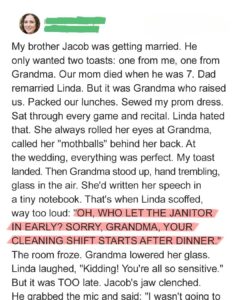
Grandma Ruth stood at the center of it all, holding her glass with steady hands as she gave her toast. She wasn’t flashy or dramatic. She never was. Her lavender dress was simple, her voice calm but warm, carrying decades of quiet sacrifice in every word she spoke.
She talked about love not as a feeling, but as a choice made daily in small, invisible acts—packing lunches at dawn, working double shifts as a nurse, showing up to every school event even when she was exhausted. People listened. Some nodded. A few dabbed their eyes.
And then Linda laughed.
It wasn’t polite or nervous. It was mocking.
“Some people just can’t let go of the past,” she said under her breath, but the microphone caught enough of it that half the room heard.
The silence that followed was immediate and suffocating.
Grandma paused mid-sentence. Her eyes flickered—not with anger, but with something quieter. Hurt. The kind that doesn’t make noise but changes everything inside you.
I felt my stomach drop. I looked at Jacob. His jaw tightened.
Linda, dressed in an expensive, glittering gown that clashed with the tone of the room, leaned back as if satisfied with herself. She had always had a way of inserting herself into moments that didn’t belong to her, of demanding attention even when it wasn’t hers to take.
But this time, she miscalculated.
Jacob stood up slowly.
At first, I thought he might defuse things politely. Smile. Redirect. Keep the peace like we always had.
Instead, he walked to the microphone.
The room shifted.
He looked at Grandma first. Not Linda. Not the guests. Just her.
“I wasn’t going to say anything tonight,” he began, his voice steady but heavy. “But I can’t sit here and watch the most important person in my life be disrespected.”
Linda shifted in her seat.
Jacob continued, “That woman you just mocked didn’t just raise me and my sister. She rebuilt us from nothing after our mother died. She worked herself to exhaustion so we wouldn’t feel like orphans. She gave up everything—her comfort, her time, her dreams—so we could have a future.”
His voice cracked slightly, but he didn’t stop.
“And you don’t get to erase that because you don’t understand what real sacrifice looks like.”
The room was frozen.
Even the music had stopped.
Jacob finally turned toward Linda.
“You weren’t asked to speak today because this day isn’t about status or appearances. It’s about love. Real love. And respect. And you just showed everyone what happens when those things aren’t in you.”
A wave of murmurs spread through the guests.
Then applause started. Slow at first. Then louder. Standing. Sustained. Overwhelming.
Linda’s face drained of color.
Grandma Ruth, however, didn’t react with triumph. She simply placed a hand over Jacob’s arm when he returned to her side.
“I love you,” she whispered.
Then she continued her toast, voice trembling only slightly.
“May your love always be louder than cruelty,” she said, looking briefly toward Linda, “and may you never forget who stood beside you when you had nothing.”
That was the moment Linda stood up and left.
No dramatic exit. No words. Just silence where she used to be.
But the damage—and the healing—had already begun.
The wedding reception continued, but something fundamental had changed. It was as if a curtain had been pulled back.
People who had spent years quietly observing Linda’s behavior—her cutting remarks, her subtle exclusions, her need to dominate every room—no longer felt obligated to stay silent.
And for the first time, neither did we.
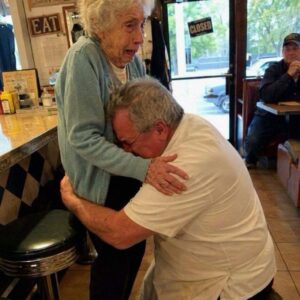
That night, Jacob danced with Grandma instead of following tradition. It wasn’t planned, but it felt inevitable. Guests surrounded them, many crying openly now, as if a shared truth had finally been acknowledged.
Grandma looked small in that moment, but not weak. Never weak. She had the kind of strength that doesn’t announce itself—it simply endures.
In the weeks that followed, the wedding became something like a turning point no one could ignore.
My father tried first to minimize it.
“It was just emotions running high,” he said. “Weddings do that.”
But Jacob didn’t accept that. Neither did I.
We called a family meeting.
Linda arrived late, dressed carefully, as if appearance could reset reality. She tried to smile before she even sat down.
“I think this has been blown out of proportion,” she began. “People misunderstood what I said.”
No one responded.
So she continued.
“I was just joking. Honestly, Ruth is too sensitive—”
That was when Jacob cut in.
“No,” he said firmly. “You don’t get to rewrite it.”
The room went still again, but this time it wasn’t shock. It was clarity.
Relatives began speaking. One by one. Hesitantly at first, then more openly.
Moments Linda had dismissed as “miscommunication” were revealed as patterns. Small humiliations. Exclusions. Comments designed to undermine rather than connect.
My father sat in silence, his face tightening with every new memory voiced aloud.
Finally, he spoke.
“I saw it,” he admitted quietly. “I just didn’t want to deal with it.”
That confession carried more weight than anything else said in that room.
Linda’s composure cracked slightly.
“You’re all turning on me over one mistake,” she said sharply.
But it wasn’t one mistake.
And she knew it.
Grandma, when asked to speak, surprised everyone.
“I don’t want punishment,” she said gently. “I want peace. But peace requires distance when respect is missing.”
No anger. No vengeance. Just boundaries.
That was harder for Linda to accept than confrontation would have been.
Over the following months, the family reshaped itself in quiet but irreversible ways.
My father eventually moved into counseling. It wasn’t immediate or clean, but it was real. He began acknowledging how long he had mistaken silence for peace.
Linda, meanwhile, struggled with isolation. Her attempts to regain control—apologies that felt rehearsed, gifts that felt transactional—fell flat. People had already begun to see the pattern.
Grandma, on the other hand, became the center of something new.
Sunday dinners returned. This time, they were at Jacob and Emily’s home. Laughter replaced tension. Recipes were shared. Stories were told.
For the first time in years, it felt like family wasn’t something we were performing—it was something we were living.
The divorce, when it came, wasn’t dramatic in its finality. It was quiet. Exhausted. Inevitable.
Linda left with what she had built on appearance rather than connection. There was no audience left to perform for.
And in that absence, the rest of us began to heal in ways we didn’t expect.
A year later, Jacob and Emily had a daughter.
They named her Ruth.
When Grandma held her for the first time, she didn’t speak right away. She just cried softly, the kind of tears that come from release rather than pain.
“I didn’t think I’d live to see this kind of love,” she finally said.
Looking back, it’s strange how one moment can redefine an entire family history.
What began as cruelty in a ballroom didn’t end in destruction. It ended in clarity.
We learned who had been carrying the weight all along.
We learned who had been pretending.
And most importantly, we learned that silence protects no one forever.
Linda’s laughter was meant to diminish someone.
Instead, it revealed everything.
And in its aftermath, what remained wasn’t humiliation alone—it was truth.
Hard, uncomfortable, necessary truth.
And from that truth, our family finally began to heal.